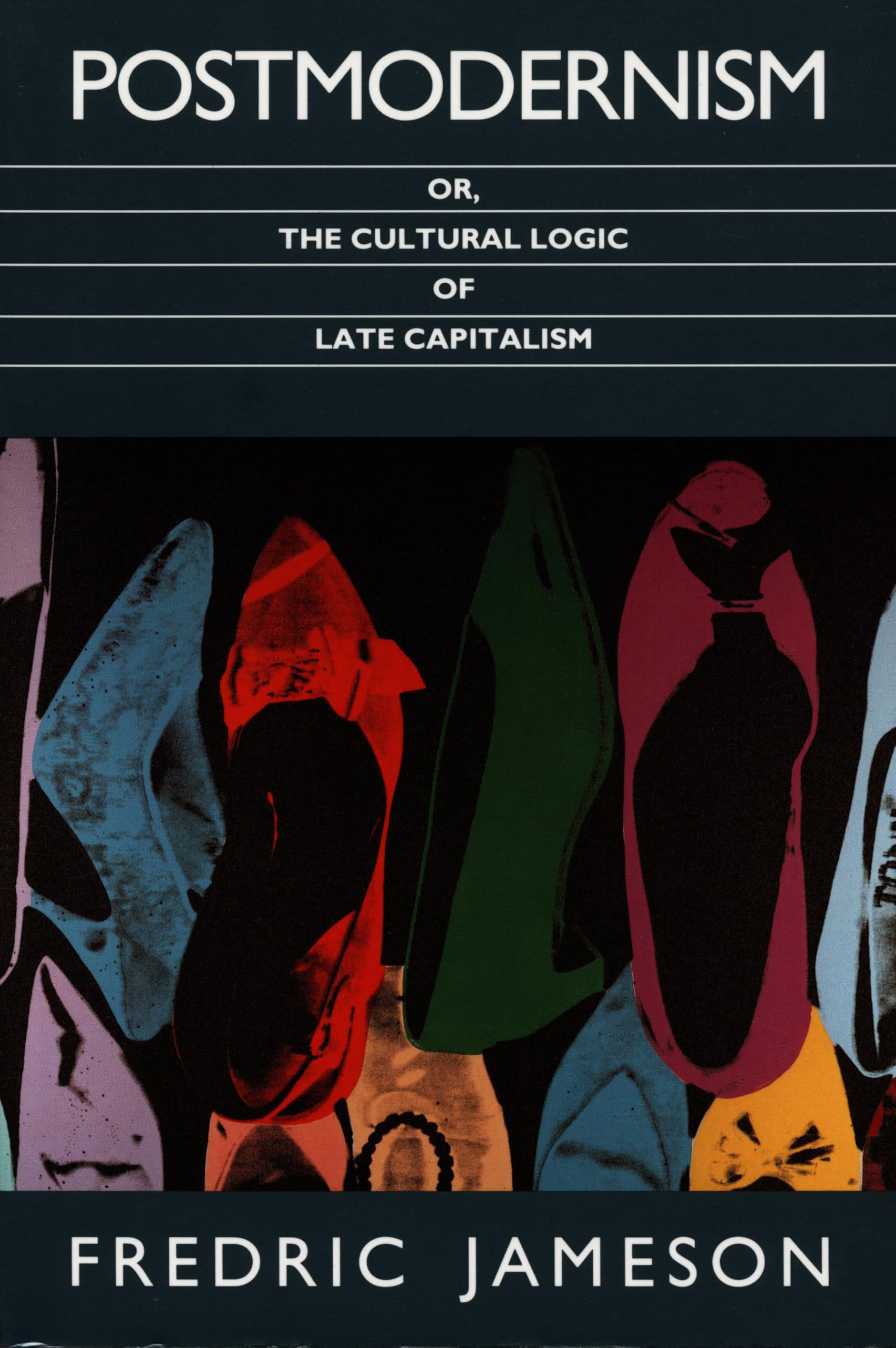
Postmodernism, or, The Cultural Logic of Late Capitalism (Post-Contemporary Interventions)
$26.82
by Fredric Jameson



Now in paperback, Fredric Jameson's most wide-ranging work seeks to crystalize a definition of "postmodernism". Jameson's inquiry looks at the postmodern across a wide landscape, from "high" art to "low" from market ideology to architecture, from painting to "punk" film, from video art to literature. "Fredric Jameson, internationally recognized as a literary theorist and as America's most notable Marxist intellectual, has established a leading place in discussions of postmodernism. Jameson brings to the subject an immense range of reference both to artworks and to theoretical discussions; a strong hypothesis linking cultural changes to changes in the place of culture within the whole structure of life produced by a new phase of economic history (multinational capitalism); and a severely scholarly wish to analyze and understand, rather than praise or blame, the object of his study."-Jonathan Arac "A classic of late 20th-century Euroamerican critical thought."? Ned Lukacher , Choice "An encyclopedic grasp of modern culture."? Stuart Hall , Marxism Today "For anybody hoping to understand not just the cultural but the political and social implications of postmodernism . . . Jameson's book is a fundamental, nonpareil text."? Gilbert Adair , Sunday Times (London) "Fredric Jameson is America's leading Marxist critic, a prodigiously energetic thinker whose writings sweep magisterially from Sophocles to science fiction. . . . Postmodernism is an intellectual blockbuster."? Terry Eagleton , Irish Times "No one theorist illustrates the recent history of postmodernism's history so well as Fredric Jameson."? Michael Bérubé , Voice Literary Supplement "The scope and profundity of Postmodernism , covering theory, architecture, film, video, and economics, is truly staggering. . . . Brilliant . . ."? Siauddin Sardar , The Independent "Fredric Jameson, internationally recognized as a literary theorist and as America's most notable Marxist intellectual, has established a leading place in discussions of postmodernism. Jameson brings to the subject an immense range of reference both to artworks and to theoretical discussions; a strong hypothesis linking cultural changes to changes in the place of culture within the whole structure of life produced by a new phase of economic history (multinational capitalism); and a severely scholarly wish to analyze and understand, rather than praise or blame, the object of his study."--Jonathan Arac Fredric Jameson is Professor and Chair of the Literature Program at Duke University. He is the coeditor, with Masao Miyoshi, of The Cultures of Globalization , also published by Duke University Press. Postmodernism, or, the Cultural Logic of Late Capitalism By Fredric Jameson Duke University Press Copyright © 1991 Duke University Press All rights reserved. ISBN: 978-0-8223-1090-7 Contents Introduction, 1 The Cultural Logic of Late Capitalism, 2 Theories of the Postmodern, 3 Surrealism without the Unconscious, 4 Spatial Equivalents in the World System, 5 Reading and the Division of Labor, 6 Utopianism after the End of Utopia, 7 Immanence and Nominalism in Postmodern Theoretical Discourse, 8 Postmodernism and the Market, 9 Nostalgia for the Present, 10 Secondary Elaborations, Notes, Index, Illustration Credits, The Author, CHAPTER 1 The Cultural Logic of Late Capitalism The last few years have been marked by an inverted millenarianism in which premonitions of the future, catastrophic or redemptive, have been replaced by senses of the end of this or that (the end of ideology, art, or social class; the "crisis" of Leninism, social democracy, or the welfare state, etc., etc.); taken together, all of these perhaps constitute what is increasingly called postmodernism. The case for its existence depends on the hypothesis of some radical break or coupure, generally traced back to the end of the 1950s or the early 1960s. As the word itself suggests, this break is most often related to notions of the waning or extinction of the hundred-year-old modern movement (or to its ideological or aesthetic repudiation). Thus abstract expressionism in painting, existentialism in philosophy, the final forms of representation in the novel, the films of the great auteurs, or the modernist school of poetry (as institutionalized and canonized in the works of Wallace Stevens) all are now seen as the final, extraordinary flowering of a high-modernist impulse which is spent and exhausted with them. The enumeration of what follows, then, at once becomes empirical, chaotic, and heterogeneous: Andy Warhol and pop art, but also photorealism, and beyond it, the "new expressionism"; the moment, in music, of John Cage, but also the synthesis of classical and "popular" styles found in composers like Phil Glass and Terry Riley, and also punk and new wave rock (the Beatles and the Stones now standing as the high-modernist moment of that more recent and rapidly evolv