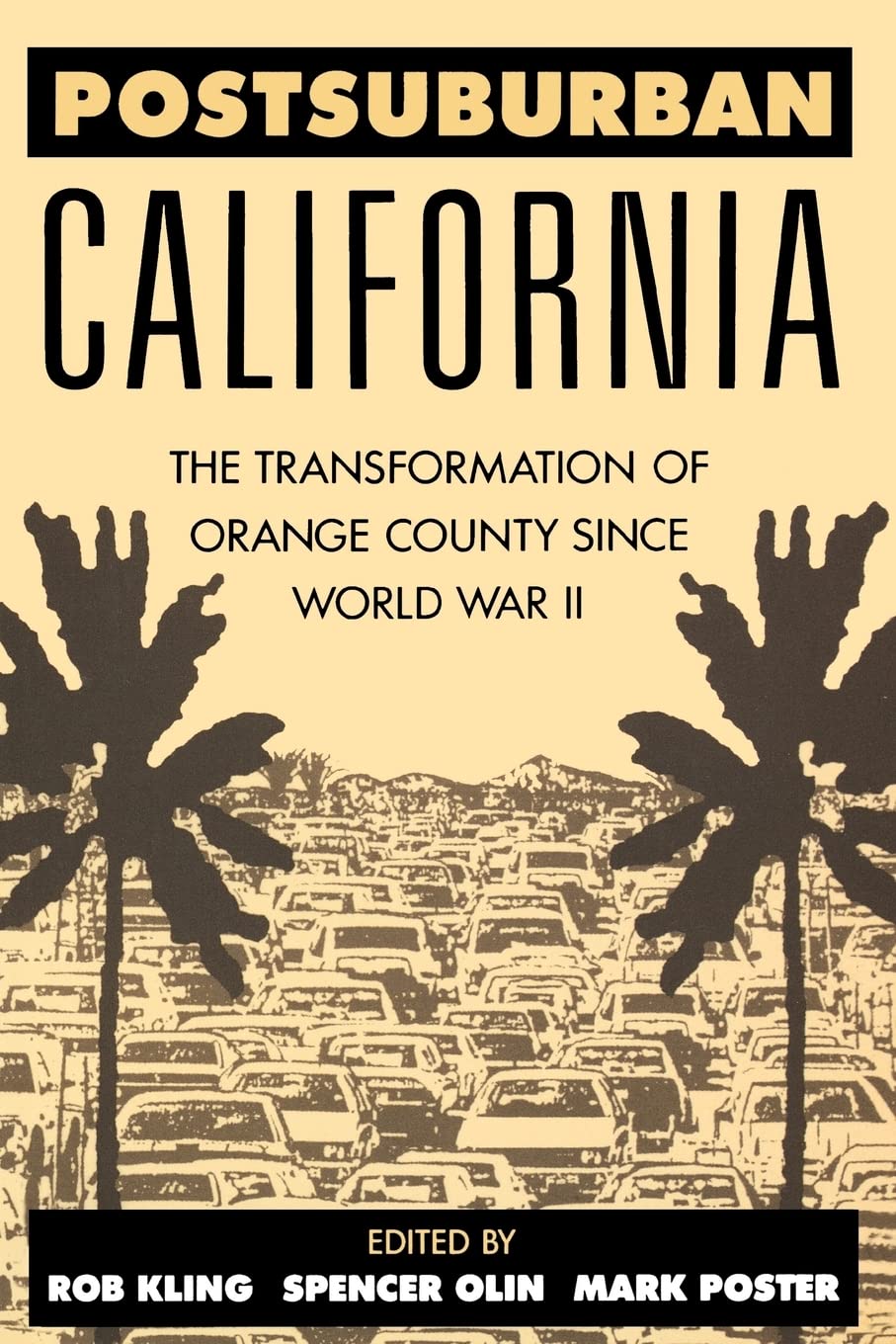



Neither a city nor a traditional suburb, Orange County, California represents a striking example of a new kind of social formation. This multidisciplinary volume offers a cogent case study of the "postsuburban" phenomenon. "A timely and important addition to the growing literature on regional development, as well as to California history."--Craig Hendricks, "Journal of American History Neither a city nor a traditional suburb, Orange County, California, represents a striking example of a new kind of social formation. This multidisciplinary volume offers a cogent case study of the 'post-suburban' phenomenon. The paperback edition is updated with a new preface. Rob Kling is Professor in the Program in Information and Computer Science, the Graduate School of Management, and the Public Policy Research Organization at the University of California, Irvine. Spencer Olin is Professor of History and Mark Poster is Professor of History, both at the University of California, Irvine. Postsuburban California: The Transformation of Orange County since World War II By Rob Kling, Spencer Olin, and Mark Poster University of California Press Copyright 1995 Rob Kling, Spencer Olin, and Mark Poster All right reserved. ISBN: 0520201604 One The Emergence of Postsuburbia: An Introduction Rob Kling, Spencer Olin, and Mark Poster The Growth of Orange County On March 8, 1889, the California Senate voted to carve a new political entity out of the southern portion of Los Angeles County. Two months later the voters of this proposed County of Orange overwhelmingly approved its formation. At that time the editorial writer of the Los Angeles Express, a leading newspaper of the day, proclaimed: "Wayward sister, depart in peace." Now, a century later, that wayward sister, Orange County, has matured into an increasingly important component of a larger southern California region comprising Los Angeles, Ventura, San Bernardino, Riverside, and Orange counties. For several decades this region has been one of the major industrial metropolises in the world,1 Within it Orange County has developed its own powerful subregional economy, which exceeded $60 billion in 1989 (compared with $13.5 billion in 1975), making it the nation's tenth largest county economy. That economy has not only surpassed the neighboring state of Arizona's but now ranks among the top thirty in the world, along with the economies of Argentina, Austria, Denmark, and Egypt. After World War II Orange County evolved from a rural county into an industrial region and bedroom adjunct to Los Angeles and finally into a complex metropolitan region, consisting of twenty-eight separate municipalities, with its own economy and cultural life.2 In 1940 Orange County's population was less than onetenth that of Los Angeles, which had about 1.5 million people. World War II accelerated Los Angeles's growth. It became a major aircraft manufacturing center with firms like Douglas Aircraft and Lockheed. And it became a major military center to help protect the West Coast and to transport troops to the Pacific war theaters.3 Los Angeles's postwar economy also mushroomed around the wartime defense firms; and many soldiers and sailors were drawn to the region after experiencing the temperate winters, seductive sandy beaches, and majestic nearby mountain ranges, which tower to ten thousand feet. Long Beach, a city south of Los Angeles, was jokingly called "Iowa's seaport" in recognition of a major migration from the Midwest to southern California. Starting in the 1950s, as Los Angeles grew and its open space became scarce and expensive, some residents and major aircraft firms sought cheaper land to the south in Orange County. Orange County's postwar population has multiplied ten times, from two hundred thousand in 1950 to more than two million by 1987. Commercial firms that owned massive parcels of land developed whole planned communities in Irvine, Laguna Niguel, and Mission Viejo. Their utopian images of a trouble-free, healthy life for families included modern housing, rural open space, high-quality schools, superb amenities, and a temperate climate that permitted an easy-going outdoor life year-round. This utopian promise was a powerful magnet, drawing many people to Orange County communities (not just the new towns), even though those communities better fit the pastoral ideals of the British garden-city movement of the late nineteenth century than the advertised utopia.4 Orange County's immigrants included people who had previously lived and worked in Los Angeles and who were seeking more space and less expensive housing, as well as people from elsewhere in the nation who were drawn to the county's mix of temperate climate and open space. Since the arrival in the 1970s and 1980s of nonaerospace firms that operate intern