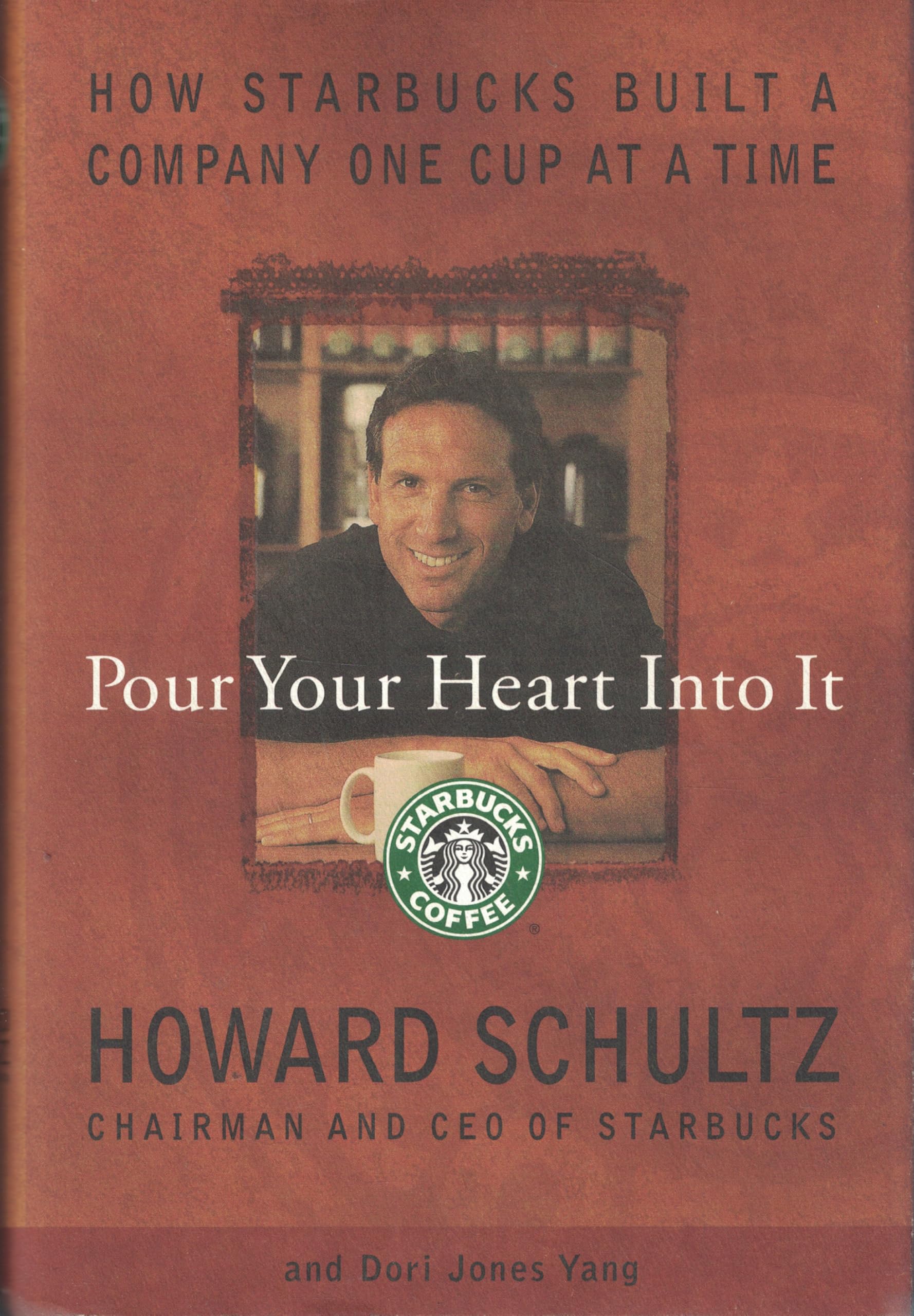
Pour Your Heart Into It: How Starbucks Built a Company One Cup at a Time
$18.49
by Howard Schultz



The success of Starbucks Coffee Company is one of the most amazing business stories in decades. What started as a single store on Seattle’s waterfront has grown into a company with over sixteen hundred stores worldwide and a new one opening every single business day. Just as remarkable as this incredible growth is the fact that Starbucks has managed to maintain its renowned commitment to product excellence and employee satisfaction. In Pour Your Heart Into It , CEO Howard Schultz illustrates the principles that have shaped the Starbucks phenomenon, sharing the wisdom he has gained from his quest to make great coffee part of the American experience. Marketers, managers, and aspiring entrepreneurs will discover how to turn passion into profit in this definitive chronicle of the company that “has changed everything . . . from our tastes to our language to the face of Main Street.” ( Fortune ) Since 1987, Starbucks's star has been on the rise, growing from 11 Seattle, WA-based stores to more than 1,000 worldwide. Its goals grew, too, from the more modest, albeit fundamental one of offering high-quality coffee beans roasted to perfection to, more recently, opening a new store somewhere every day. An exemplary success story, Starbucks is identified with innovative marketing strategies, employee-ownership programs, and a product that's become a subculture. Whether you're an entrepreneur, a manager, a marketer, or a curious Starbucks loyalist, Pour Your Heart into It will let you in on the revolutionary Starbucks venture. CEO Howard Schultz recounts the company's rise in 24 chapters, each of which illustrates such core values as "Winning at the expense of employees is not victory at all." Schultz, chairman and CEO of Starbucks, and writer-researcher Yang trace the growth and development of Starbucks from a single store in Seattle, which in 1973 sold only dark-roasted coffee beans, to the international business it has become today. Schultz does not conceal his passion for good coffee or for his company. His initial goals were to introduce Americans to really fine coffee, provide people with a "third place" to gather, and treat his employees with dignity. The extent to which he succeeded and the obstacles encountered along the way are the subjects he tackles here. This is not, in the strictest sense, a how-to book despite its considerable detail but more a motivational title. Recommended for large public libraries.?Joseph C. Toschik, Half Moon Bay P.L., Cal. Copyright 1997 Reed Business Information, Inc. A chatty history of Starbucks by its CEO, who announces that he considers the company to be only in its third chapter (which is nowhere near the eleventh). Schultz first heard of Starbucks in 1981 when he sold to the fledgling business a number of expensive coffeemakers, and he fell in love with the company immediately. He calls the meeting bashert (Yiddish for destiny), and while the Seattle-based group may have had another word for it, Brooklyn-bred Schultz does seem particularly suited to Starbucks. He repeatedly swoons over the coffee and details at length the process that turns a small green bean into a dark brown drink in a green cup. His enthusiasm for his product is palpable when he writes of ``the romance of the coffee experience'' at Starbucks, though his tips about how to run a company are less valuable. Schultz does offer some useful war stories--especially his dinner with the Seattle partners, who found him ``too New York''--and his idea of putting even part-time workers on the company's health-care plan is both admirable and cost-effective, saving money on employee turnover. Schultz, who bought the company for under $4 million, should have more specific points to convey about how he made Starbucks worth over $270 million in a half a decade. And much of the Starbucks story is overly familiar, while elsewhere, the narrative would be better served if the events were discussed chronologically: It's jarring to jump from the 1996 success of Frappuccinos and ice cream to the devastating Brazilian frost of 1994. Though this is unsatisfying as a skim-milk latte in places, Schultz is less a braggart and more a true believer than many CEOs, and (with Business Week staffer Yang) he provides a pleasing read. -- Copyright ©1997, Kirkus Associates, LP. All rights reserved. ... several moments--Schultz scoffing at the idea of Frappuccinos ... striding into a beverage pow-wow, demanding "What is going on with the eggnog latte?"--turn out richer than a cup of Kona. -- Entertainment Weekly Since 1987, Starbucks's star has been on the rise, growing from 11 Seattle, WA-based stores to more than 1,000 worldwide. Its goals grew, too, from the more modest, albeit fundamental one of offering high-quality coffee beans roasted to perfection to, more recently, opening a new store somewhere every day. An exemplary success story, Starbucks is identified with innovative marketing strategies, employee-ownership programs, and