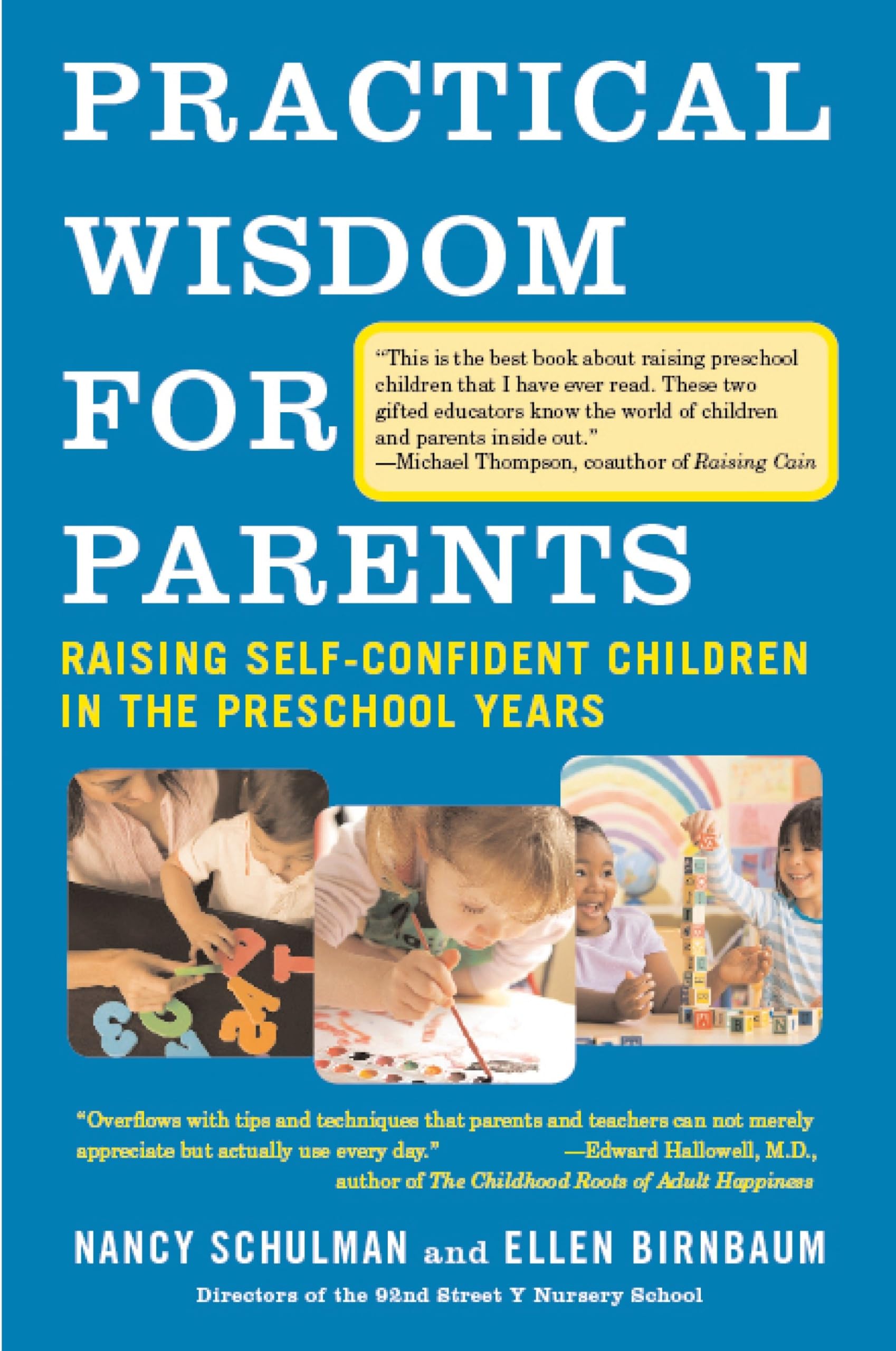
Practical Wisdom for Parents: Raising Self-Confident Children in the Preschool Years
$12.75
by Nancy Schulman



This reassuring guide to navigating nursery school life-both at home and in the classroom-is the most comprehensive book on the subject. Nancy Schulman and Ellen Birnbaum draw on their decades of experience at the 92nd Street Y Nursery School to respond to parents' hunger for practical information on a wide range of topics, including: • What to look for in a preschool • Strategies for separation, discipline, toilet training, and bedtime • The best toys, books, and activities at every stage • How to stimulate your children without overscheduling them • Ways to talk about difficult topics like divorce, illness, or death • How to support your child's social and intellectual development Schulman and Birnbaum have devoted their lives to listening to and understanding young children, and the advice they offer is as warm and humorous as it is comforting and wise. “[Parents] will find comfort here. . . .These authors are keen observers of kids and know what makes toddlers tick.” — Bookpage “A warm and commonsensical guide to this period of rapid growth. The authors have years of experience . . . and it shows.” — Newsday “We've long benefited from the calming wit and considerable wisdom of Nancy Schulman and Ellen Birnbaum. . . . Do yourself, your family, and your child a favor: read this book.” —Tracy Pollan and Michael J. Fox Nancy Schulman has been the director of the 92nd Street Y Nursery School since 1990. She is also on the board of the Independent School Admissions Association of Greater New York, the Syracuse University School of Education Advisory Board, and the NYU Child Study Center Educational Advisory Board. Ellen Birnbaum has been at the 92nd Street Y Nursery School since 1981, first as a teacher, for ten years as camp director, and as the associate director since 1997. Chapter One: Choosing an Early Childhood Program From the moment your child began to walk or even before that time, you’ve probably been hearing playground chatter from parents about preschools in your area. If you’re coming to this experience for the first time, it can feel as if you’re being introduced to a whole new language: “sibling places,” “traditional versus progressive approaches,” “cutoff dates,” “competition for places,” “applications,” and perhaps most perplexing of all, “child interviews.” It’s guaranteed that everyone you meet will have an opinion on this subject, usually based on something that they’ve heard from someone else. But even if other parents seem well informed, it’s likely that they’re feeling just as confused. As a new parent, you probably have very little knowledge about preschool, and it’s only natural to ask questions: What exactly do you need to know about a school before considering sending your child there? How do schools differ? What are their educational philosophies and what do they mean? How do you identify a quality program?It wasn’t always this complicated. When we were growing up during the 1950s, it was rare for children to attend nursery school. In those days, many mothers (ours included) were stay-at-home moms, and, as a result, there simply wasn’t the need or desire to send children to school at very young ages. In general, childhood was a much less hurried affair, without the pressure to “get ahead” that we’ve come to associate with modern family life. The assumption was that five years old was the appropriate age for children to have a first school experience and kindergarten would provide children with the skills they needed to transition from home to school.By the time Ellen’s eldest child, Alice, was nearing the age of three in the late 1970s, however, the situation had already begun to change. By then, it was much more common for families to send their children to school before kindergarten, beginning at age three. This shift had occurred for a number of reasons. Many more mothers were working outside the home, and parents wanted to know that their children would be spending time in a stimulating, sociable environment rather than staying at home all day with the babysitter. Research into children’s early brain development revealed the potential that exists for learning during the first five years of life, and parents felt they should capitalize on this if they wanted their children to develop to their full potential. Although a nursery school movement had been in existence since the early 1900s, by the late 1970s, many more early childhood programs were springing up, especially in urban areas. For Ellen, the process of enrolling Alice in school was remarkably easy: She looked around the neighborhood, identified a program that she liked, and had an informal meeting with the director. After a brief chat, the director asked Ellen if she wanted to enroll Alice for the mornings or the afternoons. It was as simple as that—no applications, school tours, or interviews needed.Four years later, when Nancy’s eldest child, Michael, was nearing the age of two, the situation had already begun to