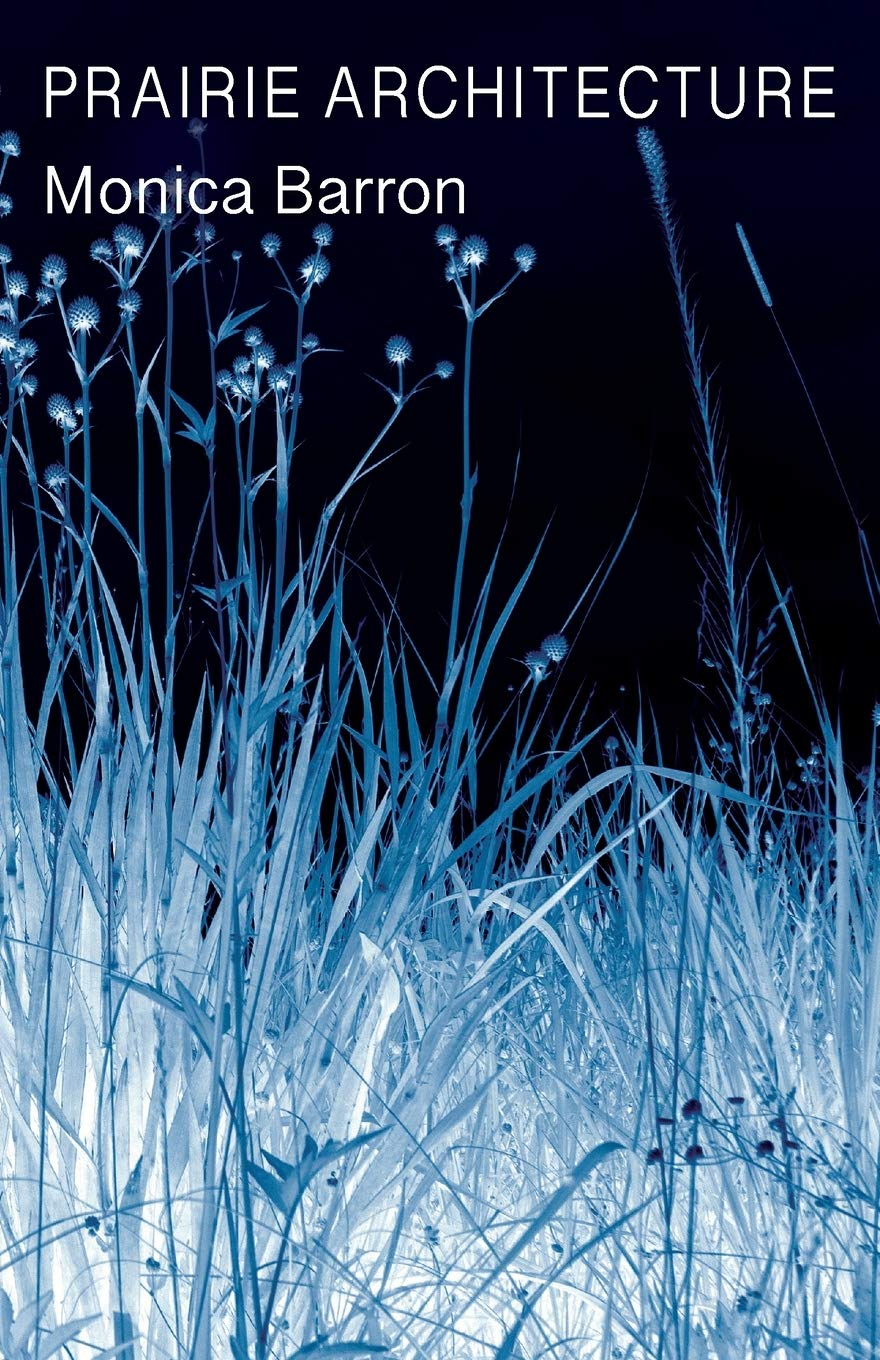



"Architecture doesn't just apply to buildings. It can apply to the way we shape our environment and the habitats of other creatures," says Monica Barron. "There's also an architecture to our emotional/intellectual makeups." Deeply aware of how humans read their surroundings, and how these readings become the bones of a culture, Barron takes us from pond to prairie, from beauty salon to abandoned gas station, from fireside loving to winter ice. Often meditative, often whimsical, the songs, sonnets, and postcard poems in Prairie Architecture cluster naturally around ideas or images, though Barron rejects the rigidity of sections with titles. "I've focused on sequencing poems that might help reveal the bones of the body of the book," she says. Thus, we see how environment shapes perspective in "Why We Need Ponds," ("to break the monotony of crops," for example, and "to teach us patience/ when the water we prepared for doesn't come." We see environment shaping perspective again two poems later, in "Kansas makes her think about." In this small and precise poem "banks of wild, cream-colored iris/ mark where a house used to be," and we sense past and present blend in beauty. And just a few poems later, in a set of seven linked sonnets titled "Meditation from West of the River," we watch the poet remembering how "a heart/could hold heat like sand after a sunset," and again, how "a steady heart can hold heat across/ two states. Mine did. Light and color/ sustained me." This seemingly simple means of sustenance gets immediately complicated as Barron names the colors: "the silver of frost on rotting soybeans" and the red of "a carcass left to the dogs as the sun bled/ the afternoon away." The linked poems here together convey a long and rich love in which closeness and distance play their parts, and in which "whatever it is that connects the heart and mind/ it's at the mercy of memory." In the words of Jamie D'Agostino, describing the half-dozen "postcard poems" scattered through the book, "Barron's the perfect poet to write these: armed with the photographer's eye, the traveler's restlessness, and the poet's imagined scrawl on the back of the card, she's out there, missing us, taking in the world she wants to share." Prairie Architecture gives body to the wide expanses of the human heart by quickly, lightly touching the tiny nerves and arteries which feed it--whether they are heated by a funereal bonfire ("Fare Well") or warmed like butternut squash simmering in wine ("Sometimes your only muse is The Minimalist") or as empty as Audrey's Place after the owner shot her husband in the abandoned kitchen ("Hunting Song.") The medieval concept of microcosm/macrocosm finds a natural place here as word-become-image grows into rich, dense, sweet, sharp metaphor, and human concerns find their place in the midst of it all. As Lori Desrosiers concludes, "we will always remember grandmother's signs of rain, and find beauty in this exquisite journey of a book." --Jamie D'Agostino, author of Nude With Anything ; Slur Oeuvre; Weathermanic ; and This Much "The news was in the black glyphs on the supple birches' trunks," our poet notes in one typical moment of vision so sharp it's serrated. For Barron, all of it's news, all of it's breaking, and her dispatches from the field provide us blanket coverage. The prairie, the meadow, great lakes, rivers, Sonora, Canada, Cuba, you name it, these poems have worked that terrain, patiently undertaking the work of the imagination. And of memory--or as one astonishing poem sings its final wisdom: "I know: we lose some, / we lose some." This is a book that tallies its losses and its love of the world with equal force. One of many designs out of the mind of this architect is a series of imagined postcards that inhabit one place but reach back to another, so each poem's a bridge closing distances--sometimes great, sometimes between neighbors, or between here and the kitchen. Barron's the perfect poet to write these: armed with the photographer's eye, the traveller's restlessness, and the poet's imagined scrawl on the back of the card. She's out there, missing us, taking in the world she wants to share. I just love these poems. --Lori Desrosiers, author of The Philosopher's Daughter , Sometimes I Hear the Clock Speak and Keeping Planes in the Air (Salmon Poetry) In Monica Barron's book of poetry, Prairie Architecture , there is a river that sends you back to where you came from. There are bridges, postcard poems about many places, and a series of linked sonnets. There is a tribute to Alice Neel, a poem about why we need ponds, a commentary on a father's death and another on hunters. I particularly enjoyed the poems that felt more personal, like "Polar Vortex", "Lana Turner All Day" and "Midsummer Songs," which concludes with this stanza: I would have guessed tonight would be clear: clouds the color of rhubarb, clean wind crossing the meadow. But wind