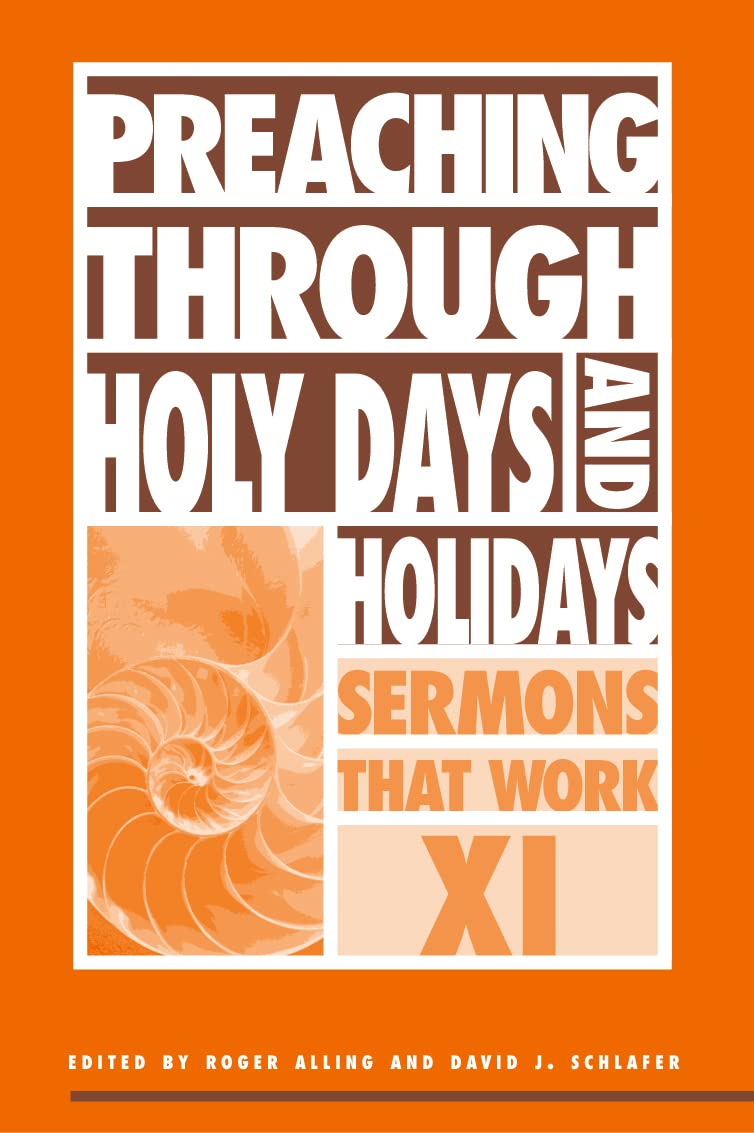
Preaching Through Holy Days and Holidays: Sermons That Work series XI
$21.16
by David J. Schlafer



Preaching Through Holy Days and Holidays is the eleventh in a series of books devoted to presenting examples of preaching excellence from parishes in the Episcopal Church. These sermons, collected from clergy around the country, focus on preaching the Holy Days and Holidays of the church and secular calendar. Contents include sermons for: The High Holy Days (Christmas Eve, Ash Wednesday, Maundy Thursday, Easter Evening, and Pentecost) - major festivals (The Presentation of Our Lord, Ascension Day, The Transfiguration of Our Lord, All Saints' Day) - Feasts of various saints - Celebrations of ministerial vocation (The Baptism of Our Lord, The Nativity of John the Baptist, the ordination of a bishop, the renewal of ordination vows) - Civic holidays (Mother's Day, Memorial Day, Fourth of July, Thanksgiving) and more. David J. Schlafer is a noted homiletician and speaker and co-author of the Morehouse series Sermons That Work. He lives in Bethesda, Maryland. Roger Alling is president of the Episcopal Preaching Foundation and director of the Foundation's Preaching Excellence Program. Co-editor of the Sermons that Work series, he lives in Camp Hill, Pennsylvania. PREACHING THROUGH HOLY DAYS AND HOLIDAYS By ROGER ALLING, DAVID J. SCHLAFER Church Publishing Incorporated Copyright © 2003 Roger Alling and David J. Schlafer All rights reserved. ISBN: 978-0-8192-1892-6 Contents INTRODUCTION Speaking Grace Through Special Occasions1 High Holy Days2 Major Festivals3 Feasts of the Saints4 Celebrations of Ministerial Vocation5 Civil Holidays6 Social Crisis7 Preaching Paul8 Preaching as Performing9 Preaching toward Collegial Excellence CHAPTER 1 High Holy Days CHRISTMAS EVE Christmas Trees Luke 2:1–20Emily J. Schnabl IF YOU HAD ASKED me last week what comes to mind when I think of Christmastrees, three images would have popped into my head. The first would be puttingup the family Christmas tree. Dragged by my father down slippery Chicagosidewalks to our apartment, then set up by the three of us—all having strong(and different) opinions about which way it was leaning, which was its bestside—all of us sticky and scratched by the time it was finally in place. Withits treasured ornaments and rituals, that annual tree reminds me of sharedfamily moments. Then there is the fantasy tree—the one children got to eat breakfast under inMarshall Field's Walnut Room. It stretched for eight floors in the departmentstore courtyard. You could gaze at the top while waiting for Santa. That treereminds me of winter holiday enchantment. Being Gen X, one of my trees is the Charlie Brown Christmas tree, its funny barebranches reminding me of the least likely, the littlest, the underdog, comingout on top at the most important moment. But on Friday evening's news I saw another tree I have not been able to get outof my mind. Did you see it? It wasn't a tall tree. It wasn't even real. Therewere no presents underneath. Instead of gracing a living room bay window, it wasset among the rubble of the destroyed home of a Palestinian Christian family inBethlehem. Its ornaments were not family heirlooms or expensive creations—theywere spent rifle casings the family found among the ruins of their home. Aesthetically it was uglier even than Charlie Brown's tree. But, standing in aruined house in the little town of Bethlehem, in danger of being toppled by yetanother tank or bullet, that tree speaks more to me about the Christmas storythan any other tree I've ever seen. We tend to forget, I think, about how fragile and dangerous was Christ's cominginto our world. How tenuous was Mary's life once it was discovered she wasunmarried and pregnant—public shame being the least of her worries. Childbirthin those days was risky even for wealthy women, let alone for a young woman ofuncertain means traveling in her ninth month of pregnancy from Nazareth toBethlehem. The registration toward which Joseph was heading was part of anoppressive tax system administered by corrupt officials. God chose an unstable time, an unsettled place. Just as our Palestinian sistersand brothers did not wait to restore their house to perfect order before theyput up their Christmas tree, God did not wait for us to get it right beforecoming into the world. The Palestinian family took what was around them—plastic,metal, concrete—and put up a sign of hope. God took what was around—a smallcountry, a poor woman with an amazingly understanding husband, a stable next toan inn, and gave us a baby to be our sign of hope. God didn't wait for us to getour house in order. God came anyway. As the angels said, that is good news of great joy. It is such good news thatgenerations of turning Christmas into a spending, partying rush has not dilutedits power. If there were not such power and truth at the heart of Christmas, itwould not have survived. Holidays come and go—we don't celebrate too many Romanor medieval feast days, after all—but the fact that God enters the rubb