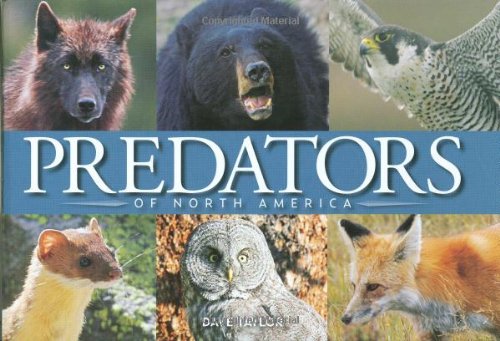



A season-by-season reference on North America's most thrilling wild animals. In this book, renowned wildlife photographer Dave Taylor presents 300 full-color images of North American predators in their natural habitats. He offers interesting notes on each animal: its behavior, the role it plays in its ecosystem and where and when it can best be observed. Taylor pays special attention to the most interesting North American predators, recording the day-to-day life of both the hunter and its prey. Predators include: Wolf - Coyote - Red fox - Otter - Mink - Badger - Grizzly bear - Black bear - Polar bear - Cougar - Bobcat - Lynx - Ocelot - Dolphin - Great blue heron - Bald eagle - Great horned owl - American alligator. Prey include: Bison - Musk ox - White-tailed deer - Elk - Bighorn sheep - Moose - Pika - Prairie dog. Predators of North America is the fascinating story of these animals over a calendar year, providing photographers, naturalists, conservationists and hunters a guide to viewing species-specific seasonal events. In this book, noted wildlife photographer and author Dave Taylor offers 300 full-color images of North America's predators captured in their natural environments. Broken down by month, the collection includes impressive shots of grizzly and polar bears, cougars, wolves, foxes, alligators, eagles, and owls. The captions provide scientific information on each species which makes this a wonderful visual experience and an educational treat. (C.A. Boylan Shutterbug 2009-12-01) This is a glossy volume with 330 colour photos, but small enough and simple enough for children to handle and enjoy. ( Waterloo Region Record 2009-12-12) Nature photographer and writer Dave Taylor takes you through 12 months of the habits and habitat of the "animals humans love to hate" - our fellow predators. The browsing-friendly format pairs nuggets of interesting and often surprising information with images of a variety of creatures snapped across Canada and the United States, with particular focus on the grizzly bear, black bear, wolf, coyote and red fox. ( Gift Books Feature, The Globe and Mail 2009-12-05) The book is chock full of photos of pelicans and eagles, wolves, lynx, and coyotes, and various bears, weasels, and owls, "the animals that humans love to hate." (Bill Robertson Saskatoon Star Phoenix 2009-12-19) Dave Taylor is a wildlife photographer and the author of 35 books on wildlife and ecology, including Deer World and Black Bears . He is the education program director for an urban-wild park in Mississauga, Ontario. Preface Predators of North America is about the animals that humans love to hate. It is about those species we view as our competitors: our fellow predators. Ours was a rural society in the 1800s and the early 1900s, which meant that we could not tolerate wild predators preying on important food species such as deer, elk, bison and later domestic cattle and sheep. It was easy to rationalize the view that predator species should be exterminated for the greater good. As a result, wolves were hunted to near extinction in the United States. After Yellowstone National Park was established in 1872, the park's wolves and cougars were actively hunted with the goal of eliminating them entirely. The last indigenous wild wolf in Yellowstone was killed in 1926. Our violent competition with other predators is not unusual in the natural scheme of things. Wild predators routinely seek out their competitors with malice. Dogs chase cats, lions kill hyenas and, as we will see in this book, wolves kill coyotes. Only in the past dozen years have naturalists and photographers been able to observe wild wolves South of the Arctic with relative ease. Much of the credit for this belongs to Yellowstone Park's controversial wolf reintroduction program. In 1995 and 1996, fourteen wild wolves captured in Western Canada were released into the park. Today, a thriving population continues to expand its range. As a species, we have gradually developed an understanding of the essential role predators play in keeping our ecosystem healthy. Our acceptance of wild predators has been fostered through decades of research by field scientists such as Adolph Murie, whose pioneering wolf study in Alaska began in 1939 and led fellow researchers to look at the roles of other predators in nature -- a process that started a revolution in the way we think about predator species. This revolution was further aided by the dramatic shift in North America's human population from mainly rural to a mainly urban. Removed from the stresses of having to grow and nurture their own food, urbanites have far less contact with predators and have developed a much greater tolerance for these wild species. In this book, we will look at the natural world from the perspective of North America's predators. My previous book, Deer World, told the story from the perspective of prey species. This book is, in a way, an attempt to complete the story o