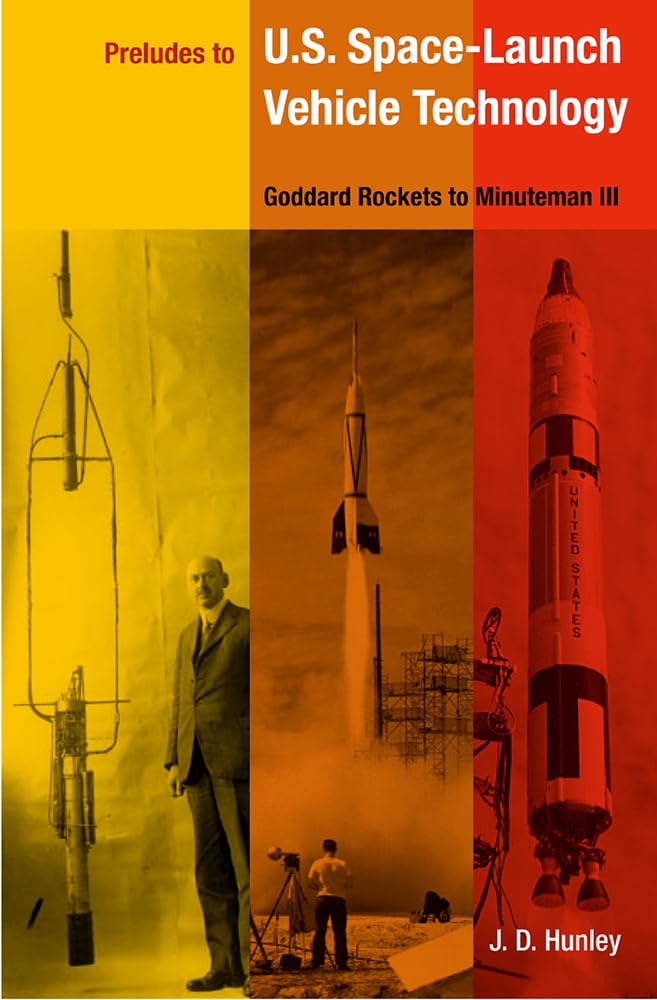
Preludes to U.S. Space-Launch Vehicle Technology: Goddard Rockets to Minuteman III
$26.11
by J. D. Hunley



A two-volume overview of U.S. missile and rocket technology For nearly fifty years, a wide range of missiles and rockets has propelled U.S. satellites and spacecraft into the sky. J. D. Hunley's two-volume work traces the evolution of this technology, from Robert Goddard's research in the 1920s through the development of the Titan missiles and launch vehicles in the 1960s to the refinement of the space shuttle in the 1980s. With the first book devoted primarily to military hardware and the second to launch vehicle hardware, Hunley offers a sweeping overview of these impressive engineering innovations as well as insights into the dynamic personalities responsible for them. Together, the two volumes offer a unique, invaluable history of rocketry that should appeal to a wide range of scholars and space buffs. Roger Launius concluded a full-page review of these two volumes with: "There is much to praise and little to criticize in these two fine volumes on the history of U.S. rocket technology. . . . They come as close to this ideal [a definitive history] as we are likely ever to see." Elsewhere, he says things like, "his [Hunley's]work is a benchmark in the process of the invention of spaceflight and its evolution throughout time" and "both works do a superb job of tracing the main lines of development of the major rocket technologies." --Quest: The History of Spaceflight Quarterly, 15:4 2008 These two volumes constitute "a thoughtful review of the technological changes and their defining reasons rather than a recitation of program development events. The thoughtfulness comes via linkages. For example there's a description of the evolution from aniline-nitric acid propellants used in the WAC Corporal to the inhibited white fuming nitric acid propellant for Vanguard." The second volume in the set shows that rocketry consists "more of engineers doing than [of] scientists knowing." Nevertheless, the reader will encounter again and again the determination of the practitioners to find a workable solution that then goes on to be a fundamental step in the progress of rocketry." Both volumes show "that, with the right resources, humans can accomplish near magical travel away from Earth." --Universetoday.com "Hunley makes the connection between military and civil space vehicles by informing readers that NASA's launchers were originally long-range military ballistic missiles."—Jacob Neufeld, editor in chief, Air Power History "These two volumes tell the compelling story of the events, people, and technology that evolved from the missile programs to the U.S. space boosters that impact every aspect of our daily lives. They also delineate the successful management techniques that produced some of the most expensive and complex systems ever developed."—Robert L. Geisler, Air Force Propulsion Laboratory (retired) A two-volume overview of U.S. missile and rocket technology "Hunley makes the connection between military and civil space vehicles by informing readers that NASA's launchers were originally long-range military ballistic missiles."--Jacob Neufeld, editor in chief, Air Power History "These two volumes tell the compelling story of the events, people, and technology that evolved from the missile programs to the U.S. space boosters that impact every aspect of our daily lives. They also delineate the successful management techniques that produced some of the most expensive and complex systems ever developed."--Robert L. Geisler, Air Force Propulsion Laboratory (retired) For nearly fifty years, a wide range of missiles and rockets has propelled U.S. satellites and spacecraft into the sky. J. D. Hunley's two-volume work traces the evolution of this technology, from Robert Goddard's research in the 1920s through the development of the Titan missiles and launch vehicles in the 1960s to the refinement of the space shuttle in the 1980s. With the first book devoted primarily to military hardware and the second to launch vehicle hardware, Hunley offers a sweeping overview of these impressive engineering innovations as well as insights into the dynamic personalities responsible for them. Together, the two volumes offer a unique, invaluable history of rocketry that should appeal to a wide range of scholars and space buffs. Hunley has been selected to receive the American Institute of Aeronautics and Astronautics 2010 Gardner-Lasser Aerospace History Literature Award for this two volume set: "Preludes To U.S. Space-Launch Vehicle Technology: Goddard Rockets to Minutemen III" and "U. S. Space-Launch Vehicle Technology: Viking to Space Shuttle." Reviews: "Hunley makes the connection between military and civil space vehicles by informing readers that NASA's launchers were originally long-range military ballistic missiles." - Jacob Neufeld, editor in chief, Air Power History. "These two volumes tell the compelling story of the events, people, and technology that evolved from the missile programs to the U.S. space boosters that impa