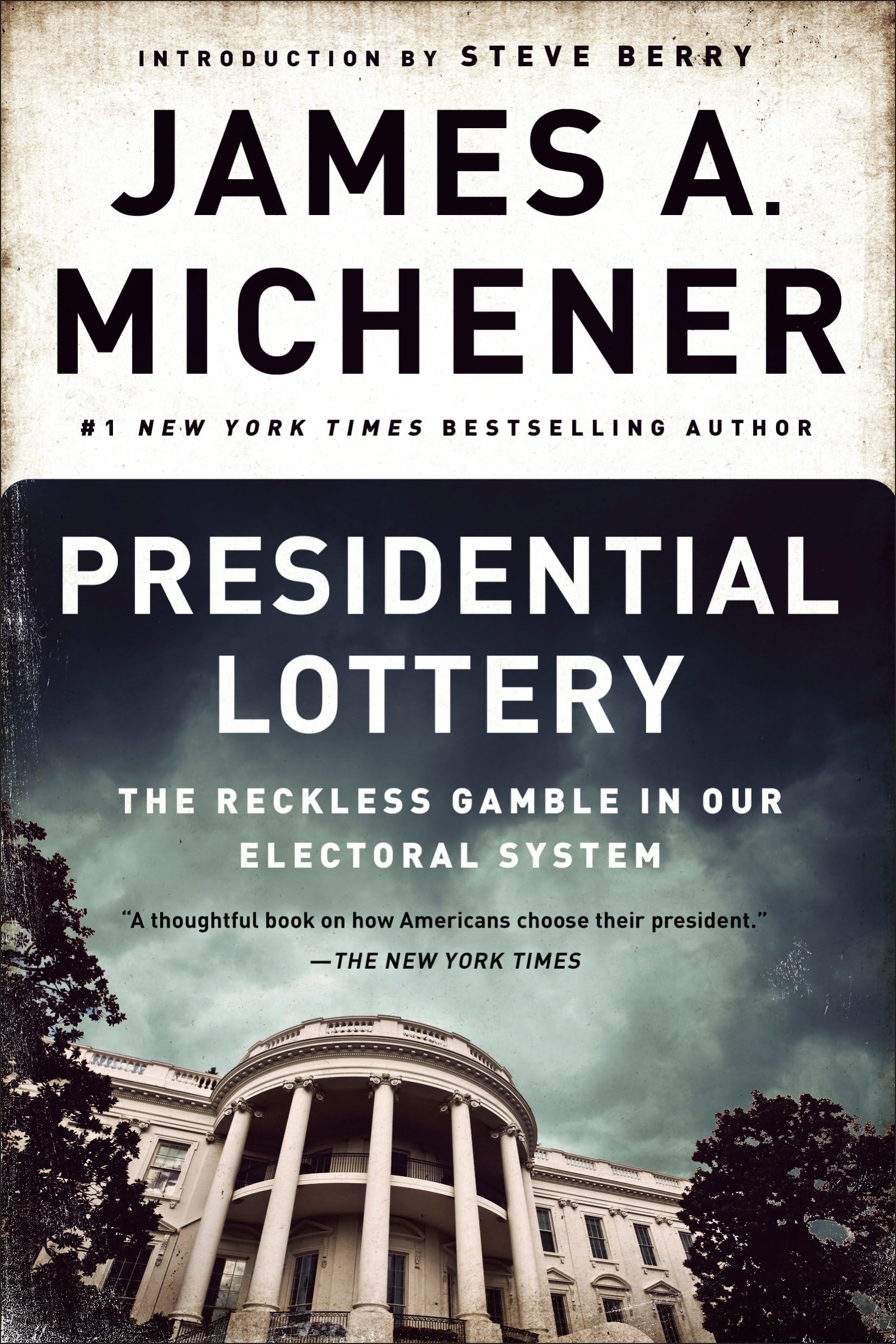
Presidential Lottery: The Reckless Gamble in Our Electoral System
$17.46
by James A. Michener



In this eye-opening nonfiction account, world-renowned author James A. Michener details the reckless gamble U.S. voters make every four years: trusting the electoral college. In 1968, Michener served as a presidential elector in Pennsylvania. What he witnessed that fall disturbed him so much that he felt compelled to expose the very real potential in this system for a grave injustice with history-altering consequences. Incorporating the wide-ranging insight and universal compassion of Michener’s bestselling novels, Presidential Lottery is essential reading for every American concerned about the ever-growing rift between the people and the political process. Praise for Presidential Lottery “Clear, concise, and sensible . . . a thoughtful book on how Americans choose their President.” — The New York Times “An urgent appeal.” — Kirkus Reviews “Clear, concise, and sensible . . . a thoughtful book on how Americans choose their President.” — The New York Times “An urgent appeal.” — Kirkus Reviews James A. Michener was one of the world’s most popular writers, the author of more than forty books of fiction and nonfiction, including the Pulitzer Prize–winning Tales of the South Pacific, the bestselling novels The Source, Hawaii, Alaska, Chesapeake, Centennial, Texas, Caribbean, and Caravans, and the memoir The World Is My Home . Michener served on the advisory council to NASA and the International Broadcast Board, which oversees the Voice of America. Among dozens of awards and honors, he received America’s highest civilian award, the Presidential Medal of Freedom, in 1977, and an award from the President’s Committee on the Arts and Humanities in 1983 for his commitment to art in America. Michener died in 1997 at the age of ninety. On election day 1968 the United States once again played a reckless game with its destiny. Acting as if we were immune to catastrophe, we conducted one more Presidential election in accordance with rules that are outmoded and inane. This time we were lucky. Next time we might not be. Next time we could wreck our country. The dangerous game we play is this. We preserve a system of electing a President which contains so many built-in pitfalls that sooner or later it is bound to destroy us. The system has three major weaknesses. It places the legal responsibility for choosing a President in the hands of an Electoral College, whose members no one knows and who are not bound to vote the way their state votes. If the Electoral College does not produce a majority vote for some candidate, the election is thrown into the House of Representatives, where anything can happen. And it is quite possible that the man who wins the largest popular vote across the nation will not be chosen President, with all the turmoil that this might cause. In 1823 Thomas Jefferson, who as we shall see had long and painful experience with this incredible system, described it as, “The most dangerous blot on our Constitution, and one which some unlucky chance will some day hit.” Today the danger is more grave than when Jefferson put his finger on it. To understand how ridiculous our system is I invite you to follow my adventures last autumn and to see for yourself how close our nation came to turmoil, if not actual disaster. In late August my phone rang and a voice I knew well and favorably asked, “Michener, you want to be a Presidential elector?” It was Milt Berkes, Democratic chairman for my home county, representative in the Pennsylvania lower house, and the hardest-working politician I know. When I ran for Congress, Milt was my campaign manager, and later when I was required to introduce him at public meetings I said, “Milt used my money to learn about politics. He used his own to get elected.” Our friendship had gone beyond politics, for I liked this former Philadelphia schoolteacher who had moved out to the suburbs to make a good life for his family. “Well, how about it?” he asked. At the moment I was sick in spirit over the debacle at Chicago and wanted no involvement with politics, but as a historian and as one who had worked hard in the practical politics of Pennsylvania, I sensed that the 1968 election was going to be of special significance. I therefore agreed to serve, even though I knew that I was heading for a potential confrontation of grave consequence. I make this statement carefully and conscientiously: When I accepted the nomination I already knew what might happen in the fall election and I was aware of the part I could be forced to play if Pennsylvania went Democratic and thrust me into the Electoral College. Nevertheless I replied, “Sure.” All across America similar phone calls were being made. “Hey, Joe! You wanna be an elector?” “Sure, why not?” It was as simple as that. Men and women were being chosen for one of the potentially most complex responsibilities in our political life simply because they had contributed money to the