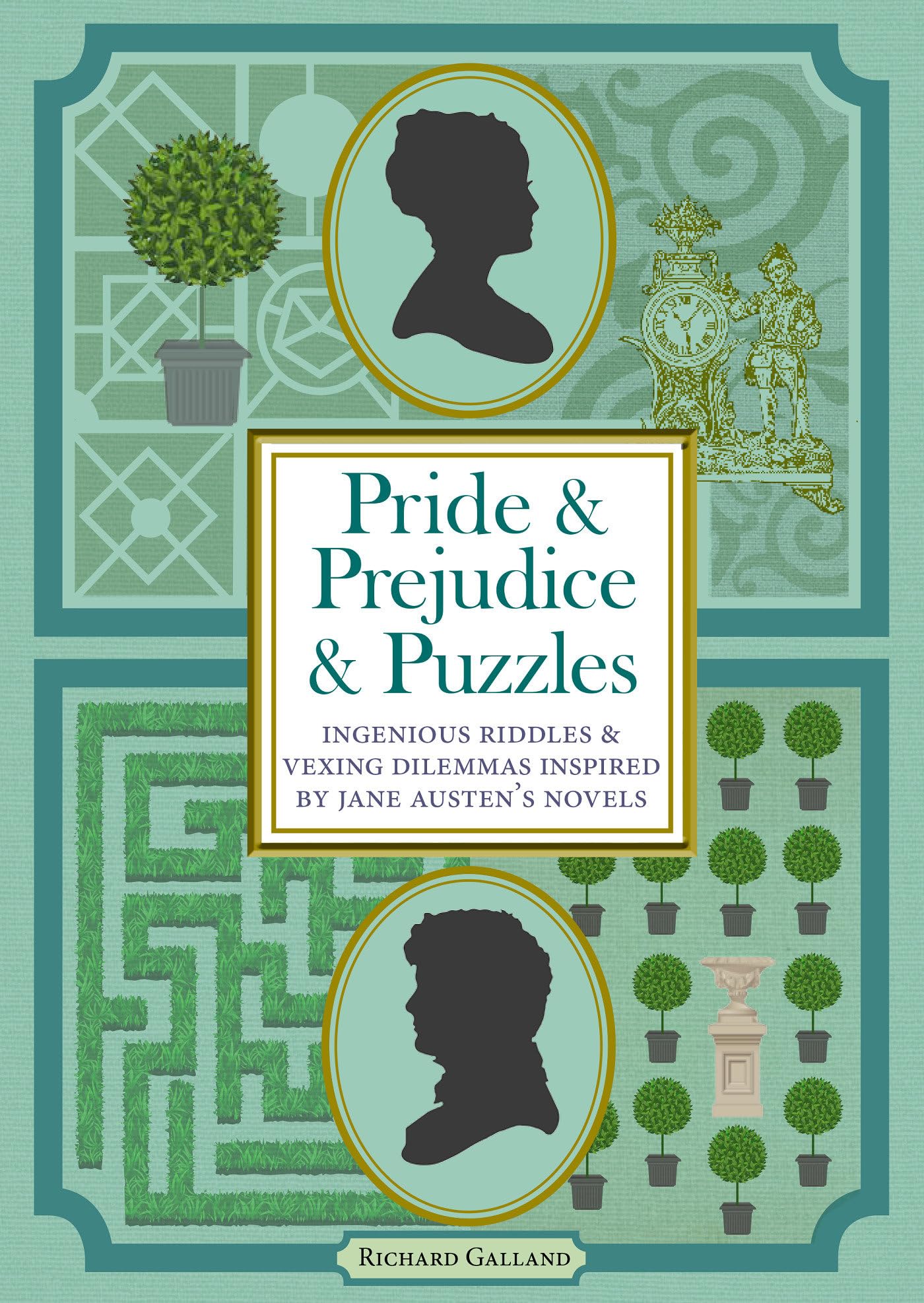
Pride & Prejudice & Puzzles: Ingenious Riddles & Vexing Dilemmas Inspired by Jane Austen's Novels
$39.91
by Richard Galland



Enter the world of Sense & Sensibility, Mansfield Park, and Persuasion with this beautifully realized puzzle collection that transports you to Jane Austen's England--a land of polite intrigue and conjugal contrivance. Permit yourself the indulgence of an interval of recreation and amusement to make your acquaintance with the riddles and conundrums contained within; for you are sure to receive no inconsiderable pleasure from the puzzling over and resolving of them. Your quest for an amiable distraction will be over, leaving your curiosity entirely satisfied. Puzzles there are plenty, clues there are many, and the pages are handsomely decorated with fine engravings entirely suited to the subject matter. "Really, Mr. Collins," cried Elizabeth with some warmth, "you puzzle me exceedingly. . ."--Jane Austen's Pride and Prejudice Richard Galland is a writer and games designer. He worked as a magazine editor for Games Workshop and designed games for Hasbro and Sony Japan. He is now creative director at Warm Acre Games, where he designed the successful Jane Austen's Matchmaker card game. He is the author of Lewis Carroll's Puzzles in Wonderland and King Arthur's Puzzle Quest . Introduction Enigmas, charades, and conundrums were very popular in the time of Jane Austen, as evinced in her 1816 novel Emma, where the following is cited as a well-known “charade”: My first doth affliction denote, Which my second is destin’d to feel And my whole is the best antidote That affliction to soften and heal. Here, the first is “woe” (affliction) and the second “man”. The whole , then is “woman”. Times change, and such charades hold little interest now, even if we can overlook the obvious sexism. The lifestyle of the nineteenth-century landed gentry in England might an alien landscape to us, but Austen’s six published novels, which are all against this backdrop, have an enduring appeal to this day. Perhaps it is her tell-it-like-it-is style that still rings true, even if the dialogue is antiquated. The social obstacle course of acceptability and interpersonal attraction might have been reconfigured, but it still exists, and we recognize it in the lavish balls and matchmaking machinations that fill her works. Pride and Prejudice was published a full century before Emily Davison threw herself in front of the King’s horse to protest women’s suffrage, and it is important to keep this in mind when judging Austen’s style as “safe” or “subversive”. Her critique of the mores and manners of her time might seem gentle now, but her quill had quite a sting. Her protagonists are women who must use their wit and imagination to find their way to happiness in a patriarchal society. Misunderstandings and miscommunication invariably make each story a puzzle that must be resolved before the principals can be joined in conjugal felicity. It is a game, however, that Jane herself preferred to enjoy as a spectator instead of as a participant; her own biography is frustratingly sparse, and she chose not to get married. The puzzles in this book are predominantly riddles and lateral-thinking conundrums with a helping of logic problems and visual brainteasers. You do not have to be a Jane Austen aficionado to attempt them, but if you have not yet experienced Miss Austen’s novels, perhaps this humble manuscript might tempt you to do so.