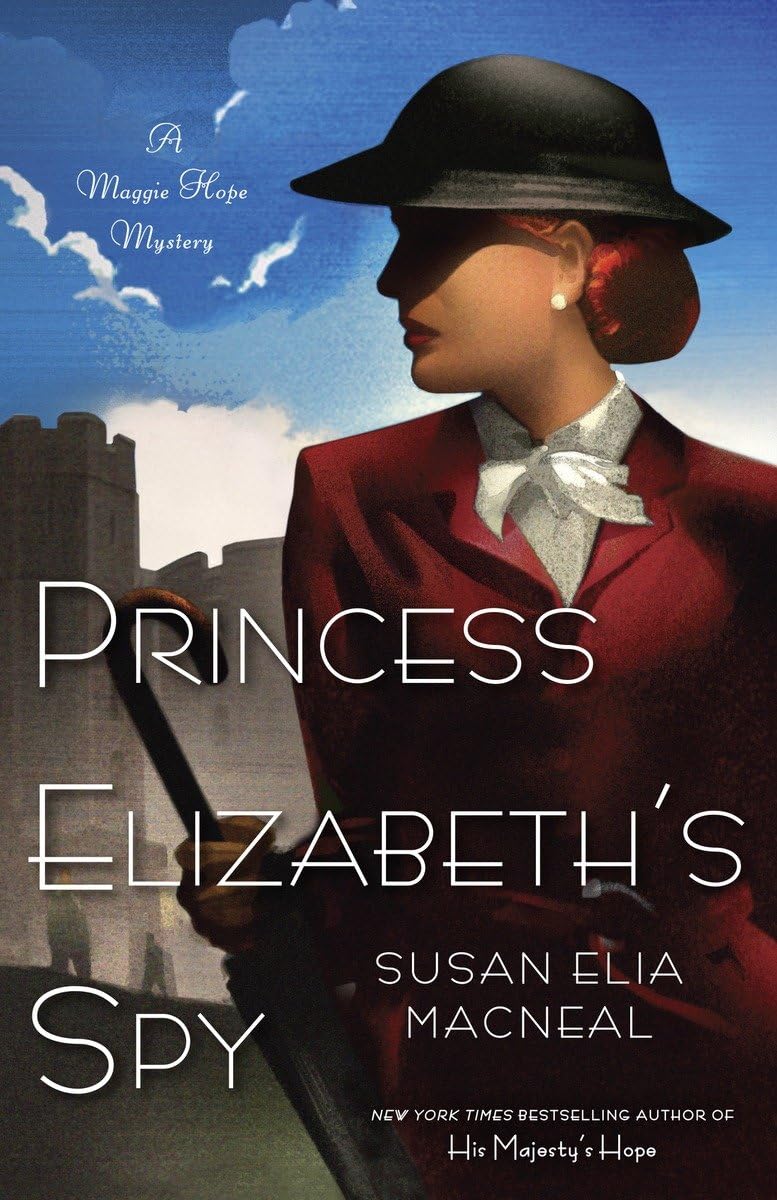



Susan Elia MacNeal introduced the remarkable Maggie Hope in her acclaimed debut, Mr. Churchill’s Secretary . Now Maggie returns to protect Britain’s beloved royals against an international plot—one that could change the course of history. As World War II sweeps the continent and England steels itself against German attack, Maggie Hope, former secretary to Prime Minister Winston Churchill, completes her training to become a spy for MI-5. Spirited, strong-willed, and possessing one of the sharpest minds in government for mathematics and code-breaking, she fully expects to be sent abroad to gather intelligence for the British front. Instead, to her great disappointment, she is dispatched to go undercover at Windsor Castle, where she will tutor the young Princess Elizabeth in math. Yet castle life quickly proves more dangerous—and deadly—than Maggie ever expected. The upstairs-downstairs world at Windsor is thrown into disarray by a shocking murder, which draws Maggie into a vast conspiracy that places the entire royal family in peril. And as she races to save England from a most disturbing fate, Maggie realizes that a quick wit is her best defense, and that the smallest clues can unravel the biggest secrets, even within her own family. Discouraged when she washes out in MI-5 physical training in late 1940, Maggie Hope is less than pleased to be assigned to Windsor Castle, ostensibly to tutor Princess Elizabeth in “maths.” A math whiz raised in America by an aunt, she aspires to be a spy on the continent. Just after she reaches the castle, a lady-in-waiting riding with the two princesses is killed, leaving Maggie wondering if the victim was really the intended target. Fourteen-year-old Elizabeth proves an apt student, even fortuitously devising a code, as Maggie successfully handles covert tasks and conceals personal concerns. (Her “almost-fiancé,” whose proposal she turned down because he was joining the RAF, is missing after being shot down over Germany.) MacNeal captures the atmosphere of wartime Britain, with its populace keeping a stiff upper lip, and Maggie is as spunky as she is smart, showing backbone yet acknowledging error. This sequel to Mr. Churchill’s Secretary (2012) is historical mystery true to its time, with concluding plot twists that pave the way perfectly for future entries in an up-and-coming series. --Michele Leber Praise for Mr. Churchill’s Secretary “Delightful may seem a strange word to describe a novel that takes place against the backdrop of the bombings of London during World War II, but it’s appropriate for this debut novel. . . . As sweet as it is intriguing.”— USA Today “A captivating, post-feminist picture of England during its finest hour.”— The Denver Post “Daring . . . Blends meticulous research on the era, psychological insight into Winston Churchill, and the creation of a riveting main character, Maggie Hope, into a spectacularly crafted novel.”—Bookreporter “A ripping good yarn [that] enthralls and satisfies.”— Richmond Times-Dispatch Susan Elia MacNeal is the New York Times bestselling author of the Maggie Hope mysteries and Mother Daughter Traitor Spy . MacNeal won the Barry Award and an AudioFile Earphones award and has been nominated for the Edgar, Macavity, Agatha, Left Coast Crime, Dilys, ITW Thriller, and Nero awards. She lives in Brooklyn, New York, with her husband and son. Prologue The midday summer sun in Lisbon was dazzling and harsh. But while nearly everyone else was inside taking a siesta, the Duke of Windsor, formerly King Edward VIII of England, kept up his British habits, even on the continent. He and his wife, Wallis Simpson, the woman for whom he’d abdicated the throne and now known as the Duchess of Windsor, sat outside at the Bar-Café Europa, which catered to tourists and British expats. The town square was nearly empty, except for a young American couple walking arm in arm and a few pigeons strutting and pecking for crumbs in the dust. Wallis, slender and elegant, wore a scarlet Schiaparelli suit, a bejeweled flamingo brooch, and dark glasses. She sipped a Campari and soda, the ice cubes clinking against one another in her tall glass. Next to her, the Duke, slight and fair-haired, toyed with a tumbler of blood-orange juice and read The Times of London. He was only forty-six, but the strain from the abdication, and subsequent banishment from royal life, made him look older. A shadow passed over his page. The Duke looked up in annoyance, then smiled broadly when he saw who it was—Walther Schellenberg, Heinrich Himmler’s personal aide and a deputy leader of the Reich Main Security Office. “Shel! Good to see you—sit down,” the Duke said. “Thank you, Your Highness,” Schellenberg replied in accented English, sitting down on the delicate wire chair. The Duke and Duchess had befriended Schellenberg on their tours to Germany before the war, visiting with Prince Philip of Hesse and Adolf Hitler. “Hello, Walther,” Walli