Principles of Magnetic Resonance Imaging: Physics Concepts, Pulse Sequences, & Biomedical Applications
$138.46
by Yi Wang PhD



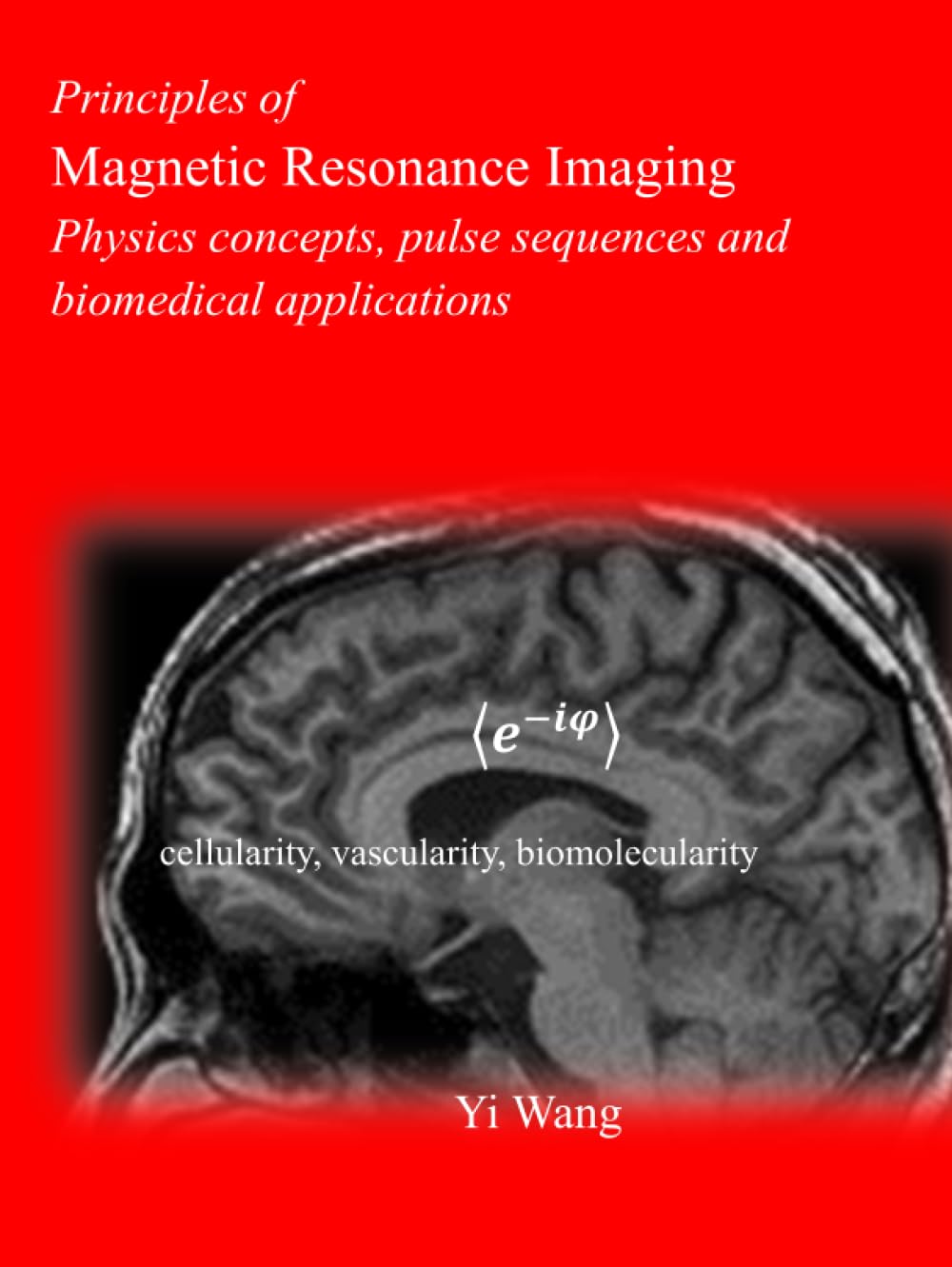
Principles of Magnetic Resonance Imaging provides a contemporary introduction to the fundamental concepts of MRI, applies these concepts in biomedical applications, and relates these concepts to the latest MRI developments. A unified approach based on spin phase factor averaging is supplied to connect microscopic molecular processes with macroscopic MRI contrasts: relaxation, magnetism, and transport. Graphic illustrations of Bloch Equation solutions and various biophysical processes are presented for visualizing abstract ideas. Simplified calculations and specific examples are given for precise appreciation of fundamental concepts. Insightful interpretations and clinical examples are furnished for exemplifying biomedical information in MRI. This book contains three parts: I. Section the body into voxels. Part I describes the Fourier encoding matrix for imaging, its realization in magnetic resonance (MR) using gradient fields, and k-space sampling. II. What’s in a voxel? Part II examines the effects of biophysical processes on MRI voxel signal. Spin phase factor averaging over the observation time and voxel space is provided as a unified biophysical model for explaining major MRI contrasts: Proton-proton interaction in a short range defined by local cellular contents (relaxation) causes T2 signal decay and T1 energy loss. - Electron-proton interaction (magnetism: nonlocal effects of magnetic susceptibility and local effects of chemical shift) can be quantitatively analyzed from MRI signal phase. - Proton motion (transport) including diffusion, perfusion, flow and biomechanical motion can be measured as a phase contrast or signal decay using a gradient field. The connection of MRI contrast physics to tissue molecular contents is conceptualized in the following three terms: 1) cellularity for T2/T1 weighted imaging, 2) biomolecularity for MR spectroscopy and magnetic susceptibility imaging, and 3) vascularity for MR angiography, MR perfusion, and MR diffusion. III. How to operate an MRI machine? Part III describes MRI safety issues, hardware, software including advanced imaging methods, MRI scanning, and routine MRI protocols. As examples of applying basic physics concepts, this MRI book further illustrates the latest technological innovations, including: B 1+ and B 1- mapping; Chemical exchange saturation transfer (CEST); Electric property tomography (EPT); Magnetic particle imaging (MPI); MR elastography (MRE); Moving spin tagging including ASL, SPAMM and DENSE; Navigator motion compensation; Parallel or accelerated imaging including SENSE, GRAPPA, compressed sensing and other Bayesian approaches; Quantitative blood oxygenation level dependent contrast (qBOLD); Quantitative susceptibility mapping (QSM); Quantitative transport mapping (QTM).