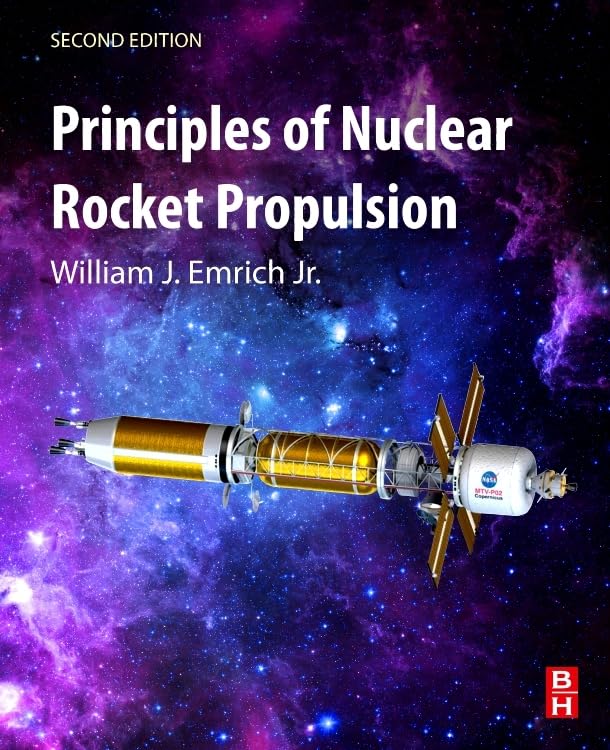



Principles of Nuclear Rocket Propulsion, Second Edition continues to put the technical and theoretical aspects of nuclear rocket propulsion into a clear and unified presentation, providing an understanding of the physical principles underlying the design and operation of nuclear fission-based rocket engines. This new edition expands on existing material and adds new topics, such as antimatter propulsion, nuclear rocket startup, new fuel forms, reactor stability, and new advanced reactor concepts. This new edition is for aerospace and nuclear engineers and advanced students interested in nuclear rocket propulsion. Provides an understanding of the physical principles underlying the design and operation of nuclear fission-based rocket engines - Includes a number of example problems to illustrate the concepts being presented - Contains an electronic version with interactive calculators and rotatable 3D figures to demonstrate the physical concepts being presented - Features an instructor website that provides detailed solutions to all chapter review questions This updated practical guide explains the physical principles underlying the successful design and operation of nuclear fission-based rocket engines The development of a solid core Nuclear Thermal Rocket for crewed space missions faces design challenges such as the thermal, fluid, and mechanical aspects that are always present in chemical rocket engine development, but also nuclear interactions and some unique materials restrictions. There is a need to have a deeper knowledge of the background theory and how it links to conventional reactor theory, as well as the concept of cooling from the propellant which is a feature that does not arise in conventional reactor design. The 2nd edition of Principles of Nuclear Rocket Propulsion continues to put the technical and theoretical aspects of nuclear rocket propulsion into a clear and unified presentation, providing an understanding of the physical principles underlying the design and operation of nuclear fission-based rocket engines. The new edition expands and adds new topics such as antimatter propulsion, a new section on a nuclear rocket startup, new fuel forms, an enhanced section on reactor stability, and new advanced reactor concepts. With a comprehensive review of the Nuclear Thermal Rocket Engine physics, design considerations and history from Kiwi to NERVA, this new edition is for aerospace and nuclear engineers, researchers involved in developing nuclear propulsion systems, and advanced students interested in nuclear rocket propulsion. William J. Emrich, Jr. has worked as a senior engineer at NASA Marshall Center for almost 35 years investigating numerous advanced propulsion concepts for travel in deep space. Most recently he worked as the project manager and principal investigator of the Nuclear Thermal Rocket Element Environmental Simulator (NTREES) which is a one of a kind facility that he developed to recreate the harsh operating environments present in operating nuclear rocket engines and where now nuclear rocket fuel elements are tested to their limits to evaluate their survivability. In 2015, as a result of his efforts in developing the NTREES facility he became only the second Marshall employee to win the AIAA Engineer of the Year award. To acknowledge this award, the city Huntsville, Alabama designated the day he received the award as William Emrich day. Now retired from NASA, he is currently an adjunct professor at the University of Alabama in Huntsville where he teaches a course in nuclear rocket propulsion and mentors young engineers seeking to pursue a career in that field. William Emrich is a registered Professional Engineer in the state of California and is a fellow in the American Society Mechanical Engineers and an associate fellow in the American Institute of Aeronautics and Astronautics.