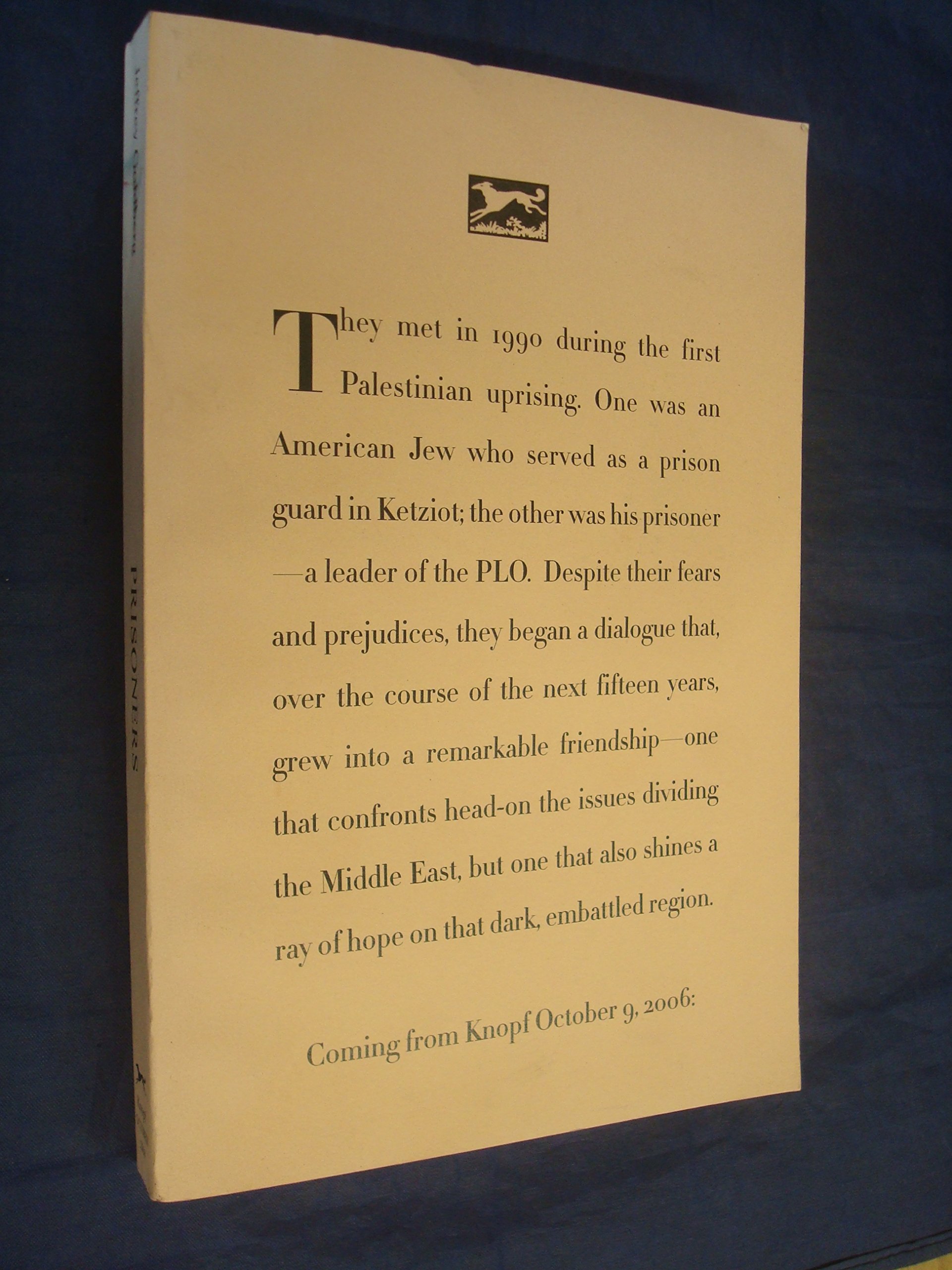



They met in 1990 during the first Palestinian uprising—one was an American Jew who served as a prison guard in the largest prison in Israel, the other, his prisoner, Rafiq, a rising leader in the PLO. Despite their fears and prejudices, they began a dialogue there that grew into a remarkable friendship—and now a remarkable book. It is a book that confronts head-on the issues dividing the Middle East, but one that also shines a ray of hope on that dark, embattled region. Jeffrey Goldberg, now an award-winning correspondent for The New Yorker, moved to Israel while still a college student. When he arrived, there was already a war in his heart—a war between the magnetic pull of tribe and the equally determined pull of the universalist ideal. He saw the conflict between the Jews and Arabs as the essence of tragedy, because tragedy is born not in the collision of right and wrong, but of right and right. Soon, as a military policeman in the Israeli army, he was sent to the Ketziot military prison camp, a barbed-wire city of tents and machine gun towers buried deep in the Negev Desert. Ketziot held six thousand Arabs, the flower of the Intifada: its rock-throwers, knifemen, bomb-makers, and propagandists. He realized that this was an extraordinary opportunity to learn from them about themselves, especially because among the prisoners may have been the future leaders of Palestine. Prisoners is an account of life in that harsh desert prison—mean, overcrowded, and violent — and of Goldberg's extraordinary dialogue with Rafiq, which continues to this day. We hear their accusations, explanations, fears, prejudices, and aspirations. We see how their relationship deepened over the years as Goldberg returned to Washington, D.C., where Rafiq, quite coincidentally, had become a graduate student, and as the Middle East cycled through periods of soaring hope and ceaseless despair. And we see again and again how these two men—both of them loyal sons of their warring peoples—confront their religious, cultural, and political differences in ways that allowed them to finally acknowledge a true, if necessarily tenuous, friendship. A riveting, deeply affecting book: spare, impassioned, energetic, and unstinting in its candor about the truths that lie buried within the animosities of the Middle East. *Starred Review* With the Middle East ablaze again, a lasting resolution of the Israeli-Palestinian conflict seems more distant than ever. So this timely and hopeful memoir reminds us that decent men of goodwill can strive to bridge even the widest gulf. Goldberg is an American-born Jew raised in a liberal, nonobservant family. He "discovered" Zionism in adolescence and immigrated to Israel as a young man. He had romantic dreams of fighting to defend the Jewish homeland. Instead, he spent his military service as a prison guard at Ketziot, a bleak desert jail where Palestinians, many who fought in the first Intifada, were warehoused. Goldberg provides incisive observations of various aspects of Israeli and Palestinian societies, including the decline of the kibbutz movement, ideological divisions between Fatah and Hamas, and, of course, the grinding monotony (for both guards and prisoners) of prison life. But the core of this story is Goldberg's evolving friendship with a prisoner named Rafiq.^B At first, they reach out warily toward each other, but the genuine warmth and affection that grow surprise and even unsettle them. Their friendship endures, even after Rafiq is released and returns to the political hothouse of Gaza while Goldberg becomes a journalist. Goldberg has no illusions that he and his friend, working at the "subatomic" level, have solved seemingly intractable larger problems, but his poignant account offers the possibility of reconciliation. Jay Freeman Copyright © American Library Association. All rights reserved “Revelatory . . . [Goldberg is] talented and ambitious . . . A tale far more grim than hopeful and, in that sense, a useful primer on why things seem so pessimistic just now. And yet, the final encounter between Mr. Hijazi [the Palestinian prisoner Goldberg guards] and Mr. Goldberg has a poignancy and power that bar utter despair. For the bittersweet complexity of that moment, offered in the context of all that has preceded it, this is a genuinely admirable book.” - The New York Times “Sensitive, forthright and perceptive . . . a forceful reminder of how rewarding, and how difficult, discourse between Israelis and Palestinians can be.” - The Washington Post “Sharply observed and beautifully written . . . a bracingly clear-eyed, deeply emotional and often humorous account of his life as an American Jew in love with Israel.” - Los Angeles Times Book Review “Goldberg’s sensitive portrayal of the nuances of his freighted relationship . . . gives soul and depth to Prisoners , a vivid account of the passions and prejudices, the tensions and terrors that exist in every camp, and every household