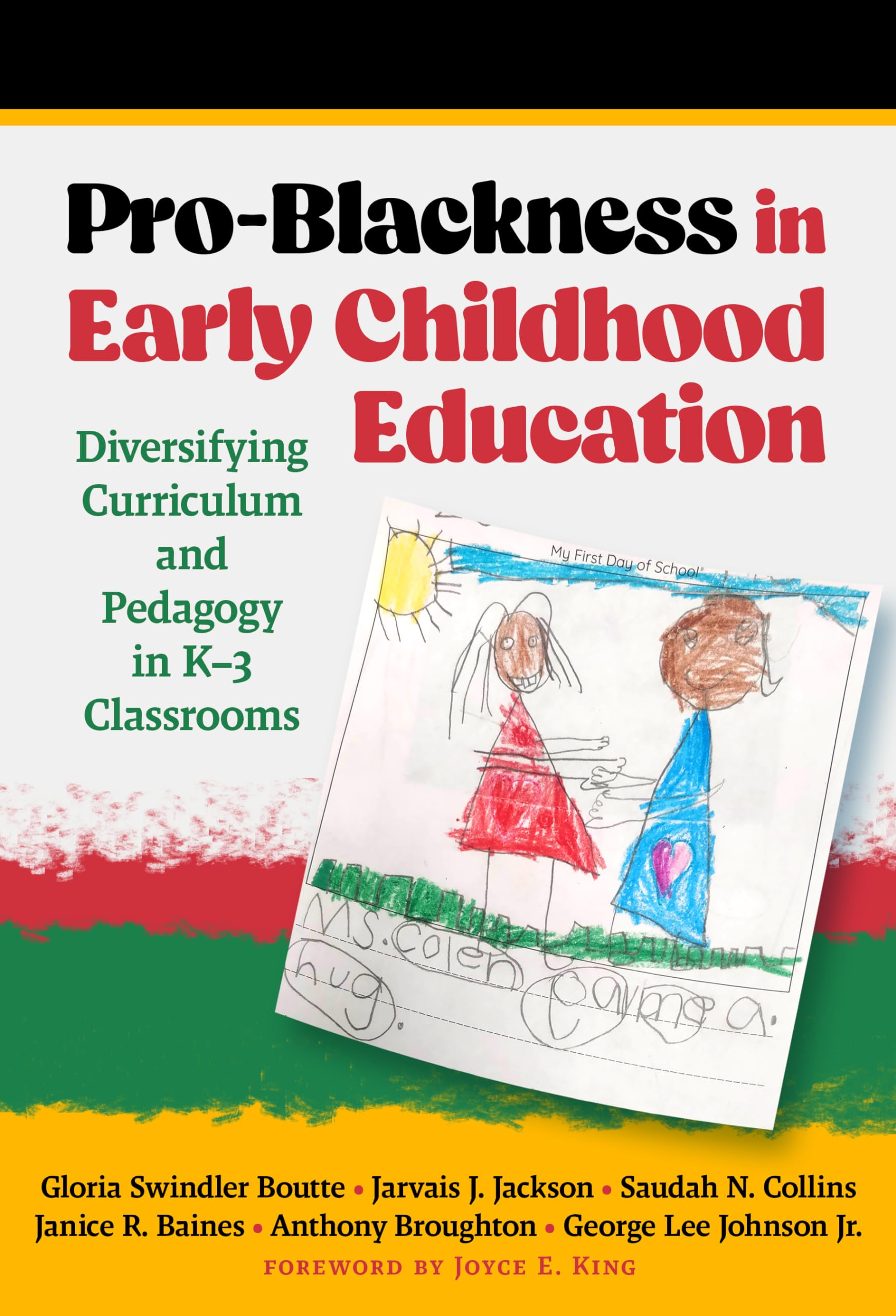
Pro-Blackness in Early Childhood Education: Diversifying Curriculum and Pedagogy in K–3 Classrooms (Early Childhood Education Series)
$37.94
by Gloria Swindler Boutte



Pro-Blackness in Early Childhood Education celebrates the agency, resistance, everyday lives, and joy of Black people. Use this inspirational resource to engage in Pro-Black teaching with young children as an antidote to endemic anti-Black racism in schools and society. Drawing from a critical case study of K–3 teachers who used Pro-Black teaching in their daily instruction, this important book puts forth positive perspectives regarding Blackness and Black people that are not evident in most educational settings. An easy-to-understand text provides evidence-based curriculum examples, pedagogies, and resources; demonstrates how teachers can achieve Pro-Black teaching while also addressing curricular standards and other demands on their time; and explains the benefit of Pro-Black teaching for all children. The authors draw from decades of practice and research by Black scholars (e.g., Asa Hilliard, Janice Hale, Amos Wilson) to position racial identities as a key part of Black children’s development. They center African diaspora literacy as a Pro-Black pedagogy to ensure that Black children are competent in their own culture as well as in global cultures. Book Features: Demonstrates how Pro-Blackness can be used to interrupt ethnocide practices that threaten Black children’s culture and spirits. - Provides guidance for implementing and sustaining Pro-Black instruction, with accessible examples of curriculum and instruction. - Focuses on Pro-Blackness rather than anti-Blackness. - Includes examples of K–3 lessons from Drs. Diaspora curriculum that have been used in majority Black, majority White, and racially mixed classrooms. “This volume demonstrates what educators . . . should be able to do and be like to understand and use the Black experience―and African diaspora literacy―as humanizing, healing pedagogy.” ―From the Foreword by Joyce E. King , Benjamin E. Mays Endowed Chair and professor, Georgia State University “ Pro-Blackness in Early Childhood Education makes me want to holla, shout, and lift my hands to rejoice! Rejoice that we now have, in one book, a comprehensive overview of how to transform our early childhood educational and curricular systems into one that is Pro-Black and centers cultural and academic excellence for Black children. The authors have graciously provided us with a groundbreaking and timely treasure that is a must-read for educators, leaders, community advocates, families, researchers, and policy officials who, as Dr. Asa Hilliard would contend, ‘have the will’ to educate Black children.” ― Tonia Durden , clinical professor and birth through five program coordinator, Georgia State University “ Pro-Blackness in Early Childhood Education is a must-read for everyone, including teachers, teacher educators, families, and community members. It is one of the first books in early childhood education that boldly and unapologetically centers Black cultural ways of knowing and being as a pedagogical framework. This book is brilliant, remarkable, and accessible to educators and stakeholders who love and deeply care about the well-being of Black children in early childhood classrooms.” ―Nathaniel Bryan , associate professor, The University of Texas at Austin, and author of Toward a BlackBoyCrit Pedagogy: Black Boys, Male Teachers, and Early Childhood Classroom Practices Gloria Swindler Boutte is associate dean of diversity, equity, and inclusion and Carolina Distinguished Professor of Early Childhood Education at the University of South Carolina. She received the 2025 AERA Social Justice in Education Award. Jarvais J. Jackson is an assistant professor of elementary and special education at Georgia Southern University. Saudah N. Collins is an African Studies teacher at Jackson Creek Elementary and adjunct instructor at the University of South Carolina. Janice R. Baines is a clinical instructor of early childhood education at the University of South Carolina. Anthony Broughton is associate dean of the College of Education and associate professor at Alabama State University. George Lee Johnson Jr. is acting department chair of education and professor of special education at South Carolina State University.