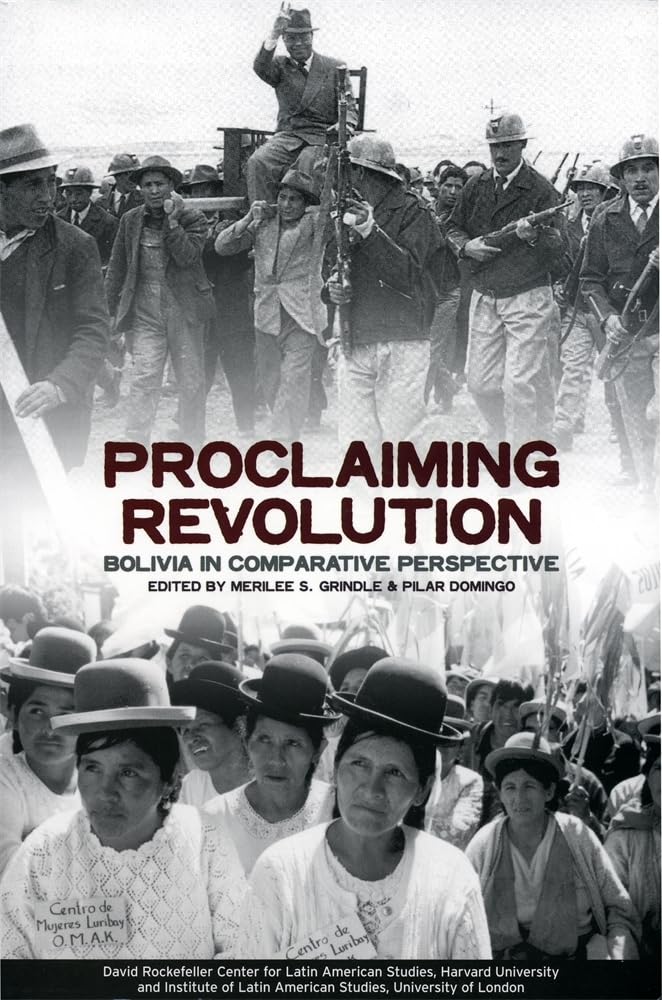
Proclaiming Revolution: Bolivia in Comparative Perspective (Institute of Latin American Studies)
$19.71
by Merilee Grindle



The fiftieth anniversary of the 1952 Revolution in Bolivia offered an opportunity to explore contrasting visions about change in this often overlooked country from a comparative perspective. Blending the approaches of history and the social sciences, the chapters in this volume examine both implicitly and explicitly the extent to which the process opened by the uprising of April 1952 is comparable to the great radical transformations that occurred elsewhere during the twentieth century. The question of historical memory, the origins of the revolution in the political economy and culture of the towns, mines and countryside, and the extent to which the political process after 1952 shaped new interpretations of the country's place in the world are all analysed by leading scholars from Bolivia, the USA and the UK. Full and critical attention is given to the consequences of the revolution over fifty years, with assessments of the parties, structures and policies shaping economic, political and social conditions at the start of the twenty-first century. “ Proclaiming Revolution is an important contribution―the first book of its kind to approach the implications and consequences of the 1952 revolution in comparison with other Latin American revolutions of similar magnitude...[It] permits us to see the possibility of creating a society that is more humane, reconstructing diverse sociocultural identities in order to reinvent the Bolivian nation " sin mayziscúlas "―the plurimulti 'nation' and not 'Nation.'” ― Franco Gamboa Rocabado , Hispanic American Historical Review Merilee Grindle is the Edward S. Mason Professor of International Development, Emerita, at Harvard University and the former director of its David Rockefeller Center for Latin American Studies. She served as president of the Latin American Studies Association and has written or contributed to over a dozen scholarly books. Pilar Domingo is Lecturer in Politics, Queen Mary College, University of London. Used Book in Good Condition