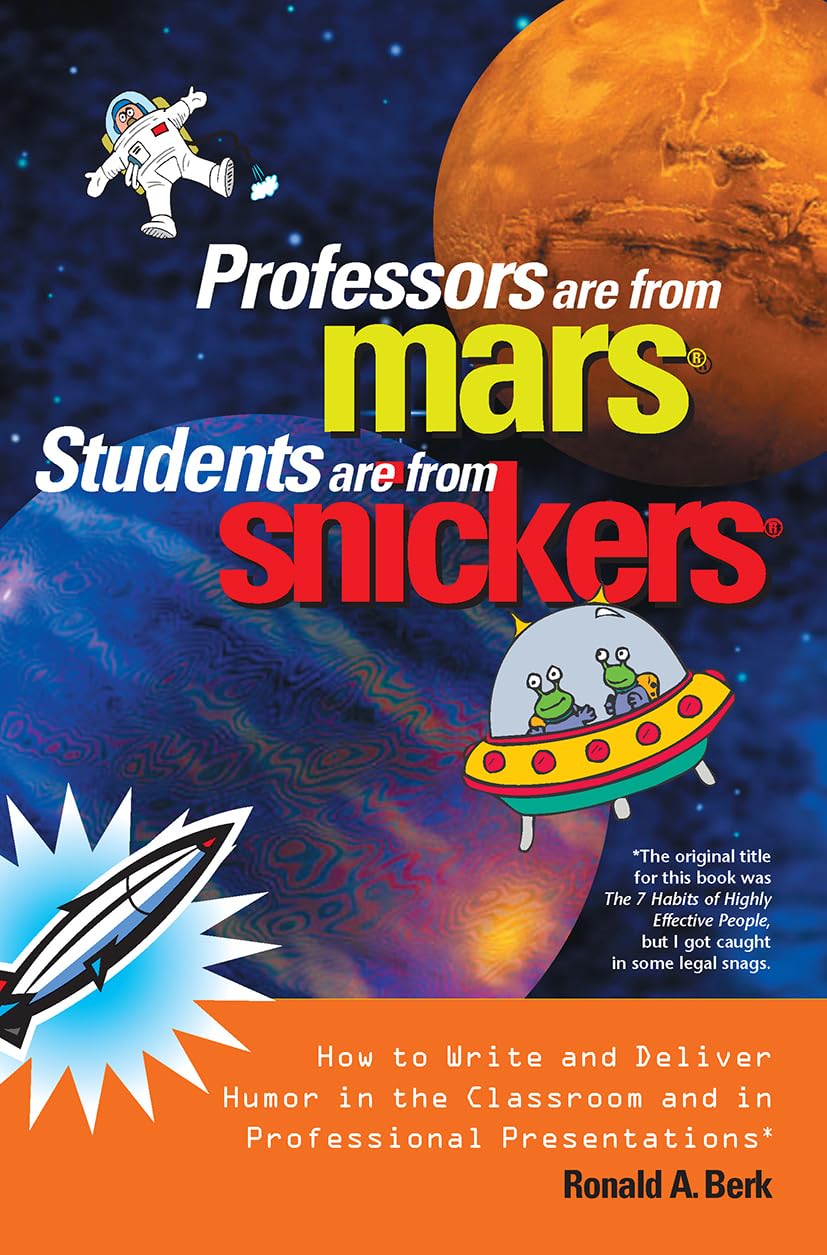
Professors Are from Mars®, Students Are from Snickers®: How to Write and Deliver Humor in the Classroom and in Professional Presentations
$22.00
by Ronald A. Berk



Professors and students seem to come from different planets (or candy bars). Barriers frequently exist that impede their communication, such as age, income and cholesterol level.Humor can break down these barriers so that professors can better connect with their students and other audiences. It can be used as a teaching tool to facilitate learning. Ron Berk describes and illustrates a wide variety of techniques that can be integrated systematically into instruction and professional presentations. For professors who consider themselves as "jocularly arthritic", this book moreover provides a special feature: it is close-captioned for the humor impaired.Berk's techniques are "the product of ten years of inadequate development, testing and research." But why take the author's words at their face value? Consider the testimonials of those who have actually attempted these methods in their own classes and presentations:'Before I tried Ron's methods in my philosophy class, I had an attendance problem. Now, no one comes to class.' -- H.I., Slot Machine U., Nevada'Applying humor to my engineering courses led me to understand the meaning of humiliation and rejection.' -- J.K., Toyota College, Kentucky "Ronald Berk, a recognized authority in measurement and biostatistics, has written two books on the use of humor in teaching and professional presentations. While "humorous biostatistician" is an oxymoron at face value, it is an accurate descriptor for Berk. Both books incorporate his humorous style and are easy and enjoyable to read while also being useful as guides to the use of humor. In writing this review, the temptation is to model, or even parody, Berk's style, trying to out-Berk Berk with witty aphorisms, clever language, double entendre, or other devices. Prudence (perhaps even good taste) suggests a more conservative approach. Professors Are from Mars, originally published in 1998, provides a rationale, evidence, and helpful hints for those who are interested in using humor in their presentations or materials. Humor as an Instructional Defibrillator provides much of the same information, but extends the review of scholarship dealing with the effects of humor, provides more examples, and contains a larger treatment of assessment issues, including test item construction. For those interested in simply exploring the use of humor, Professors Are from Mars is probably the better choice. These books are not for everyone. As Berk acknowledges, there will be some who ..."have the sense of humor of tile grout..." and who will look upon any attempt to use humor as disrespectful to teaching, the discipline, and all things holy. He rightly cautions that there is some danger, especially for untenured faculty who may have to reply on the opinions of colleagues at promotion and tenure time. Berk also is realistic about the dangers of "bombing" caused by bad material, poor delivery, insensitivity to the audience, etc., especially for those just beginning to incorporate humor into their courses and presentations. Not only does the humor fail, but the teacher risks negative consequences with respect to self-concept, reputation among students and peers, and career aspirations. To help readers avoid such disasters, Berk stresses several useful techniques, including analysis of what makes oneself and one's audience laugh, selecting and adapting material to fit one's situation, testing material in advance, and making constant revisions. To a certain extent, what Berk recommends requires that the reader be willing to exercise some suspension of disbelief. One may read a considerable number of examples without bursting out in uncontrollable laughter, and thus question the extent to which anyone else would find the material funny. Likewise, when attempting to deliver material (and as with any kind of performance), confidence in one's material and ability are important. In effect, if you don't think the material is funny, it won't be, and if you don't think you can deliver it well, you probably won't. There is an old distinction between being a comic and a comedian: one says funny things, the other says things funny. A terse description of Berk's books is that, in the case of classroom humor, the safest advice is to try to do both.Berk's contributions in this are, for all purposes, unique. Anyone interested in incorporating humor into the classroom should refer to these books often. Berk himself notes that he is constantly involved in looking for, creating, or adapting material and that this repertoire changes as a result of context, his audiences, or simply the passage oftime. References to a 1960s TV show, for example, may not work with contemporary students, and an academic audience may have little knowledge of the pop culture that provides the basis for much of today's humor. In any case, the lesson to be learned from Berk's books is that humor requires thought, preparation, and consideration of context.Now let me tell you about a f