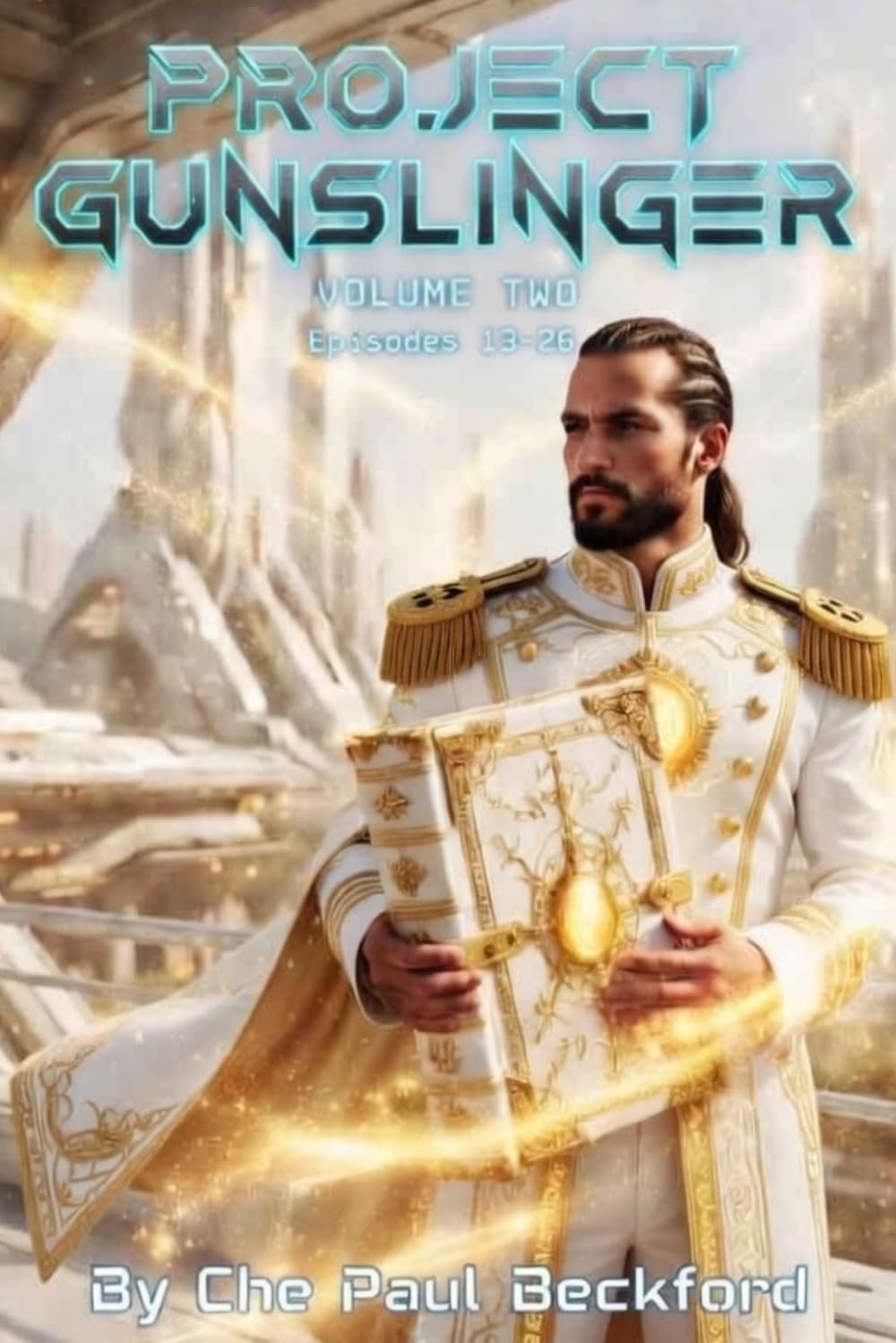
Project Gunslinger: Volume Two: Episodes 13–26 (Aurelia Gunslinger Saga)
$40.00
by Che Paul Beckford



In Volume Two, Project Gunslinger evolves from a record of survival into a story about how wars end—and what must be preserved in the act of ending them. As the Aurelion Concord confronts the full emergence of Deimos, it becomes clear that the enemy is not an invading force or a weapon to be outmatched. Deimos feeds on coherence itself, thriving on repetition, predictability, and systems that prize optimization over humanity. It does not destroy civilizations outright; it pressures them until governance hardens, care becomes delay, and survival is used to justify the erosion of the future. At the center of the conflict stands Admiral Damien Valbane, Gunslinger—not as a singular hero, but as a living calibration point for reality. Deeply altered by hypertrophy and BERI, Damien possesses immense power, yet understands early that Deimos is attacking meaning rather than infrastructure. Safety is turned into scarcity, procedure into paralysis, and sacrifice into policy. The war becomes a test not of strength, but of whether humanity can endure without hollowing itself out. The struggle is fought on multiple fronts. Cultist networks attempt to shape Deimos into an ideological weapon, while factions within the Concord push for increasingly ruthless forms of optimization. The conflict sharpens into a moral crisis: whether humanity should trade lives, futures, and ethics for continued existence, or choose a more difficult path that preserves continuity instead of efficiency. Damien is not alone. Alongside him stand the other Admirals of the Concord: Lira Valbane, whose harmonic mastery stabilizes reality through care rather than force; Azrael Tyche, who learns to read chaos as signal; Dred Locks, who embodies layered defense without cruelty; and Grimjaw Jean, whose ferocity is governed by loyalty and restraint. Together, they redefine Project Gunslinger—not as a weapon, rank, or elite class, but as a living doctrine built on distributed authority, ethical limits, and shared accountability across generations. The war reaches its turning point with the deployment of the Aurelion Protocol. Rather than containing or delaying Deimos, the protocol forces it into total dimensional resolution, undoing the logic that allowed it to feed on coherence. Deimos is not scattered or displaced—it is ended. For the first time, the war does not pause. It concludes. In the aftermath, Terra begins to heal. Sanctuaries evolve from bunkers into living infrastructure. Hypertrophy becomes guided growth rather than escalation. And Talpa Valbane, Damien’s son, emerges not as a weapon or prophecy, but as proof that a future can exist without being sacrificed to fear. His presence represents inheritance without predestination, and a redefinition of strength measured by what is protected, not what is erased. The novel closes not with vigilance for the next catastrophe, but with a deliberate choice. Project Gunslinger is complete. What follows is stewardship—and the recognition that humanity does not endure by sacrificing its future, but by refusing to abandon it.