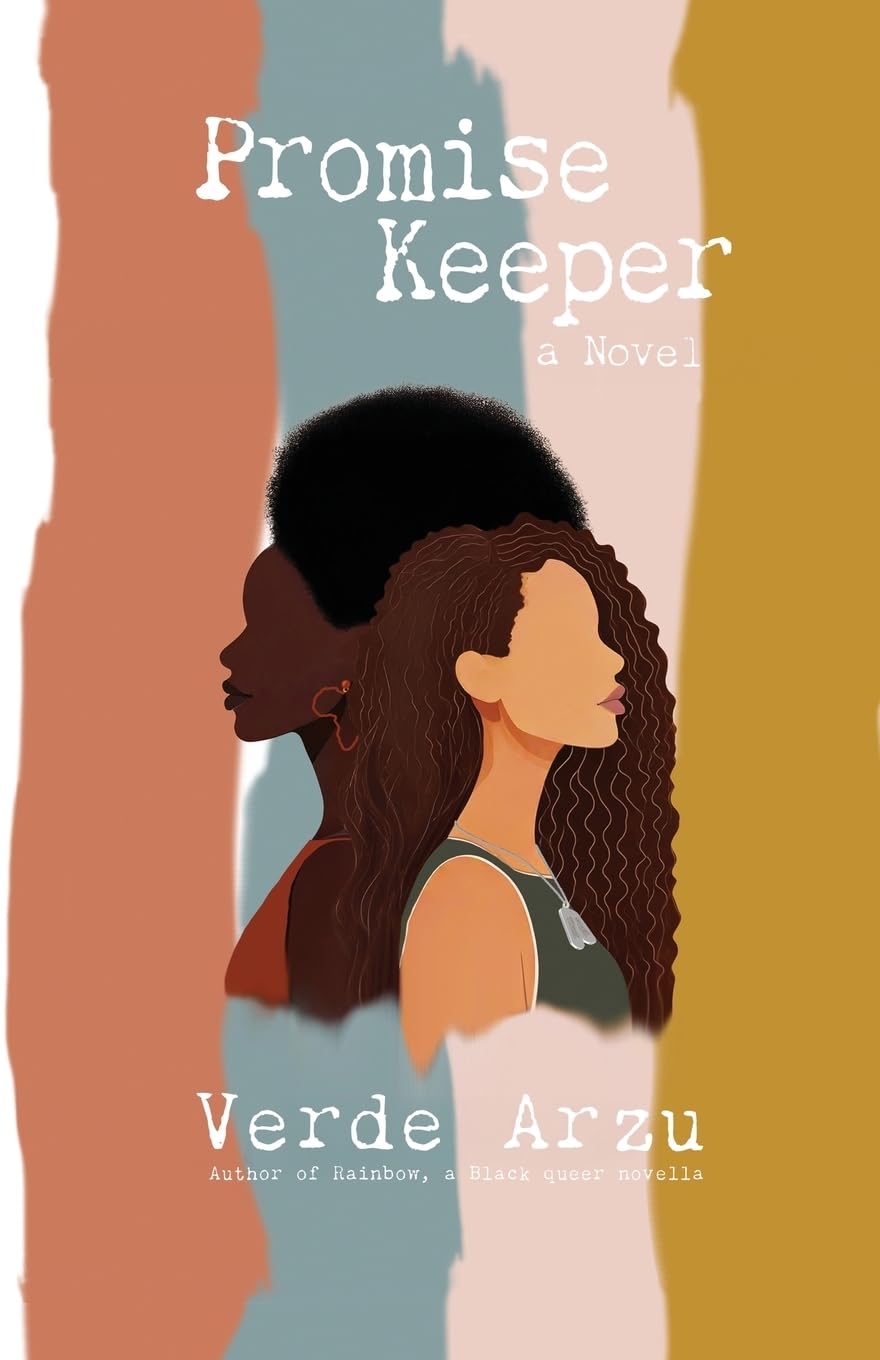



In Verde Arzu’s powerful second novel, Promise Keeper, Chandon Kilpatrick enters Franklin University, a historically Black college, with a quiet vow: to live life on her own terms—not her grandfather’s, not the world’s, just her own. But one heated argument with Corey—the sharp-tongued president of the Black Student Union—goes viral, and Chandon is once again labeled the girl who isn’t “Black enough.” Determined to reclaim her narrative, she joins the campus LGBTQ+ group and commits to a bold new cause: fighting to free two Black lesbian veterans imprisoned overseas. Her drive for justice is rivaled only by the complicated pull she feels toward two very different people—her loyal friend Alisha and her frenemy Corey. As emotions around the protest rise and her relationships deepen, Chandon finds herself drawn back to the promise she made—the one rooted in her father’s legacy, and the one that demands everything she’s still becoming. Promise Keeper is a coming-of-age story about racial identity, inner conviction, and the quiet, powerful promises we make to ourselves—and what it takes to keep them. -Kirkus Indie Review In Arzu's queer New Adult college romance, a young woman struggles with issues of identity and social justice while pursuing a relationship with a committed activist. It's 2015, and Chandon Kilpatrick is just starting her freshman year at historically Black Franklin University. She has a white mother and a Black father, and she's never felt "White enough" or "Black enough"; she's also grown up on her grandfather's stories of his time at Franklin and wants to make him proud: "I wanted to show him that I wasn't afraid or ashamed of my Blackness, though he might think I was." Almost immediately, Chandon meets an attractive Black student, Corey, when the two women get stuck in an elevator together after attending a local protest focusing on the killing of a Black teenager by police. Corey's passionate about social justice issues and is president of Franklin's Black Student Union, which she tries to convince Chandon to join. However, Chandon is drawn more to All Colors United, a queer campus organization, and starts working on a campaign to free two queer Black military contractors who were arrested in Kuwait for their sexual orientation. Corey and Chandon have a public fight about how to approach enacting change; Chandon initially sinks into a depression after classmates' backlash, but with friends' support, she finds her voice. Meanwhile, her relationship with Corey heats up, with their dynamic igniting romantic sparks. Arzu's novel focuses strongly on plot, with fast-paced dialogue and a prose style that offers direct explanations of feelings, which sometimes lack subtlety. However, the characters' debates over the course of the narrative provide nuanced takes on important social issues and effectively offer a wide variety of perspectives for readers to consider. Wright's full-color illustrations, which occasionally appear between some chapters, are appealing and sometimes recall animated productions, which adds to the story's youth-oriented feel; they also add to the keen sense of place, as they mostly focus on locations, rather than individual characters. A straightforward slow-burn queer love story with thoughtful and frequent discussion of weighty topics. -Indie Reader Review: 3.9/5 Verde Arzu's PROMISE KEEPER never loses sight of its rich and timely thematic heart. A young, mixed-race lesbian struggles to integrate her feelings on race and sexuality at a prestigious historically-Black university. Chandon comes from a difficult family. Her father served in the Middle East and died overseas; her Black family is still uneasy about her white mother; most of them still don't know she's gay; and expectations are high as she heads to her freshman year at Franklin University, an historically Black university of high prestige. But Chandon's biggest challenge yet is balancing new flame Corey with close friend Alisha. Verde Arzu's PROMISE KEEPER leads with its values. The university setting supports that intention: with passionate young people jockeying for academic and social recognition, the frequency of explicitly ideological conversation rings true. That drive for Black excellence is acknowledged on its own terms, but also in the context of police violence, activism, and the early years of the Black Lives Matter movement—high achievement is one strategy for defense against white violence. College is also a period of confusion and self-discovery, and that becomes particularly fraught for Chandon, with her complex layers of identity informing her ideas about the world. Again, the setting is well-framed to support this journey: choosing between a Black student group or an LGBTQ+ student group, for instance, is weighted with Chandon's anxiety over self-definition. These complex emotional journeys are carried on brisk, highly visual prose, and often with a touch of humor. The old collegiate