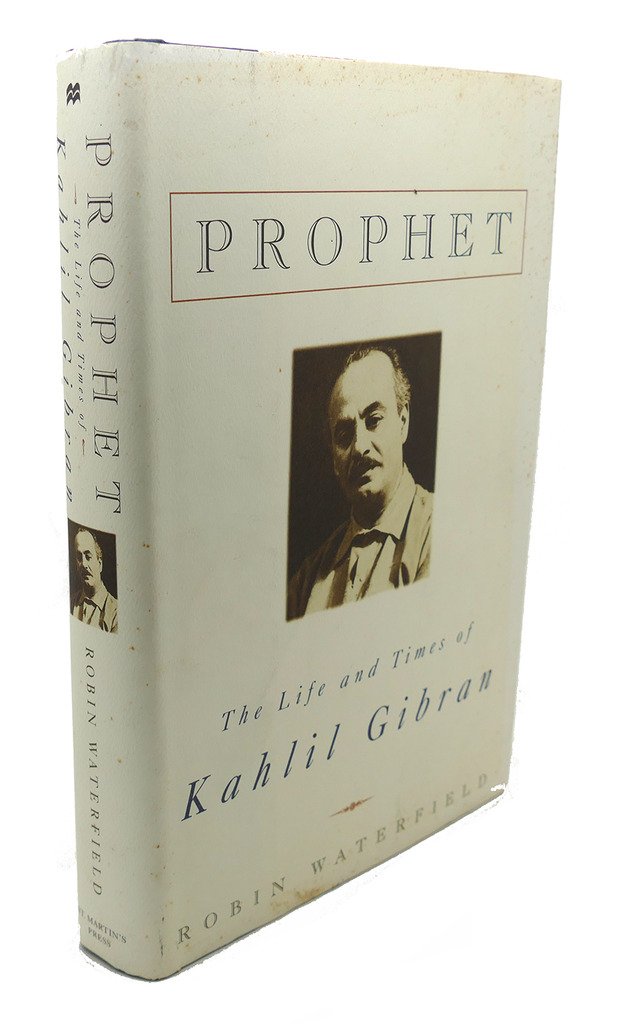



A definitive biography of the author of The Prophet traces the life of Kahlil Gibran from his youth in Lebanon and America to his artistic and literary endeavors, the tragedies and conflicts of his life, and his lasting impact on New Age philosophy. 17,500 first printing. This respectful but frank biography of the author of The Prophet reveals Kahlil Gibran (1883-1931) as a deeply conflicted man. Robin Waterfield, an English translator of ancient Greek philosophical texts, believes that Gibran never felt entirely at ease in America (to which he immigrated from Lebanon in 1895) or in his native culture. His influential Arabic poetry infused a rigidly classical literature with Western-style romanticism and colloquialism. And his English-language books like The Prophet (which has sold millions since its initial publication in 1923), with their emphasis on the individual's quest for enlightenment and inner peace outside of the constraints of organized religious institutions, helped to create New Age spirituality. Yet Gibran was an alcoholic, frequently unhappy in his relationships with women, and in Waterfield's judgment became so enmeshed in his role as poet-prophet that he "could not endure the reality of being a human being." Somewhat pedantically written and argued, this useful work sifts fact from fiction to illuminate Gibran's links with early 20th-century bohemians in Boston and Greenwich Village, his political and literary affiliations with fellow Arab immigrants, and his impact on the culture of his time and our own. --Wendy Smith British classicist Waterfield has composed a social history of Kahlil Gibran, a man of his times. This interpretation of Gibran focuses on his personal tragedy and conflicted sexuality as well as on the major influences of his time, providing new interpretations of Gibran's work and showing how he was in the right place at the right time with the right people. Waterfield traces the influence of the Romantics on Gibran's writings through his connection with Fred Holland Day. The book presents Gibran as a poet rather than a prophet, a solitary figure observing and capturing life in precise words. This book complements Suheil Bushrui and Joe Jenkins's Kahlil Gibran: Man and Poet(LJ 8/98), which focuses on family life and captures the Gibran experience more vividly. Recommended for larger research collections.?Leo Kriz, West Des Moines Lib., IA Copyright 1998 Reed Business Information, Inc. An absorbing biography of the beloved poet, philosopher, artist, and author of The Prophet. Waterfield has previously published an anthology of Gibran's work, The Voice of Kahlil Gibran, and sets out here to correct the hagiographic portrait of Gibran (18831931) often painted by his followers. True, Waterfield asserts, Gibran was a genius, but he was also a complex man haunted by insecurities. Waterfield's task is arduous in part because Gibran left a legacy of romanticized pasts for himself; at various times he claimed that he had been raised in a palace, had published romantic ballads in Syria and Egypt before emigrating at the age of 12, and had met the kaiser as a child. The reality was more a typical Ellis Island hardscrabble story, with Gibran, his mother, and his siblings escaping the poverty and patriarchy of their Lebanese background by coming to America. America was almost as cruel: Gibrans mother and two of his three siblings died of terminal illnesses within a year of one another. Gibran sought refuge from his family's hardships by drawing the portraits of the elite in Boston society, gradually playing upon their Oriental romanticism to be accepted (and financially supported) by them. After a classical Arabic college education back in Beirut, Gibran returned to America to make a name for himself in art and literature. He studied art in Paris, courtesy of an older benefactress to whom he was once engaged, then sampled the bohemian life of Greenwich Village. Waterfield ventures further than any of Gibran's previous chroniclers by including the details of the artist's often callous sexual dalliances and his alcoholism, which caused his early death from cirrhosis. Waterfield's agenda here is not merely to expose the artist's feet of clay, but to show him as a man, as capable of narcissism as spiritual depth, as gifted at ruthlessly using others as at charming them. The result is critical but well researched and cogently argued. -- Copyright ©1998, Kirkus Associates, LP. All rights reserved. "For the first time, Waterfield's book establishes Gibran as the founding father of New Age literature....More than just a literary biography, the book contains a wealth of social history, vividly evoking the atmosphere of Gibran's time." -- The London Times Robin Waterfield is an authority on Gibran and his work. He has also translated a number of ancient Greek texts, chiefly for Penguin Classics and Oxford University Press, and is the consultant editor for religious and New Age Publishing. H