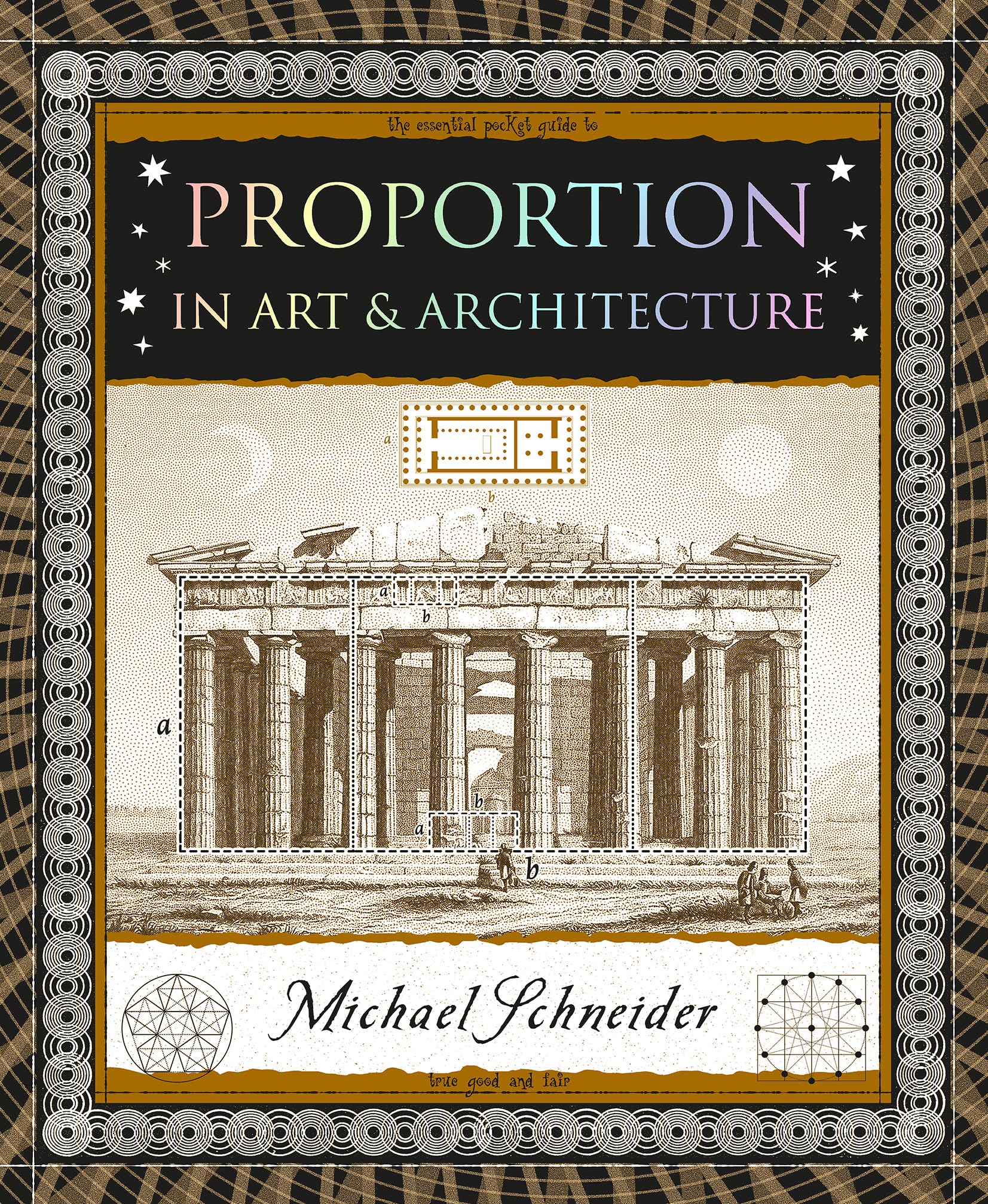
Proportion: In Art & Architecture (Wooden Books North America Editions)
$8.32
by Michael Schneider



What is the difference between ratio and proportion? When is a harmonic rectangle also geometric? Do pentagons, hexagons, and heptagons really each have their own characters? Is there a secret to great art? In this beautiful little book, art educator Michael Schneider presents a groundbreaking synthesis of proportion in the ancient world. From temples to dinner plates, paintings to pots, archways to jewelry, discover the eternally useful tools and techniques of the masters. Michael Schneider is an educator, specializing in the use of mathematics in art. He has taught at the Met, New York, and at the California college of the Arts, San Francisco. Also the author of the bestselling A Beginner’s Guide to Constructing the Universe , he lives in California. Mathematics and art can seem worlds apart. Modern art educators often warn against using numerical schemes and geometric ideas in creative work (cold water on passion). Yet many traditions, from the earliest civilizations onward, used symbolic number as a design tool in their great works of art, crafts, architecture. The intelligent and creative application of ratio, proportion, and harmony, expressed through geometry, can be seen in many ancient works, from the architectural and town planning canons of the c.500 BC Vaastu Shastra to many of the ancient great buildings, artifacts and illustrations around the world. In countless cultures, mathematics was recognized not as a human creation but as the discovery of a sacred and philosophical language already inherent in the cosmos. Numbers were considered ambassadors from eternity, bestowing a divine gift upon humanity for the rational appreciation of creation, and revealing guidelines for our harmonious cooperation with it. In many traditions, a Divine Architect transformed dark chaos into this marvelously ordered cosmos by means of number, ratio and proportion merely using the tools of divider and straightedge. Numbers represent formative powers, and nature displays this numerical canon from quarks to flowers to galactic clusters and beyond. Numbers and their ideal shapes and patterns were once considered paradigma, archetypes, the eternal models we see approximated in nature’s marvelous architecture. Throughout history, civilizations have sought to move in accord with the teachings of this divine gift of mathematical wisdom by applying similar ideas to the harmonic and geometric designs of their arts, crafts and architecture.