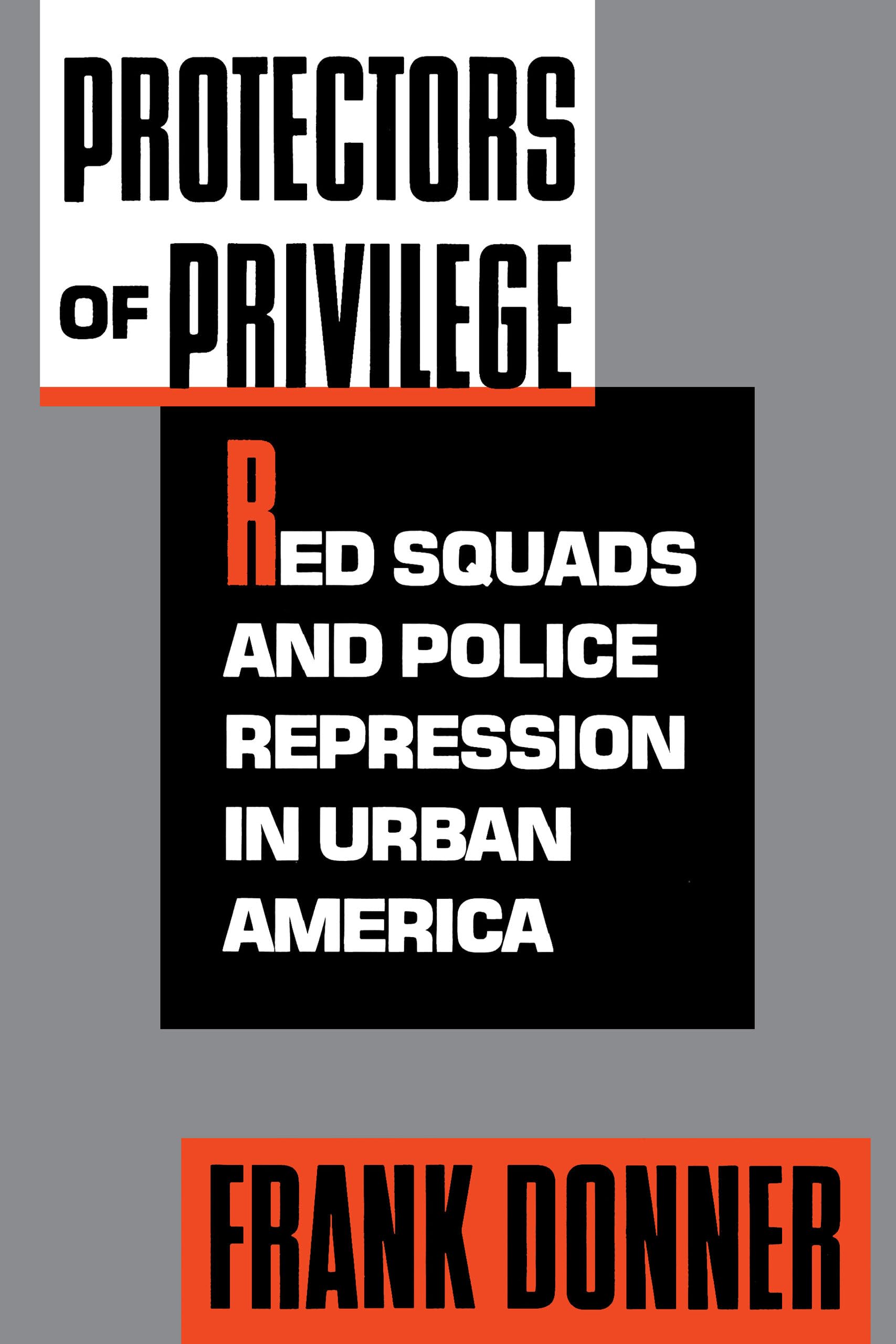
Protectors of Privilege: Red Squads and Police Repression in Urban America
$34.94
by Frank Donner



This landmark exposé of the dark history of repressive police operations in American cities offers a richly detailed account of police misconduct and violations of protected freedoms over the past century. In an incisive examination of undercover work in Chicago, Los Angeles, New York, and Philadelphia as well as Washington, D.C., Detroit, New Haven, Baltimore, and Birmingham, Donner reveals the underside of American law enforcement. "A comprehensive and well-documented study of the political environment that spawned repression; police target selection and operations; the relationship of the squads to the power structure; the role of the press; the methods, assumptions, and career aspirations of ambitious police 'Big Men, ' and the factors that effectively brought an end to the squads."--Pamela D. Delaney, "Political Science Quarterly This book spotlights the repressive police tactics of the past thirty years, particularly the urban intelligence operations and abuses that burgeoned during the political unrest of the 1960s and 1970s. Frank Donner is a prominent civil liberties attorney and the author of The Un-Americans and The Age of Surveillance . Protectors of Privilege Red Squads and Police Repression in Urban America By Frank Donner University of California Press Copyright © 1992 Frank Donner All right reserved. ISBN: 9780520080355 Introduction A strong case has been made for the thesis that in the course of the past hundred years urban police have served as the protective arm of the economic and political interests of the capitalist system. What is especially compelling is that specialized police units have openly performed such functions. Over time these unitssometimes referred to here as "red squads"have vastly proliferated in American cities; at their peak in the sixties, they numbered in the hundreds and according to a 1963 report (see pp. 8182) were served by a "nearly 300,000 man effort . . . pursuing subversion." These cadres have, beginning in the Gilded Age, predominantly engaged in political repression, which, in the context of policing, may be defined as police behavior motivated or influenced in whole or in part by hostility to protest, dissent, and related activities perceived as a threat to the status quo. The damaging impact of this police mission on the protected freedoms was facilitated by the fact that the police charged with such responsibilities were typically engaged in line functions bringing them into direct contact with targeted dissenters and operated in a context of broad discretion (discussed below). These units developed an aggressive confrontational style in fulfilling their repressive mission. The thrust and coverage of these police units have varied considerably over the past century from city to city and reflected such variables as power structure, political culture, ethnic considerations, the role of the press, and industrial development. Over the years, however, especially in the areas of target selection and operations, certain patterns have emerged that explain the process by which police repression was institutionalized throughout urban America. The repressive mission focused first on the classic outdoor protest modes prominent in the nineteenth century, such as demonstrations, mass meetings, rallies, picket lines, pa- rades, and, in the 1960s, vigils. The tactics that have historically been associated with the police response to outdoor gatherings include dragnet and pretext arrests, use of force or the threat of force to disperse gatherings, indiscriminate clubbings, physical dispersal and banishment of targets, and mounted charges, along with vigilante offensives conducted with police support. With the maturation of dissent agendas, organizational growth, and the politicization of protest, police intervention intensified. Indoor meetings and activities were also targeted, as were not only individuals ("agitators") but organizations as well. This expansion of coverage led to covert intervention through informer infiltration, a development strongly influenced by the operational style of private detective agencies. Another consequence of the police attack on organizations was the raid, typically conducted at times and in a confrontational manner intended to maximize intimidation. In the early years of the history of police repression, police authority for intervention was "peacekeeping," a blanket excuse for a virtually unbounded range of activities, and the enforcement of such common law offenses as "unlawful assemblage," "incitement to violence," and "riotous conduct." In the Progressive Era a host of state statutes and local ordinances were added, creating a broad "law enforcement" excuse for restraining the exercise of rights that were then beginning to be recognized as involving constitutionally protected freedoms. An effective device for curbing dissent and protest was the denial by police authoritiesdirectly or vicariouslyof the