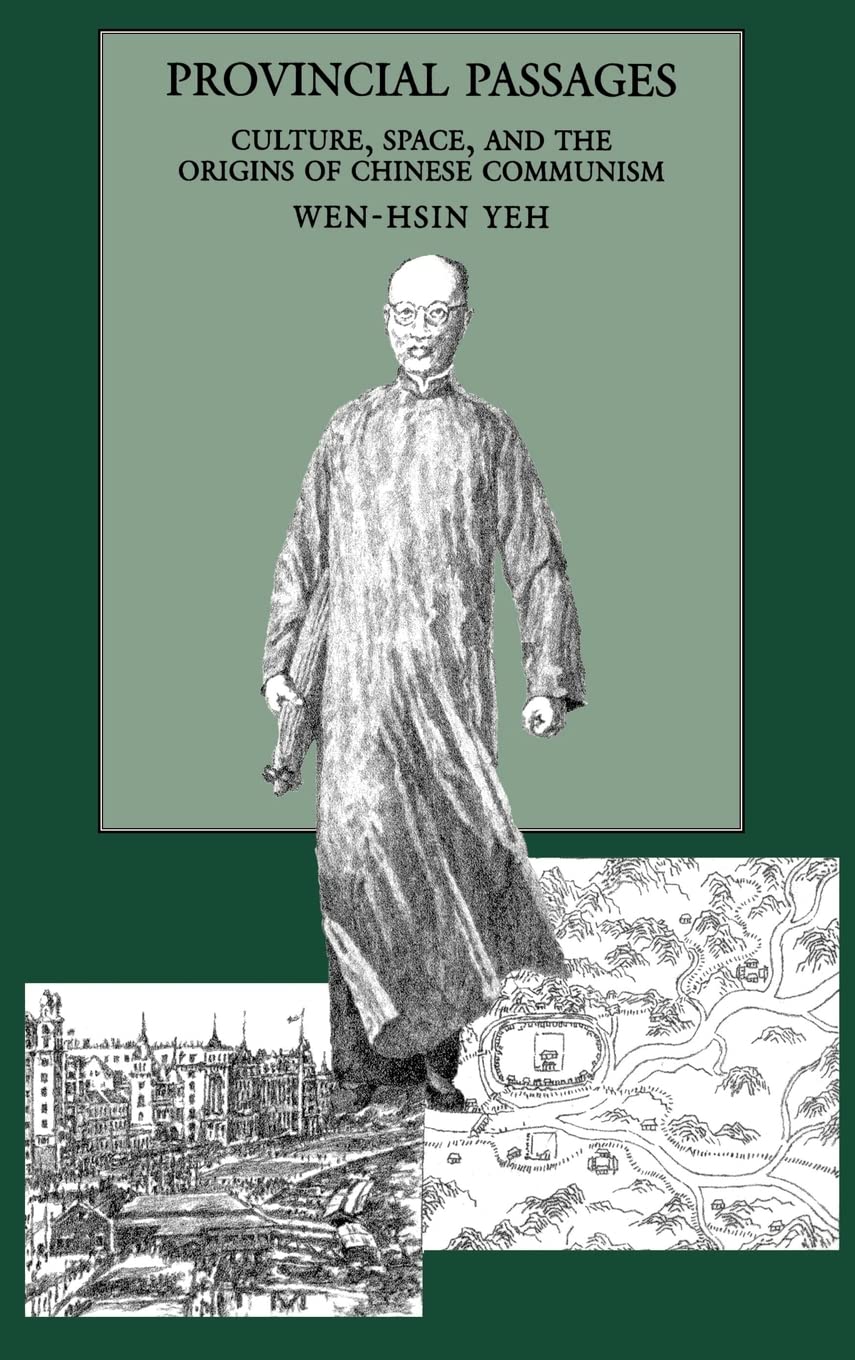
Provincial Passages: Culture, Space, and the Origins of Chinese Communism
$68.95
by Wen-hsin Yeh



Revealing information that has been suppressed in the Chinese Communist Party's official history, Wen-hsin Yeh presents an insightful new view of the Party's origins. She moves away from an emphasis on Mao and traces Chinese Communism's roots to the country's culturally conservative agrarian heartland. And for the first time, her book shows the transformation of May Fourth radical youth into pioneering Communist intellectuals from a social and cultural history perspective. Yeh's study provides a unique description of the spatial dimensions of China's transition into modernity and vividly evokes the changing landscapes, historical circumstances, and personalities involved. The human dimension of this transformation is captured through the biography of Shi Cuntong (1899-1970), a student from the Neo-Confucian county of Jinhua who became a founding member of the Party. Yeh's in-depth analysis of the dynamics of change is combined with a compelling narrative of the moral dilemmas in the lives of Shi Cuntong and other early leaders. Using sources previously closed to scholars, including recently discovered documents in the archives of the First United Front, Yeh shows the urban Communist movement as an intellectual revolution in social consciousness. The Maoist legacy has often been associated with the excesses of the Cultural Revolution. Yeh's historical reconstruction of a pre-Mao, non-organizational dimension of Chinese socialism is thus of vital interest to those seeking to redefine the place of the Communist Party in a post-Mao political order. "This work initiates a broad reevaluation of the origins of the Chinese Communist Party . . . and demonstrates the importance of earlier history to the understanding of twentieth-century events." Don C. Price, University of California, Davis "This work initiates a broad reevaluation of the origins of the Chinese Communist Party . . . and demonstrates the importance of earlier history to the understanding of twentieth-century events."―Don C. Price, University of California, Davis Wen-hsin Yeh is Associate Professor of History and Chair of the Center for Chinese Studies at the University of California, Berkeley. She is the author of The Alienated Academy: Culture and Politics in Republican China, 1919-1937 (1990) and coeditor of Shanghai Sojourners (1993). Provincial Passages: Culture, Space, and the Origins of Chinese Communism By Wen-hsin Yeh University of California Press Copyright © 1996 Wen-hsin Yeh All right reserved. ISBN: 0520200683 1 Zhejiang It remains for us to explain this diversity—the breaks and contrasts, extreme and not so extreme, and the chronic fragmentation of the whole. —Fernand Braudel, The Identity of France Zhejiang province was named after a crooked waterway that was locally much better known as the Qiantang.1 A winding river of more than eight hundred miles, the Qiantang traverses a landscape of "thousands of lush peaks and rolling hills" through a region of over twenty thousand square miles.2 Together with the mountain ranges that contour its flow, this river defines the topographical features of Zhejiang. Zhejiang is located at the point where the southeastern mountain ranges of China meet the East China Sea. Different geologists advance different hypotheses, but by one theory, Zhejiang's mountains were formed tens of millions of years ago, when the Pacific plate thrust itself under the Asian plate at a wide angle along China's southeastern corner. The result is a pattern of mountains arching from southwest to northeast—the great "Cathaysian geosyncline" that created, among other things, strings of islands off the coast, leaving a mere 15 percent of coastal China at less than fifteen hundred feet above sea level. By the same tectonic theory, the Indian continent, riding on a north-ward-drifting plate, collided with Asia some forty million years ago. This "Himalayan Frontal Thrust" created, in China's southwest, the world's steepest mountain ranges and highest plateaus, resulting in a distinct pattern of mountain blocks, inter-mountain plateaus, and basins that follow a northwest-southeast strike.3 One chain of hills links these two mountain systems: the Nanling (Southern Ridges), which run eastward from the Tibetan Plateau toward the South China Sea, forming the watershed between the drainage systems of central and south China. Nanling's easterly thrust toward the sea is altered when the ridges run into what geographers term the southwest-northeast "strike" of the Fujian-Zhejiang hills and particularly the higher ranges of the Wuyi and the Huangshan mountains—part of the Cathaysian geosyncline that arcs to embrace sea, not land. Where the Nanling mountains run into the Wuyi and Huangshan ranges, the ridges intertwine to form the watershed that separates the drainage system of the Yangzi from that of the Fujian-Zhejiang hills. This knot of mountains, which traditionally forms part of Zhejiang's provinc