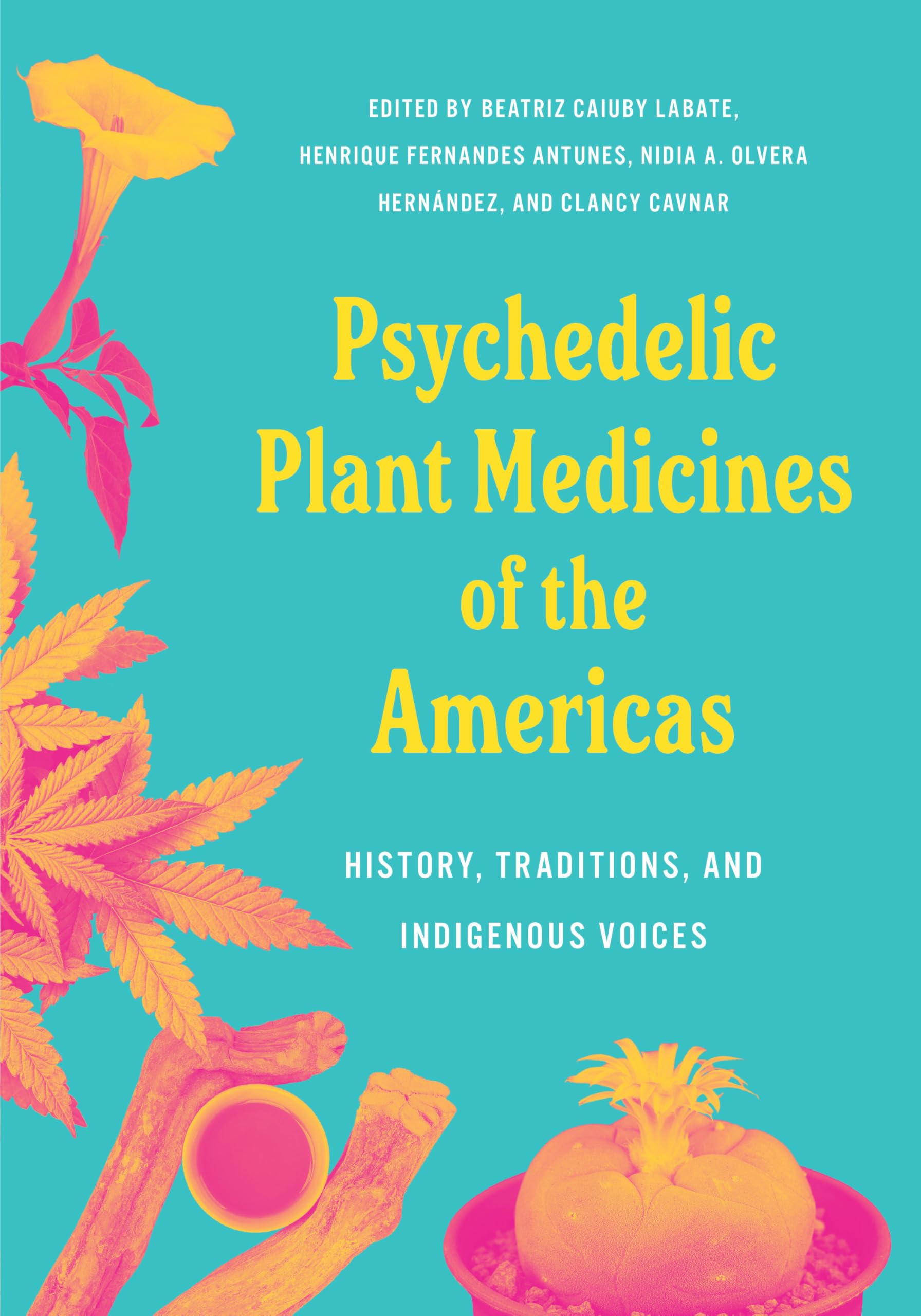
Psychedelic Plant Medicines of the Americas: History, Traditions, and Indigenous Voices
$27.95
by Beatriz Caiuby Labate PHD



An essential new collection that explores the cultural, medicinal, and spiritual traditions of marijuana, psilocybin, ayahuasca, and other psychedelics—informed by both Western and Indigenous knowledge Psychedelic Plant Medicines of the Americas is a collection of 23 psychedelic-specific articles, written by historians, anthropologists, psychologists, and those from other fields in the humanities. Edited by Biatriz Caiuby Labate, PhD—the executive director of the Chacruna Institute for Psychedelic Plant Medicines—this book includes contemporary Indigenous voices and weaves together deep understandings of Indigenous and Western encounters. It offers the broadest, most up-to-date perspectives of any book on the field of psychedelics, including explorations of: • Marijuana’s colonial history in Mexico • Psilocybin mushrooms’ traditional and contemporary uses • Ayahuasca’s and peyote’s roles in Indigenous and religious contexts • Many more psychoactive plant medicines, including coca and tobacco The anthology is a critical reminder, at a time when psychedelics continue to become more popular and mainstreamed at a global level, that these plant medicines are more than a facet of Western counterculture—they’re central to the Indigenous cultures and lifeways that sustain them. Gaining a greater understanding of why people have used and continue to use psychedelic plant medicines—informed by those with rich expertise and knowledge histories—is imperative. The editors and contributors offer a vital, comprehensive, and deeply rooted examination of plant medicine ontologies. “An innovative book that focuses on a variety of plants and practices, some of which have received rather limited scholarly attention. It approaches the complex circuits and new agents within the global landscape of psychoactive plant medicines from a nuanced and balanced ethical stance, and takes into account the reality of commodification, implying the growing circulation of substances throughout the entire world, the problem related to the territories and ecology where these plants grow, and the challenges and opportunities this opens up for Indigenous communities.” —Brigitte Adriaensen, professor of Latin American Studies at Radboud Universiteit Nijmegen (Netherlands) “Coming to this book after years of work at the intersection of drug policy, human rights, and community based responses to substance use, I most value its deep respect for shared knowledge and for the Indigenous wisdom that has safeguarded psychedelic plant medicines for generations. Grounded in the voices of communities themselves, it explores ancestral practices as they live and adapt in the present, from peyote in Mexico to coca circles and the Wirikuta community’s relationship with peyote, reminding us to honor where this knowledge comes from and how we continue learning together.” —Zara Snapp, director of Instituto RIA Dr. Bia Labate, cofounder and executive director of the Chacruna Institute for Psychedelic Plant Medicines, is an anthropologist, educator, author, speaker, and activist, committed to the protection of sacred plants while amplifying the voices of marginalized communities in the psychedelic science field. She has a PhD in anthropology, and her main areas of interest are the study of psychoactive substances, drug policies, shamanism, ritual, and religion. She is author, coauthor and coeditor of twenty-nine books, one journal special edition and several peer-reviewed articles. Dr. Henrique Fernandes Antunes holds a PhD in anthropology from the University of São Paulo (2019), has been a visiting scholar at UC Berkeley, and has held postdoctoral positions at EHESS, the University of Ottawa, and CEBRAP. Currently, he is research director at the Chacruna Institute, a member of CEBRAP’s Religion in the Contemporary World Group, and is affiliated with the Interdisciplinary Group for Psychoactive Studies (NEIP). His research examines the regulation and global circulation of ayahuasca Nidia A. Olvera Hernández is a Mexican historian and anthropologist. She has a PhD in modern and contemporary history from the Mora Institute in Mexico City. Nidia earned a bachelor’s degree in ethnohistory from the National School of Anthropology and History (ENAH) and a master’s in social anthropology from the Center for Research and Higher Studies in Social Anthropology (CIESAS) in Mexico City. Her primary research interests lie in the historical and contemporary dimensions of psychoactive substance use and drug policy. She collaborates as a research associate at Chacruna Latinoamérica in México and contributes to the Journal of Social History of Alcohol and Drugs as associate review editor and is a research fellow at the Consortium for the History of Science. Currently she is a postdoctoral researcher on the project “Poison, Medicine or Magic Potion? Shifting Perspectives on Drugs in Latin America” at Radboud University, Netherlands. Clancy Cavnar, PsyD, is a clinical ps