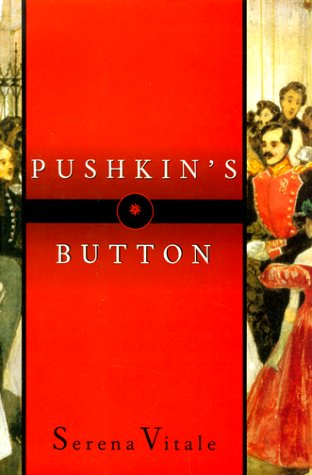



Traces the last four months of the revered Russian poet, Alexander Pushkin, who died from wounds received in a duel with a French officer In telling the story of the duel that killed Aleksandr Pushkin, Russia's great poet, writer Serena Vitale does something more exciting than simply putting together a biographical chronology of the man's life. In place of the usual plod through life and works, Vitale focuses on the extraordinary events of the end of Pushkin's life, and works backwards and sideways, as it were, to provide a quirkily rich portrait of the man. She is successful in part because she writes like a novelist instead of an ordinary biographer and she makes connections and assessments worthy of the lively mind of Pushkin himself. Take, for instance, the book's title: an anecdote about Pushkin's clothing noted by a contemporary ("Pushkin's bekesh was missing a button at the back, at waist height ... clearly they were not looking after him") leads Vitale not into contemplation of the adequacy of the many servants who attended the poet, but rather into the way the missing button "resembles the stress accent that suddenly breaks loose from the iamb and vanishes into the void" in a typical Pushkinian line of verse. Pushkin's Button is bursting at the seams with surprising and illuminating perspectives such as this. --Adam Roberts Alexander Pushkin, a descendant of Hannibal of Carthage, was Russia's greatest poet. He was also married to the most beautiful woman in St. Petersburg, who attracted the attention and admiration of many men in Russian society, notably one Georges D'Anthes. D'Anthes had been adopted by the Dutch ambassador, Baron von Heerecken, and was a chevalier de garde for Tsar Nicholas I. Vitale (Russian literature, Univ. of Pavia, Italy) presents a marvelous biographical mystery in which she explores the events leading to the duel between Pushkin and D'Anthes. Through letters, the reader gets an intimate view of the personalities and passions of early 19th-century Russia. Vitale sheds new light on the causes of the duel and makes the story accessible to 20th-century readers. Highly recommended for public and academic libraries.AAnn Irvine, Montgomery Cty. P.L., Silver Spring, MD Copyright 1999 Reed Business Information, Inc. An Italian scholar's unorthodox take on the events leading to Pushkin's fatal duel reads like impassioned fiction. On January 27, 1837, one of Russia's greatest poets, Alexander Pushkin, died as the result of a wound inflicted during a duel hed fought to defend his wife's honor. His opponent was none other than his sister-in-law's husband, Georges d'Anthes, a French officer. Readers will recognize telltale signs in Vitales (Russian/Univ. of Pavia, Italy) narrative of the typically massive Russian novel: the cast of thousands (here enumerated in a 24-page ``Index of Names'') and the storys soap-opera-like overtones. Combining her own research with information gleaned from secondary literature and the memoirs and letters of Pushkin's contemporaries, this account brims with humor, drama, scholarly insight, and a breathless conversational tone, hinting of espresso and cigarette smoke wafting in a cafe corner. Vitale's approach, however, is not for everyone. The duel occurs some 242 pages into the text. Chapter titles, like the title of the book, are more poetic than informative. And the facts are often conveyed repetitiously. Still, the drawbacks seem finally beside the point, for Vitale brings to life the drama of Pushkin's end, from the state of the poet ``whose frenzied jealousy was known to all,'' to the doings of his flirtatious wife and the royal court, Pushkin's strained relations with the tsar, and the bizarre case of d'Anthes's adoption by a Dutch ambassador and his affairs with the women of St. Petersburg. Also, the author eagerly takes up her role as detective, investigating d'Anthes's circumstances, his opinion of Pushkin's wife, and the circulated letter that provoked the duel. With its unabashed love of intrigue and nuance, Vitale's unusual chronicle of Pushkin's final days will appeal to any lover of Russian literature, history, and culture. -- Copyright ©1998, Kirkus Associates, LP. All rights reserved. ... Pushkin's Button is a delightful combination of retrograde pleasures (court balls, the demise of a doomed genius) and primary sources. -- The New York Times Book Review , Richard Lamb Pushkin's Button embeds the still-mysterious story of Pushkin's last years, love(s) and works, duel and death in a richly costumed and often comic portrayal of Russia's repressive court society during the reign of Tsar Nicholas I, "the gendarme of Europe." It will keep all constituencies of readers fastened to their seats, as they watch Petersburg's lofty denizens leave no moment of the hurtling Pushkin scandal unrecorded or not speculated upon. -- The Los Angeles Times Sunday Book Review , Monika Greenleaf