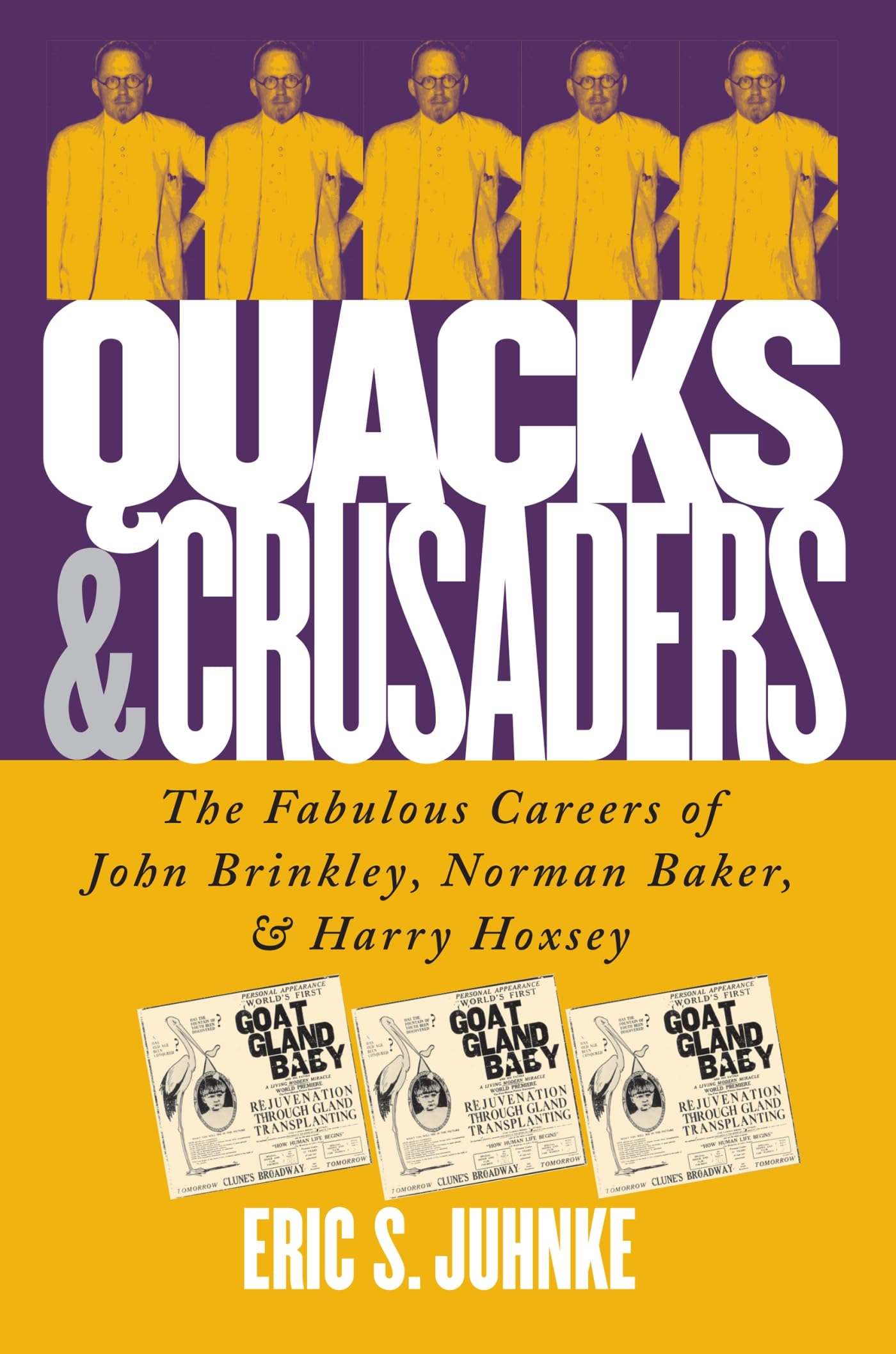
Quacks and Crusaders: The Fabulous Careers of John Brinkley, Norman Baker, and Harry Hoxsey
$49.99
by Eric S. Juhnke



One promoted goat gland transplants as a remedy for lost virility or infertility. Another blamed aluminum cooking utensils for causing cancer. The third was targeted by the Food and Drug Administration as “public enemy number one” for his worthless cures. John Brinkley, Norman Baker, and Harry Hoxsey were the ultimate snake oil salesmen of the twentieth century. With backgrounds in lowbrow performance—carnivals, vaudeville, night clubs—each of these charismatic con men used the emerging power of radio to hawk alternative cures in the Midwest beginning in the roaring twenties, through the Depression era, and into the 1950s. All scorned the medical establishment for avarice while amassing considerable fortunes of their own; and although the American Medical Association castigated them for preying on the ignorant, this book shows that the case against them wasn’t all that simple. Quacks and Crusaders is an entertaining and revealing look at the connections between fraudulent medicine and populist rhetoric in middle America. Eric Juhnke examines the careers of these three personalities to paint a vision of medicine that championed average Americans, denounced elitism, and affirmed rustic values. All appealed to the common man, winning audiences and patrons in rural America by casting their pitches in everyday language, and their messages proved more potent than their medicines in treating the fears, insecurities, and failing health of their numerous supporters. Juhnke first examines the career of each man, revealing their geniuses as businessmen and propagandists—with such success that Brinkley and Baker ran for governor of their states and Hoxsey had thousands of supporters protest his “persecution” by the FDA. Juhnke then investigates the identity, motives, and willingness to believe of their many patients and followers. He shows how all three men used populist rhetoric—evangelical, anti-Communist, anti-intellectual—to attract their clients, and then how their particular brand of populism sometimes mutated to anti-Semitism and other sentiments of the radical right. By treating the incurable, Brinkley, Baker, and Hoxsey took on the mantles of common folk crusaders. Brinkley was idolized for his goat gland cures until his death, and Hoxsey’s former head nurse continued his work from Tijuana until her death in 1999. In considering who visits quacks and why, Juhnke has shed new light not only on the ongoing battle between alternative and organized medicine, but also on the persistence of quackery—and gullibility—in American culture. "In this interesting and enlightening book, Eric Juhnke has extended our insights into twentieth-century quacks and quackery—and their patients."— Journal of the History of Medicine "Juhnke delves into the personal motives and social bases of the quacks’ clientele. . . . That he manages to delineate a social base for quackery, without denigrating the populace composing that base, is the remarkable achievement of this book."— Journal of American History "An interesting, well-written story of mid-twentieth century charlatanism. . . . A significant contribution to an increasingly vibrant literature on the practitioners of irregular or non-traditional medicine."— American Studies "Juhnke looks back at three of the most notorious medical quacks of the first half of the 20th century and provides a perspective on how one can manipulate the sick and the not-so-sick to accept bogus medical solutions. . . . The perspective revealed portrays a reality more complex than the stereotypes would suggest. A readable and entertaining work."— Choice "Provides a useful glimpse into America in the Great Depression and illustrates the deep distrust of organized medicine among some elements of our society."— Arkansas Historical Quarterly "The quacks and crusaders this book covers are deeply woven into the fabric and history of mid-America. . . . Both a scholarly and an entertaining read. . . . I commend this contribution to the history of Middle America in the twentieth century."— Nebraska History “Based on prodigious research, Juhnke’s book makes a major contribution to the study of health quackery in America. . . . Readers will be gripped by his narrative and enlightened by his insights into a major, continuing problem in the nation’s health marketplace.”— James Harvey Young , author of American Health Quackery “A readable account of why three of America’s best known medical frauds succeeded, and what their success indicates about the context of our health care system.”— Michael S. Goldstein , author of Alternative Health Care: Medicine, Miracle, or Mirage? “Vividly describes the sales pitches and political maneuvering that enabled Brinkley, Baker, and Hoxsey to ‘succeed.’ Astute readers will recognize that today’s quacks use many of the same techniques.”— Stephen Barrett , M.D., Quackwatch.com "Based on prodigious research, Juhnke s book makes a major contribution to the study of health quackery in