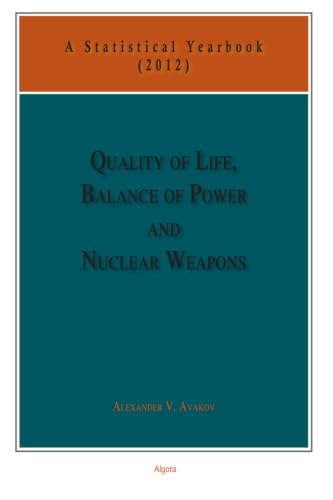
Quality of Life, Balance of Power and Nuclear Weapons (2012): A Statistical Yearbook for Statesmen and Citizens
$19.95
by Alexander V Avakov



Quality of Life, Balance of Power and Nuclear Weapons by Alexander V Avakov explores the intersection of nuclear weapons, global politics, and human well-being. This insightful analysis examines the balance of power between nations shaped by nuclear weapons and their impact on the quality of life both in nuclear-armed countries and globally. Introduction: The Paradox of Nuclear Power Avakov begins by addressing the paradox of nuclear weapons. While nuclear deterrence is seen as a means of national security, it also fosters global fear and instability. The balance of power has been profoundly influenced by the existence of nuclear arsenals, creating a tense environment where the potential for mass destruction exists. Despite their destructive power, nuclear weapons are often viewed as necessary for security, even as they raise questions about the cost to global stability. Nuclear Weapons and National Security The book explores the impact of nuclear weapons on national security, examining how different countries, from superpowers to emerging states, view their nuclear arsenals. Key events like the Cold War and the arms race are revisited to understand how nuclear weapons have altered military strategies and international diplomacy. Nuclear deterrence, while preventing large-scale wars, has also caused a shift in global power dynamics, making the world more vulnerable to conflicts of a different nature. Quality of Life in the Nuclear Age A significant focus of the book is the effect nuclear weapons have on the quality of life worldwide. Avakov discusses the psychological and economic tolls of living in a nuclear age, from the constant threat of nuclear conflict to the resources diverted into military buildup instead of social needs like education and healthcare. The arms race has also diverted attention from issues of poverty and social welfare, creating a global environment of uncertainty. The Ethics of Nuclear Deterrence Avakov further delves into the ethical dilemmas surrounding nuclear deterrence. While some argue that nuclear weapons maintain peace through deterrence, others believe their very existence creates instability. The book addresses the justifications for nuclear arsenals and the moral debate about their use, questioning whether their role in national security outweighs the dangers they present to global peace. Nuclear Disarmament and Global Peace The final section of the book advocates for nuclear disarmament as a path to global peace. Avakov calls for global cooperation to reduce nuclear stockpiles and work toward a world where nuclear weapons are eliminated. Drawing on historical attempts at disarmament, including the Non-Proliferation Treaty and arms reduction agreements, the book highlights the challenges in achieving this goal, such as political resistance and the rise of non-state actors. Conclusion: A Call for Change Avakov concludes by urging world leaders to focus on improving the quality of life for citizens rather than prioritizing military power. He emphasizes the need for a new approach to international relations that values human security and global peace over nuclear power. The book concludes with a call for continued dialogue and a commitment to disarmament, ensuring a safer, more stable world for future generations. Alexander V. Avakov holds degrees in mathematics and mathematical economics with additional studies in economics, philosophy, law, politics, anthropology, sociology and psychology. Used Book in Good Condition