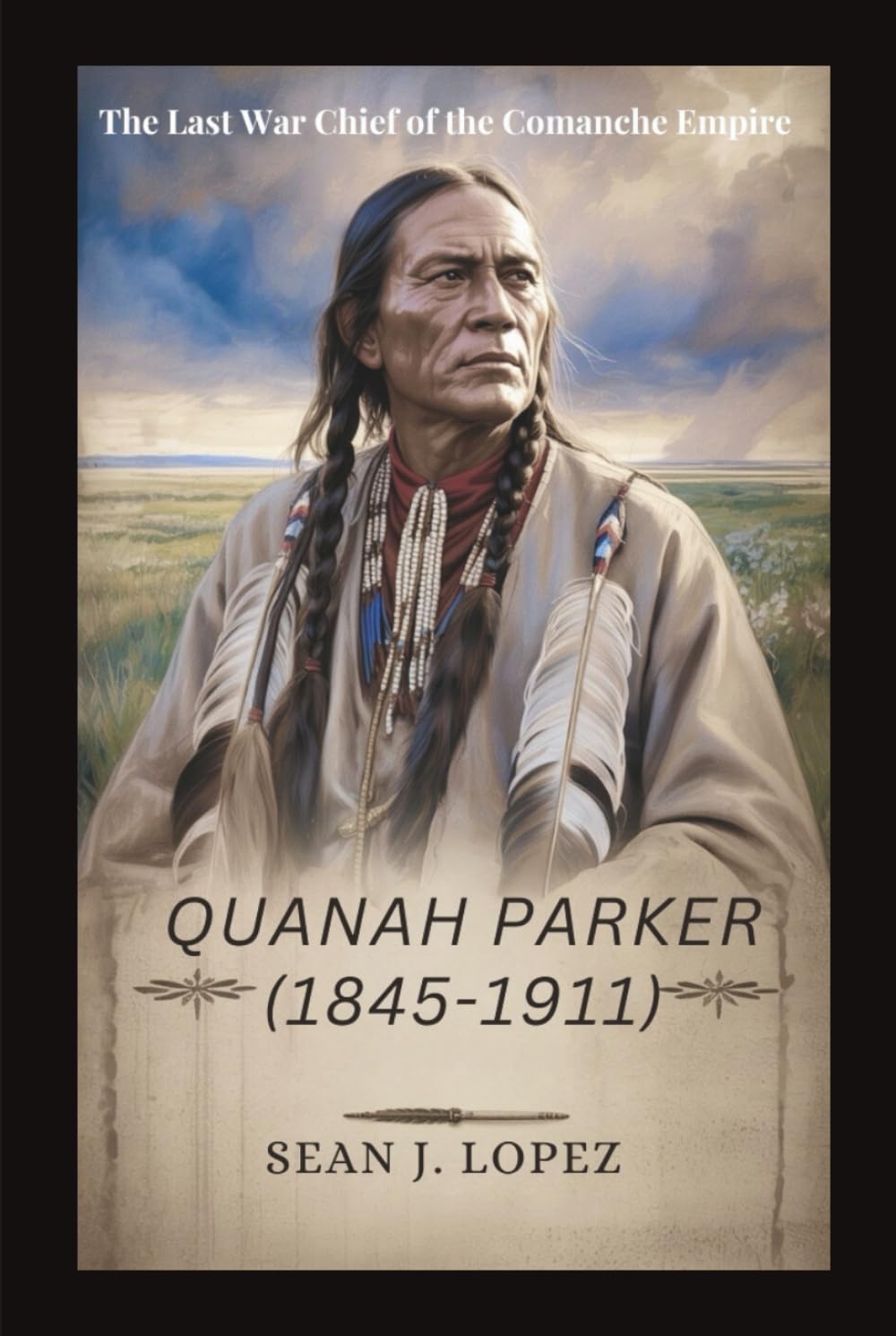
Quanah Parker (1845–1911): The Last War Chief of the Comanche Empire
$26.99
by Sean J.Lopez



Can one man embody both the end of a warrior empire and the beginning of a new world? "I do not belong to the past alone. I look to the future, and to my people’s survival." — Attributed to Quanah Parker On the boundless Southern Plains, where the horizon stretched farther than the eye could see, the Comanche once ruled as the unrivaled masters of horse, buffalo, and war. Into this world, in 1845, a boy was born whose life would become the story of a nation’s rise, resistance, and transformation. His name was Quanah Parker —the son of the legendary warrior Peta Nocona and Cynthia Ann Parker, a white woman captured as a child and absorbed into Comanche life. From his first breath, Quanah carried within him the merging of two worlds that would clash with unrelenting fury across the 19th century. As a young warrior, Quanah came of age in the twilight of Comanche power. He rose quickly to lead the Quahadi, the fiercest of all Comanche bands, men who refused to bow to soldiers or settlers. His raids cut deep into Texas and Mexico, his horsemen striking with terrifying speed across the open plains. At the Second Battle of Adobe Walls, his warriors confronted buffalo hunters in a thunderous clash that echoed the last great resistance of the free Comanche people. Yet even Quanah’s brilliance in war could not halt the tide of destruction. The U.S. Army, relentless and equipped with superior resources, waged the Red River War with a single aim: the annihilation of Comanche freedom. The buffalo were slaughtered, the camps starved, and the plains emptied of life. In 1875, Quanah Parker faced the unthinkable—surrender. But his greatest test was only beginning. On the reservation at Fort Sill, Quanah did not fade into history. Instead, he reinvented himself. Refusing to be broken, he became the bridge between two civilizations. He negotiated with Washington politicians and cattle kings, secured land and resources for his people, and defended their dignity in an age that sought to erase them. His leadership was not only political but spiritual: through his embrace of the peyote religion, Quanah helped give birth to the Native American Church, ensuring that the spiritual heart of his people endured even as their world changed forever. His life is the story of paradox and power—of a warrior who became a statesman, of a man rooted in tradition yet forced to navigate modernity, of a leader who embodied both resistance and survival. When he died in 1911, Quanah Parker was more than the last war chief of the Comanche Empire—he was a living symbol of adaptation, resilience, and the unbreakable spirit of his people. Quanah Parker (1845–1911): The Last War Chief of the Comanche Empire is more than a biography. It is a sweeping epic of the American frontier, a tale of conquest and survival, of blood and betrayal, of courage and transformation. It takes readers from the buffalo plains to Washington’s corridors of power, from Comanche raids that shook the Texas frontier to the sacred peyote ceremonies that reshaped Native American spirituality. For anyone who seeks to understand the collision of cultures that defined America’s westward expansion, and the man who stood astride that violent divide, this book offers a journey as unforgettable as the chief himself.