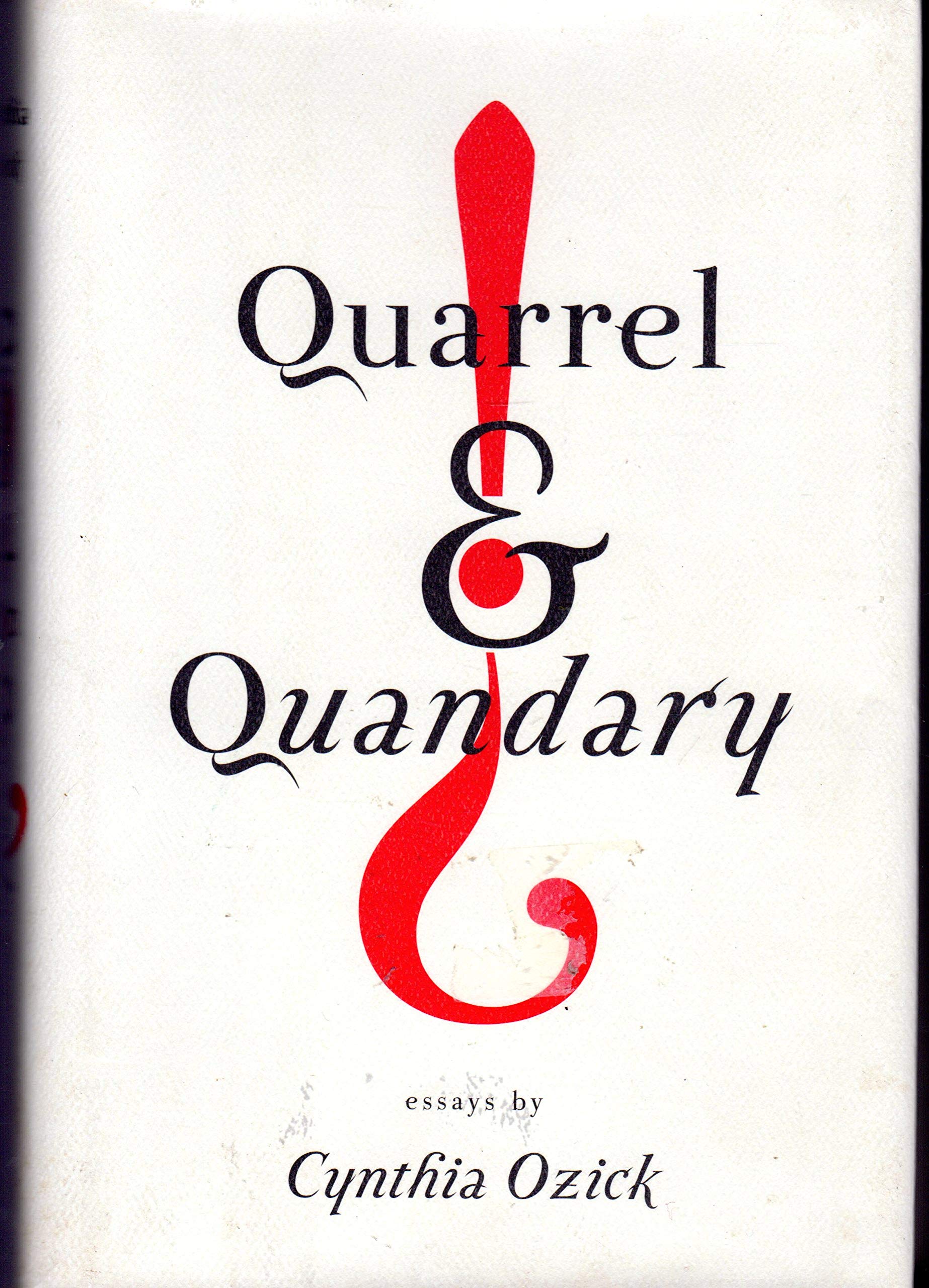



In her new collection of essays, Cynthia Ozick, everywhere acclaimed as a critic, novelist, and storyteller, examines some of the world's most illustrious writers and their work, tackles compelling contemporary literary and moral issues, and looks into the wellsprings of her own lifelong engagement with literature. She writes--quarrelsomely--about Crime and Punishment , about William Styron's Sophie's Choice , about the Book of Job. She inquires into the subterranean dispositions and quandaries of Kafka and Henry James. She discusses the difficulties inherent in the translation of great books, whether into film or into another language. She explores what she calls "the selfishness of art" and courts controversy with her views on The Diary of Anne Frank and its transformation for the stage. Her reflections on the "rights of history" and the "rights of imagination" tap a profound concern for truth in regard to the Holocaust. She considers the shifting splendors of New York City, past and present. And she revisits her youth more deeply and with more feeling--and comedy--than ever before, in essays that reveal some of the formative experiences of her life as a writer. Quarrel & Quandary is a literary event and a cause for celebration. "True essayists," declares Cynthia Ozick, "rarely write novels." This pronouncement would seem to overlook a horde of ambidextrous types, from John Updike to Gore Vidal to Charles Baxter to Joyce Carol Oates --and, of course, Ozick herself. The author of three novels, she is also among our finest essayists, combining a Jamesian nose for moral nuance with some of the most playful and pugnacious prose in contemporary letters. And her fourth collection, Quarrel & Quandary , contains some of her very best work. There are ardent considerations of particular authors, including W.G. Sebald, Franz Kafka, and Swedish modern Goran Tunstrom. But this time around, the author is even more intent on exploring the rhetorical minefield where art and politics overlap. Her introduction, in fact, is one long riff on the importance of being earnestly engagé , at the end of which Ozick manages to have her cake and eat it too: "Two cheers, then--when there is no choice--for being engagé ; but three cheers and more for that other bravery, the literary essay, and for memory's mooning and maundering, and for losing one's way in the bliss of American prose...." In three provocative pieces ("The Rights of History and the Rights of the Imagination," "The Posthumous Sublime," and "Who Owns Anne Frank?"), Ozick suggests that the Holocaust is almost--but not quite--impervious to literature. She's particularly angered by the morphing of Frank's diary into a mother lode of Broadway-style uplift, a transformation that "tampers with history, with reality, with deadly truth." Elsewhere, though, Ozick is less polemical, more willing to be dazzled by Roethke's radiance or Henry James's epistemological high beams. And it's not only specific artists but entire genres that win her awed and eloquent approval: When we say that poetry is strange, we mean not that it is less than intelligible, but exactly the opposite: poetry is intelligibility heightened, strengthened, distilled to the point of astounding us; and also made manifold. Metaphor is intelligibility's great imperative, its engine of radical amazement. At its best, Ozick's prose is equally, radically amazing. She may not always compel our agreement--the scolding she administers to W.G. Sebald, whom she clearly admires, is something of a puzzler--but her voice never ceases to register distinction and detail, emitting what she calls "the hum of perpetual noticing." Five cheers, then, for Quarrel & Quandary . And by the way, might Mooning & Maundering be a candidate for the author's next alliterative title? --James Marcus In the introduction to this wide-ranging collection of essays, Ozick (Fame and Folly) argues: "If there is information in an essay, it is by-the-by, and if there is an opinion in it, you need not trust it for the long run. A genuine essay has no educational, polemical, or sociopolitical use." Her elegant essays live up to her own definition. Although she takes up political topics, as when she uses Dostoevsky's writing as a foil for a discussion of terrorism, or when she writes about literature and politics in an essay on The Diary of Anne Frank, politics is not the center of those essays. Ozick takes us on a meandering walk through the halls of literature, moving us to ponder Henry James's selfishness in protecting his space to write his stories and novels or the difficulties in translating Kafka. Her essay on public intellectuals, who, she argues, find a suitable model in E.M. Forster, offers fresh insights into a contentious topic. While many of the essays may be subtly polemical, all of them are deeply personal considerations of literature and life. Warm, funny, and engaging, this collection is highly recommended.