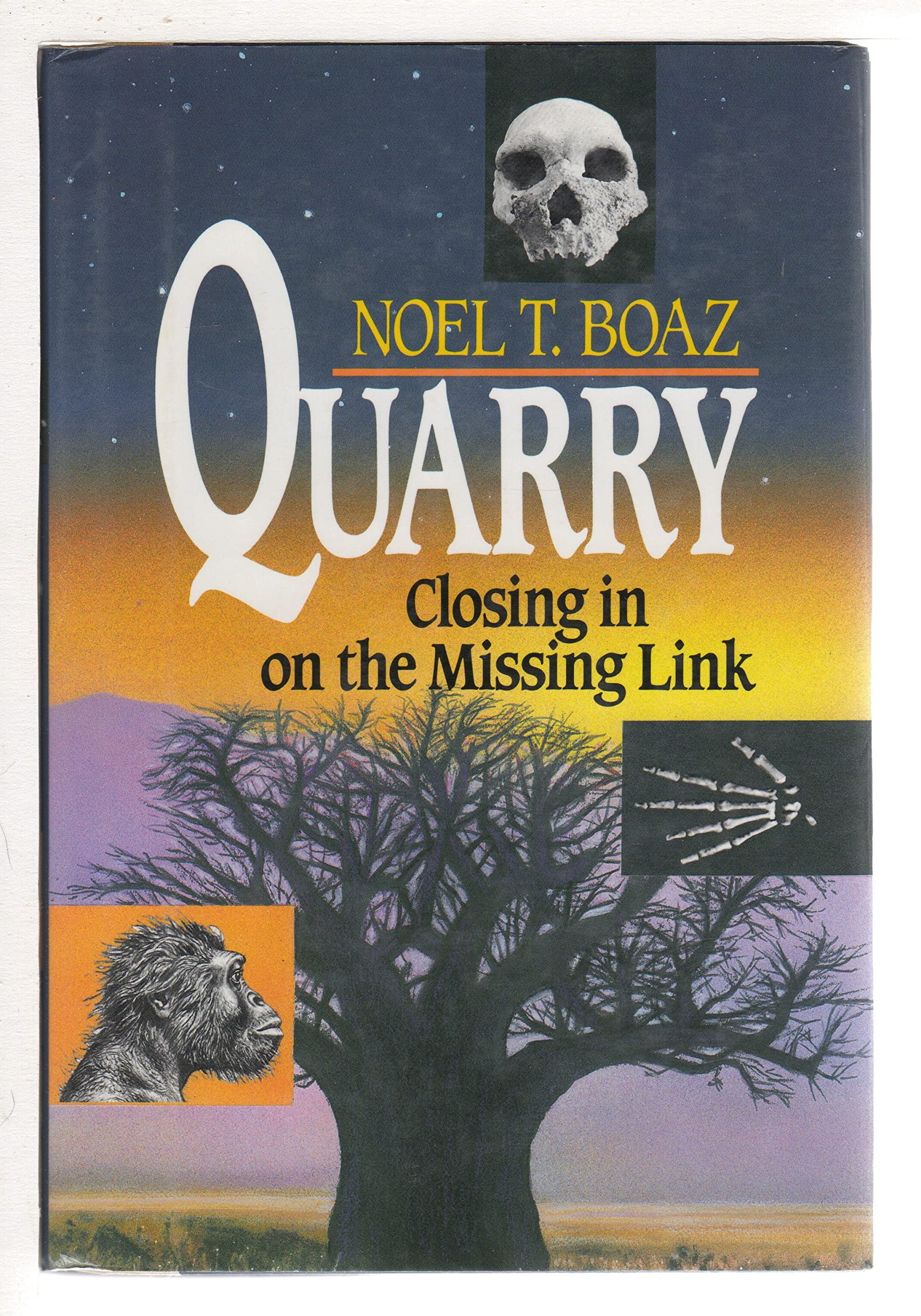



An anthropologist recounts his twenty-year quest in northern and eastern Africa, and shows how findings from a variety of fields contribute to a complete picture of human evolution and provide a context for understanding today's problems Boaz, director of the International Institute for Human Evolutionary Research, has written a popular account of his fieldwork experiences in North and West Africa. Like many books written by field anthropologists, Quarry combines an adventure story of fieldwork in Africa--in this case a search for the common ancestor of humans and the great apes--with non-technical chapters on the author's interpretations of his fossil finds and their implications for human evolutionary theory. The vignettes on life in the field are entertaining, but one wishes Boaz had spent more time developing his views on the evolution of bipedalism, large brains, and culture and defending them against rival interpretations. Recommended for public and large academic libraries. - Eric Hinsdale, Trinity Univ. Lib., San Antonio Copyright 1993 Reed Business Information, Inc. ``Have they found it?'' will be the query of most readers. The answer is no--not by a long shot--although Boaz (Anthropology/George Washington University) shows that knowledge about early humans has leaped dramatically during the last generation. The Rubicon was 1950, when biological anthropology was born at a conference at Cold Spring Harbor. This new science replaced the old method of studying fossil human specimens--by endlessly categorizing them into ever-finer types--with new disciplines that situated early humans in their social and ecological context. What ancient people ate, when they hunted, even how they made love became issues in the new paleoanthropology, aided by advances in geology, ethology, and taphonomy (the study of how fossils are created and preserved), as well as by new dating methods. Boaz argues strongly for biological anthropology and its tenets, the most controversial of which is that human behavior--gang warfare, for instance--is ``hardwired,'' a result of evolution and natural selection rather than social conditions. Readers will take note, too, of Boaz's chiding of leading paleontologists, including Richard Leakey (for being dictatorial), Stephen Jay Gould (for relying on armchair science), and Donald Johanson (for faulty dating). His own adventures on long, weary, dusty digs in Zaire and Libya are recounted with verve as he addresses key questions--Why did bipedalism develop? What role did climate play in our origins? --and makes his case that humans arose in East Africa 2.5 million years ago. Peppery, informative bones of contention. -- Copyright ©1993, Kirkus Associates, LP. All rights reserved.