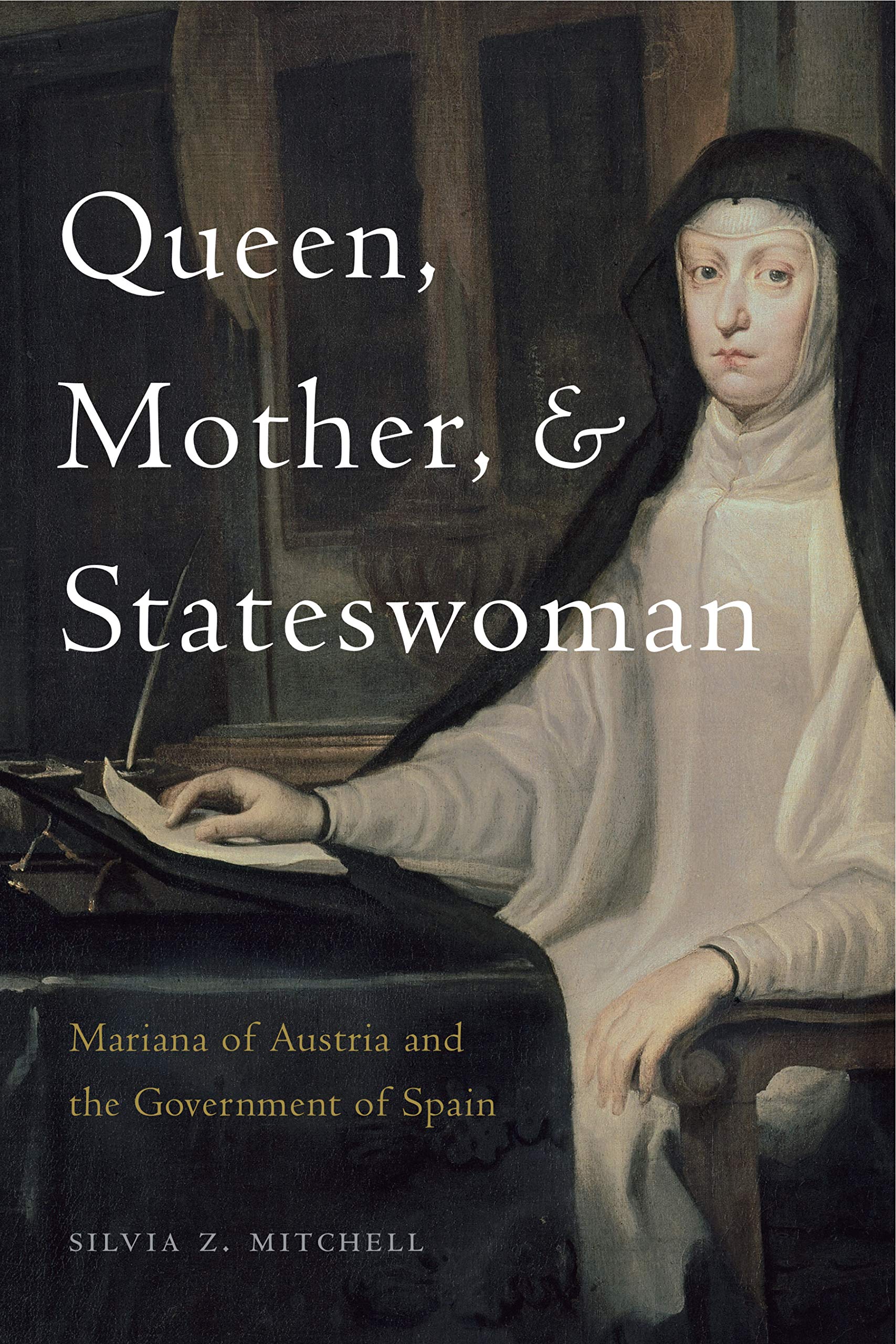
Queen, Mother, and Stateswoman: Mariana of Austria and the Government of Spain
$34.95
by Silvia Z. Mitchell



When Philip IV of Spain died in 1665, his heir, Carlos II, was three years old. In addition to this looming dynastic crisis, decades of enormous military commitments had left Spain a virtually bankrupt state with vulnerable frontiers and a depleted army. In Silvia Z. Mitchell’s revisionist account, Queen, Mother, and Stateswoman , Queen Regent Mariana of Austria emerges as a towering figure at court and on the international stage, while her key collaborators―the secretaries, ministers, and diplomats who have previously been ignored or undervalued―take their rightful place in history. Mitchell provides a nuanced account of Mariana of Austria’s ten-year regency (1665–75) of the global Spanish Empire and examines her subsequent role as queen mother. Drawing from previously unmined primary sources, including Council of State deliberations, diplomatic correspondence, Mariana’s and Carlos’s letters, royal household papers, manuscripts, and legal documents, Mitchell describes how, over the course of her regency, Mariana led the monarchy out of danger and helped redefine the military and diplomatic blocs of Europe in Spain’s favor. She follows Mariana’s exile from court and recounts how the dowager queen used her extensive connections and diplomatic experience to move the negotiations for her son’s marriage forward, effectively exploiting the process to regain her position. A new narrative of the Spanish Habsburg monarchy in the later seventeenth century, this volume advances our knowledge of women’s legitimate political entitlement in the early modern period. It will be welcomed by scholars and students of queenship, women’s studies, and early modern Spain. “Contains many insights that help us to understand a very complex series of events. This is an important book that people will want to read. It will be invaluable for undergraduate courses on Spanish and European history, as well as an essential point of reference for future research into the exciting world of early modern Spanish political and cultural history.” ―Alistair Malcolm Bulletin of Spanish Studies “An impressive work of scholarship that adds a great deal not only to our knowledge of late Hapsburg Spain, but also to the field of queenship studies by increasing our understanding of both the life of this formidable royal woman and the mechanisms and challenges of female regency itself.” ―Elena Woodacre Royal Studies Journal “Built upon a base of impressive archival research, Mitchell has provided an illuminating analysis of a ruler whose historical reputation has been the victim of incomplete, stereotypical, and even misogynist characterizations.” ―Elizabeth A. Lehfeldt Renaissance Studies “An imaginative and wholly original account of a ruler who is regarded as the personification of Spain’s seventeenth-century decline as an imperial power. Mitchell revises the traditional view of Mariana as the hapless pawn of her confessors and male courtiers and shows her to be a fiercely independent woman capable of decisive action in domestic and foreign affairs as well as a ruler who successfully managed to defend the interests and reputation of Spain’s Habsburg monarchy. This book is a valuable contribution to the growing body of literature on early modern queenship.” ―Richard L. Kagan, author of Clio and the Crown: The Politics of History in Medieval and Early Modern Spain “Countering the common perception of Mariana de Austria as weak, too young to govern, and easily manipulated, Silvia Mitchell demonstrates that Mariana was a forceful, effective regent during the period of her son’s minority (1665-75). Grounded solidly in fresh archival research, Queen, Mother, and Stateswoman will advance the historical debate on Mariana, on seventeenth-century royal favorites, and on the court of Charles II of Spain.” ―Magdalena Sánchez, author of The Empress, the Queen, and the Nun: Women and Power at the Court of Philip III of Spain “Mitchell mines court archives and state records to demonstrate that Mariana of Austria had clear and consistent diplomatic and military strategies as queen regent, and he establishes her as part of a long tradition of strong female leadership in early modern European courts. This work fills a significant gap in our understanding of the late seventeenth-century Spanish court and supports recent arguments in favor of Spanish resilience rather than decline under the last Habsburgs.” ―Jodi Campbell, author of At the First Table: Food and Social Identity in Early Modern Spain “Silvia Mitchell’s work is an important revisionist study of the regency of Mariana of Austria, mother of the last Spanish Habsburg. Based upon wide-ranging and detailed research, it has considerable implications for a much more positive understanding than has prevailed hitherto not only of the last decades of Habsburg rule in Spain but also, more broadly, of female political agency in early modern Europe.” ―Christopher Storrs, author of The Resil