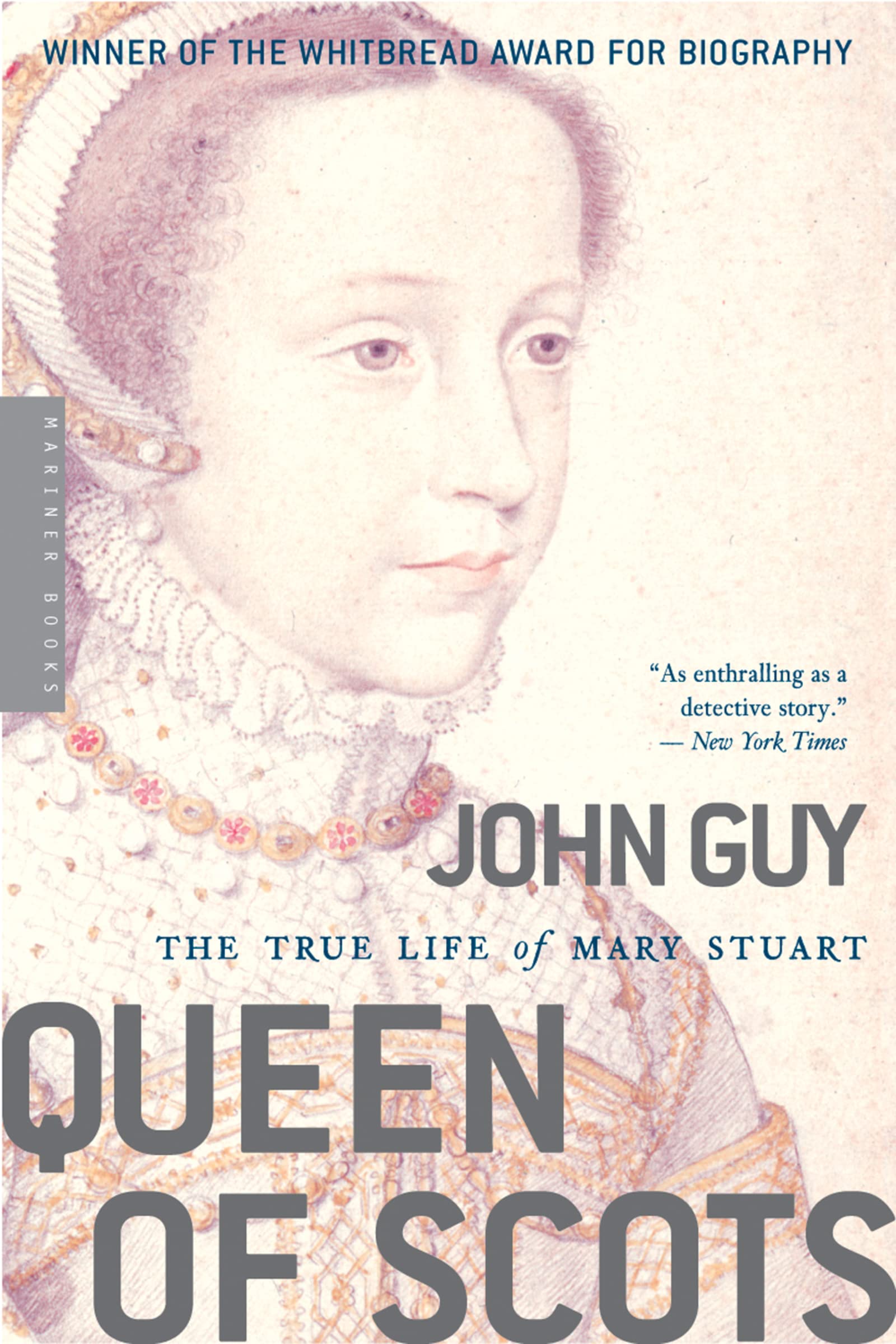



NOW A MAJOR MOTION PICTURE starring Saoirse Ronan and Margot Robbie. A biography "as enthralling as a detective story," of the woman who reigned over sixteenth-century Scotland ( New York Times Book Review ). In Mary Queen of Scots , John Guy creates an intimate and absorbing portrait of one of history’s most famous women, depicting her world and her place in the sweep of history with stunning immediacy. Bringing together all surviving documents and uncovering a trove of new sources for the first time, Guy dispels the popular image of Mary Stuart as a romantic leading lady—achieving her ends through feminine wiles—and establishes her as the intellectual and political equal of Elizabeth I. Through Guy’s pioneering research and superbly readable prose, we come to see Mary as a skillful diplomat, maneuvering ingeniously among a dizzying array of factions that sought to control or dethrone her. It is an enthralling, myth-shattering look at a complex woman and ruler and her time. “The definitive biography . . . gripping . . . a pure pleasure to read.”— Washington Post Book World "Spirited and satisfying....Guy's account has all the twists and turns of a good thriller--and plenty of horror, too." Kirkus Reviews "As enthralling as a detective story..." --Gerard Kilroy The New York Times Book Review "Recent royal shenanigans look tame compared with what John Guy unearths in QUEEN OF SCOTS." --Claire Lui Entertainment Weekly "Queen of Scots is a triumph of biography, artistry, and historical detective work. John Guy has produced a masterpiece, full of fire and tragedy." --Amanda Foreman, author of Georgiana "Rarely have first-class scholarship and first-class storytelling been so effectively combined." --John Adamson, Daily Telegraph "[An] absorbing biography . . . meticulously researched . . . scholarly and intriguing." --Peter Ackroyd The Times of London "A definitive biography. . . . Reads as thrillingly as a detective story, and is rich in detail and authoritative in its analysis." --Miranda Seymour, The Sunday Times "I couldn't put this book down....Never before has [Mary's story] been told with such detail, accuracy, insight and drama." --Gerard DeGroot, Scotland on Sunday John Guy is an award-winning historian of Tudor England. A Fellow of Clare College, Cambridge, he is the author of Queen of Scots: The True Life of Mary Stuart, a major international bestseller that won the Whitbread Award and the Marsh Biography Award and was a National Book Critics Circle Award finalist. His other books include A Daughter's Love: Thomas More and His Dearest Meg ; T homas Becket: Warrior, Priest, Rebel ; and a landmark, bestselling history of Tudor England. Queen of Scots The True Life of Mary Stuart By John Guy Mariner Books Copyright ©2005 John Guy All right reserved. ISBN: 9780618619177 Prologue Around eight o'clock in the morning on Wednesday, February 8, 1587, whenit was light enough to see without candles, Sir Thomas Andrews, sheriff ofthe county of Northamptonshire, knocked on a door. The place wasFotheringhay Castle, about seventy-five miles from London. All that remainsthere now beneath the weeds is the raised earthen rampart of the inner baileyand a truncated mound, or "motte," on the site of the keep, a few hundredyards from the village beside a sluggish stretch of the River Nene. But in the sixteenth century the place was bustling with life. Fotheringhay was a royal manor. Richard III had been born at the castle in 1452. Henry VII, the first of the Tudor kings, who had slain Richard at the battle of Bosworth, gave the estate as a dowry to his wife, Elizabeth of York, and Henry VIII granted it to his first bride, Catherine of Aragon, who extensively refurbished the castle. In 1558, Elizabeth I inherited the property when she succeeded to the throne on the death of her elder sister, Mary Tudor. Despite its royal associations, nothing had prepared Fotheringhay, or indeed the British Isles, for what was about to happen there. Andrews was in attendance on two of England's highest-ranking noblemen, George Talbot, Earl of Shrewsbury, and Henry Grey, Earl of Kent. The door on which he knocked was the entrance to the privy chamber of Mary Queen of Scots, dowager queen of France and for almost nineteen years Elizabeth's prisoner in England. The door opened to reveal Mary on her knees, praying with her bedchamber servants. Andrews informed her that the time was at hand, and she looked up and said she was ready. She rose, and her gentlewomen stood aside. She was only forty-four. Born and brought up to be a queen, she walked confidently through the doorway as if she were once more processing to a court festival. Almost six feet tall, she had always looked the part. She had been fjted since her childhood in France for her beauty and allure. "Charmante" and "la plus parfaite" were the adjectives most commonly applied to her singular blend of celebrity. Not just physically mesmerizing