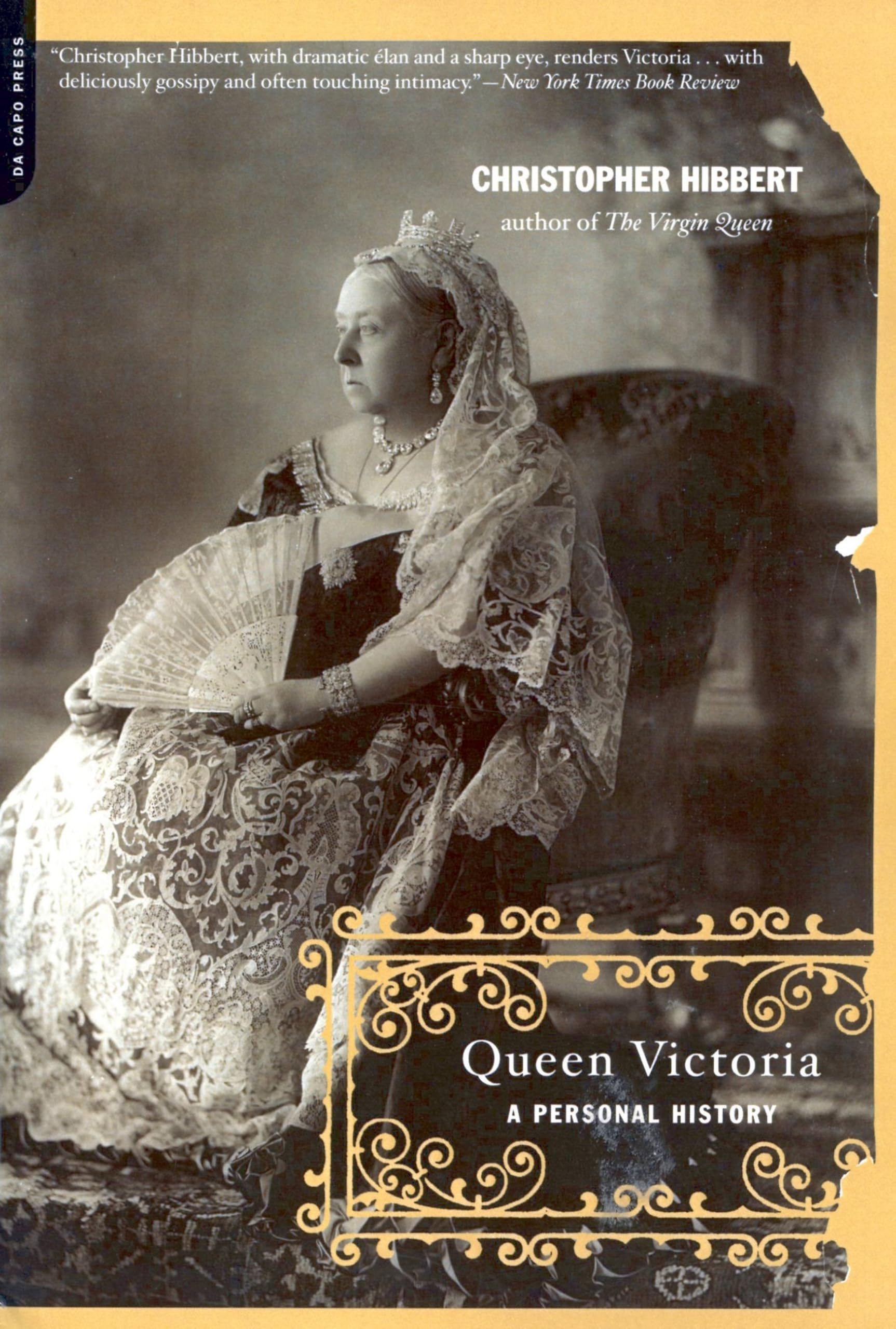



In this surprising new life of Victoria, Christopher Hibbert, master of the telling anecdote and peerless biographer of England's great leaders, paints a fresh and intimate portrait of the woman who shaped a century. His Victoria is not only the formidable, demanding, capricious queen of popular imagination -- she is also often shy, diffident, and vulnerable, prone to giggling fits and crying jags. Often censorious when confronted with her mother's moral lapses, she herself could be passionately sensual, emotional, and deeply sentimental. Ascending to the throne at age eighteen, Victoria ruled for sixty-four years -- an astounding length for any world leader. During her reign, she dealt with conflicts ranging from royal quarrels to war in Crimea and rebellion in India. She saw monarchs fall, empires crumble, new continents explored, and England grow into a dominant global and industrial power. This personal history is a compelling look at the complex woman whom, until now, we only thought we knew. Christopher Hibbert has written many well-received biographies, including Queen Victoria . He is a fellow of the Royal Society of Literature and an Honorary Doctor of Letters of Leicester University. Queen Victoria A Personal History By Christopher Hibbert Da Capo Press Copyright © 2001 Christopher Hibbert All right reserved. ISBN: 9780306810855 Chapter One THE FAMILY `God damme! D'ye know what his sisters call him? By God! They call him Joseph Surface!' SITTING AT HIS BREAKFAST TABLE in his rented house in Brusselsin December 1817, Edward, Duke of Kent, fourth son of King George III,carelessly threw across the Morning Chronicle to his attractive mistress,Julie de St Laurent, and began to open his letters. `I had not done so buta very short time,' he told Thomas Creevey, the witty, gossipy politicianwho was then also living in Brussels for reasons of economy, `when myattention was called to an extraordinary noise and a strong convulsivemovement in Madame St Laurent's throat. For a short time I entertainedserious apprehensions for her safety; and when, upon her recovery, Ienquired into the occasion of this attack, she pointed to [an] article inthe Morning Chronicle .' This article ? adverting to the death in childbirth of Princess Charlotte,the only legitimate child of his eldest brother, the Prince Regent ? calledupon the Duke of Kent and the other bachelor royal dukes to marry forthe sake of the family succession. For, although it was later calculatedthat King George III had no fewer than fifty-six grandchildren, at thistime not one of these grandchildren was legitimate. The Prince Regent, who was to become King George IV on his father'sdeath in 1820, was now fifty-five years old, separated from a detested wifeand living languorously in sumptuous grandeur at Carlton House inLondon and the exotic Marine Pavilion at Brighton. The King's secondson, the Duke of York, was also married and also separated from a wifewho, childless, lived an eccentric life at Oatlands House in Surrey where,surrounded by numerous pet dogs, monkeys and parrots, she was to diein 1820. The Regent's next brother, the Duke of Clarence, who, followingthe Duke of York's death, was to succeed to the throne as William IV in1830, had lived contentedly for several years with the actress Dora Jordan,who had given birth to ten little FitzClarences, before dying the yearbefore the death of Princess Charlotte. To be sure, the Duke of Clarencemight marry now; and, indeed, after unsuccessfully pursuing variousheiresses, both foreign and domestic, in the hope of paying off debtsamounting to £56,000, he at last did find a bride in Princess Adelaide, thehome-loving, good-natured but far from prepossessing eldest daughter ofthe Duke of Saxe-Coburg Meiningen. But she was not to prove so successfula mother as Mrs Jordan had been: her two daughters both died asbabies. Of the Duke of Kent's three younger brothers only one as yet hadchildren. This was the asthmatic Duke of Sussex, a man whom ThomasCreevey described as `civil and obliging' but about whom `there was a nothingness that was to the last degree fatiguing'. He had been marriedin Rome in 1793 to a rather bossy lady some years older than himself,Lady Augusta Murray, daughter of the Earl of Dunmore, by whom hehad had two children; but since the marriage had been contracted inbreach of the Royal Marriages Act of 1772, which made it illegal for anymember of the Royal Family to marry without the previous consent ofthe Crown, the King had declared the marriage void and the Sussexchildren were accordingly illegitimate. The Duke of Sussex's elder brother,the sardonic, much feared, widely disliked, reactionary and fiercely ProtestantDuke of Cumberland, whose face had been given an alarminglyugly cast by a head wound suffered while he was serving with the Hanoveriancavalry in the Low Countries, had managed to obtain permission tomarry Princess Frederica of Mecklenburg-