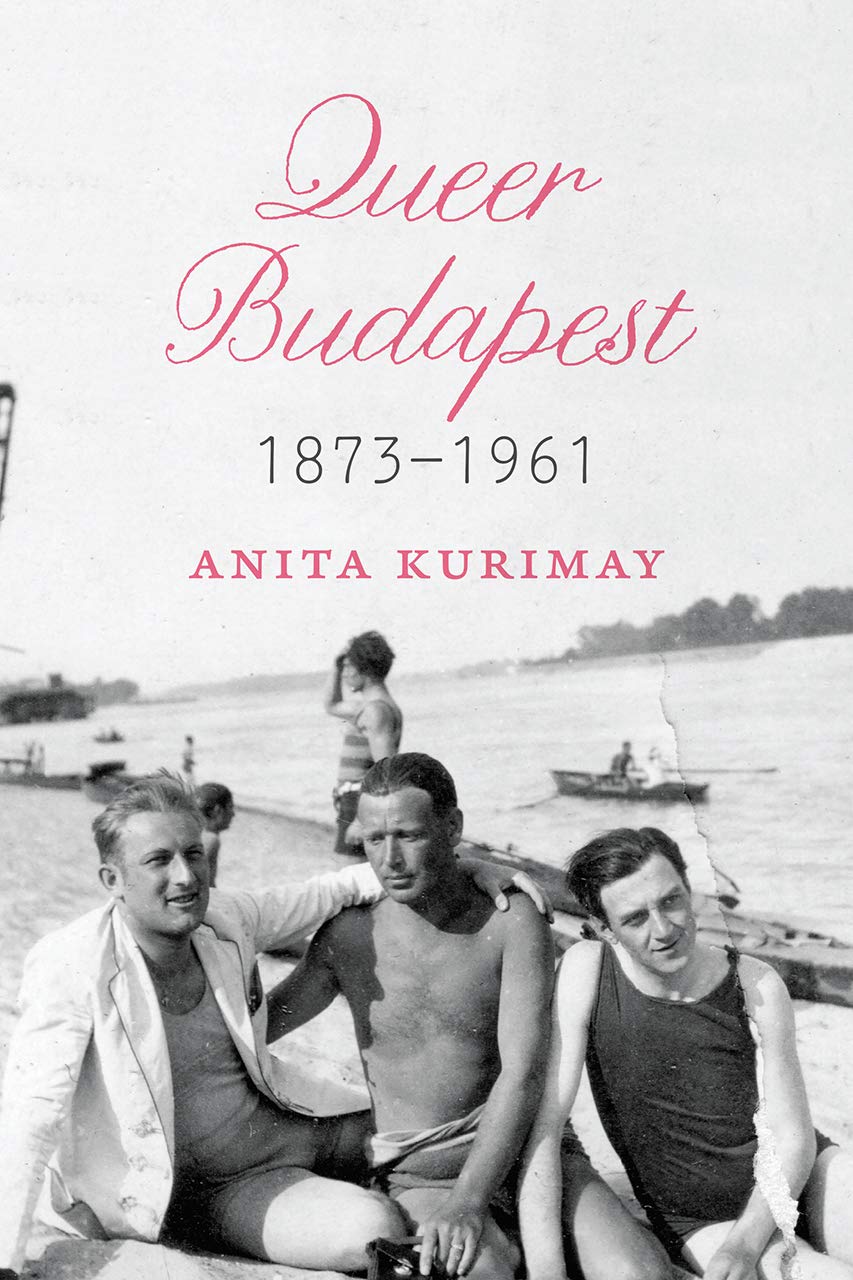



By the dawn of the twentieth century, Budapest was a burgeoning cosmopolitan metropolis. Known at the time as the “Pearl of the Danube,” it boasted some of Europe’s most innovative architectural and cultural achievements, and its growing middle class was committed to advancing the city’s liberal politics and making it an intellectual and commercial crossroads between East and West. In addition, as historian Anita Kurimay reveals, fin-de-siècle Budapest was also famous for its boisterous public sexual culture, including a robust gay subculture. Queer Budapest is the riveting story of nonnormative sexualities in Hungary as they were understood, experienced, and policed between the birth of the capital as a unified metropolis in 1873 and the decriminalization of male homosexual acts in 1961. Kurimay explores how and why a series of illiberal Hungarian regimes came to regulate but also tolerate and protect queer life. She also explains how the precarious coexistence between the illiberal state and queer community ended abruptly at the close of World War II. A stunning reappraisal of sexuality’s political implications, Queer Budapest recuperates queer communities as an integral part of Hungary’s—and Europe’s—modern incarnation. "There is much to comment about this study: it provides nuanced analysis of discourses on and legal treatment of homosexuality and paints a vivid and empathetic portrait of queer life in Budapest across nearly a century. Moreover, it is a significant contribution to histories of urban modernity, women and gender, socialism, and conservatism in Hungary, the East Central European Region, and Europe. In addition to Queer Budapest 's scholarly contributions, Kurimay's reflections on methodology and the challenges of researching sexuality in general and in Hungary specifically are invaluable for students and scholars planning to undertake historical research on sexuality. But perhaps most importantly, Kurimay provides a vital refutation of the claim that queer life has no history in Hungary." ― Canadian Journal of History “Anita Kurimay’s book is important not only as an amazing critical history of a rich array of sources on same-sex sexuality in Hungary from the late nineteenth century to the decriminalization of homosexuality in 1961, but also as a challenging response to widespread beliefs that often form the basis for attacks against the LGBT+ community in Hungary.” ― Hungarian Cultural Studies “With its rich readings of cultural, medical, and police records, Queer Budapest makes a major contribution to our understanding of modern queer European history. Kurimay’s vivid exploration of how political regimes of twentieth-century Hungary conceived of the queer in their midst illuminates the tangled relationship between politics and sexuality.” ― Dan Healey, University of Oxford “Filled with riveting subplots—from rural servants’ interpretations of aristocratic lesbianism to the brutal eugenic fantasies of Arrow Cross fascism—Kurimay’s book traces the paradoxical twists and turns in Hungarian authorities’ handling of homosexuality. Queer Budapest felicitously and brilliantly scrambles all our usual assumptions about the relationships between sexual and other kinds of politics.” ― Dagmar Herzog, author of Cold War Freud: Psychoanalysis in an Age of Catastrophes "From Kurimay's pen, a title as simple as an adjective, a place name and a range of dates is also a manifesto, insisting on a continued queer presence that defies far-right visions of the Hungarian past." ― Europe-Asia Studies "Anita Kurimay’s brilliant and innovative Queer Budapest, 1873–1961 is an important contribution to the new body of work on the history of sexuality in East Central Europe. . . She shows that throughout the twentieth century consecutive Hungarian regimes were generally silent about homosexuality, which, on the one hand, gave queers a certain degree of freedom (so they could lead their lives unnoticed) but, on the other, erased them from history. . . In this context, reinstalling queers in Hungarian history is a political act meant to combat homophobia and oppression." ― Hungarian Studies Review " Queer Budapest is an important book that paints a complicated picture of the tensions between sexual repression and liberation throughout the twentieth century in Hungary as well as in Central and Eastern Europe." ― Austrian History Yearbook Anita Kurimay is assistant professor of History at Bryn Mawr College.