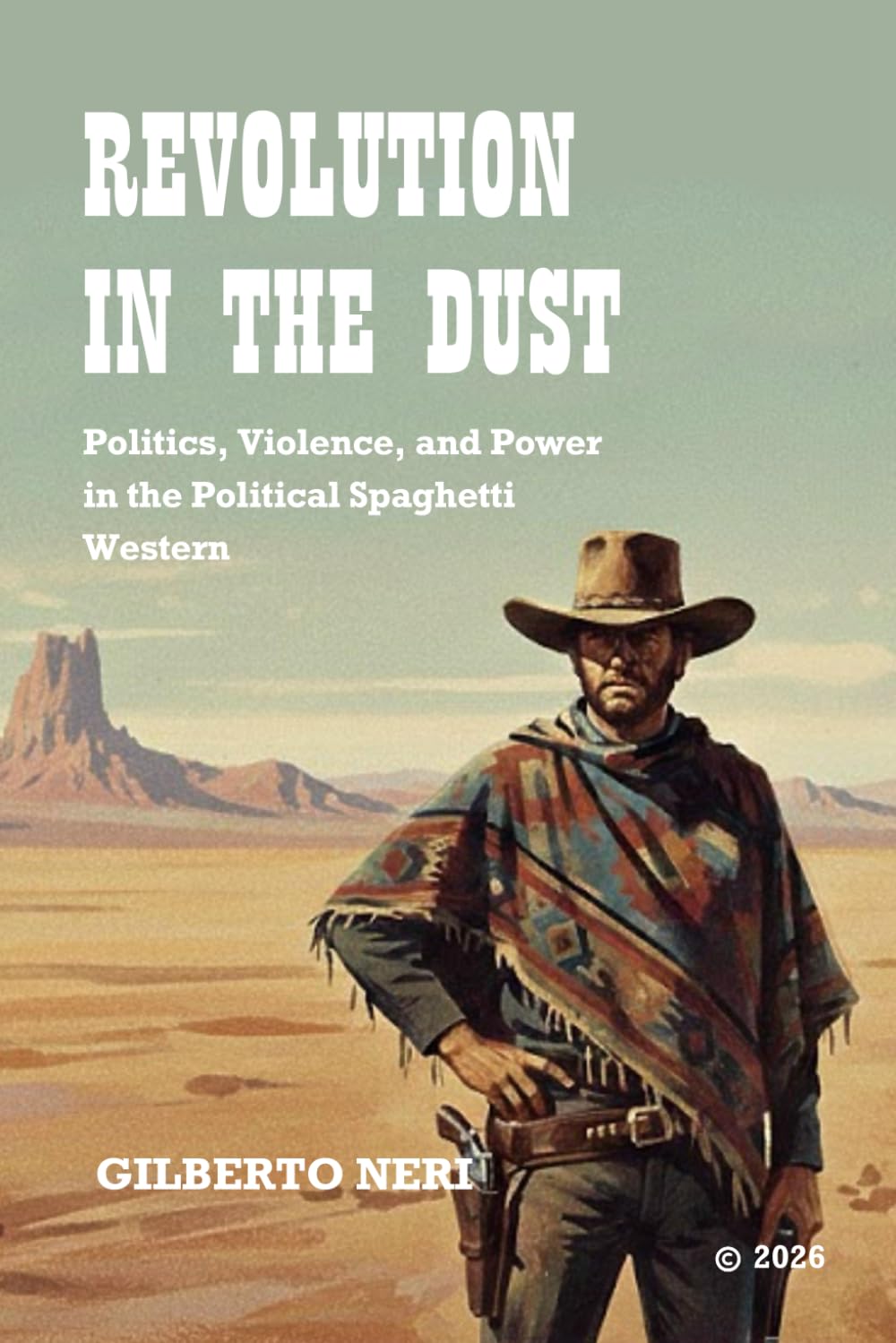
REVOLUTION IN THE DUST: Politics, Violence, and Power in the Political Spaghetti Western
$13.99
by Gilberto Neri



In the late 1960s, the Spaghetti Western became one of the most radical political laboratories in European cinema. Written by Gilberto Neri , an Italian film scholar and long-time cinephile, this book examines the political Spaghetti Western from a perspective grounded in the cultural, social, and production context of Italy in the 1960s. Rather than treating these films as exotic genre variations, Neri reads them as products of a specific historical moment shaped by political unrest, class struggle, and ideological disillusionment. Focusing on seven films by Damiano Damiani, Sergio Sollima, and Sergio Corbucci—often dismissed as minor , forgotten , or marginal—this study restores their critical and political significance. From A Bullet for the General to The Great Silence , from Face to Face to the surreal nihilism of Django Kill… (If You Live Shoot!) , these works expose the contradictions of revolutionary violence, the illusion of justice, and the commodification of political commitment. Drawing on close textual analysis and historical awareness, the book shows how law functions as an instrument of class power, how intellectual authority becomes morally dangerous, and how violence ultimately reveals the structural impossibility of justice. Far from celebrating rebellion, these films dismantle heroic narratives and leave behind a bleak, unresolved vision of politics. Clear, rigorous, and accessible, this book is ideal for: readers interested in film studies and political cinema - scholars and students of Italian and European cinema - cinephiles seeking to rediscover overlooked works beyond the established canon A journey into a dusty, violent, and deeply political cinema—where ideology collapses, power endures, and revolution leaves no heroes behind.