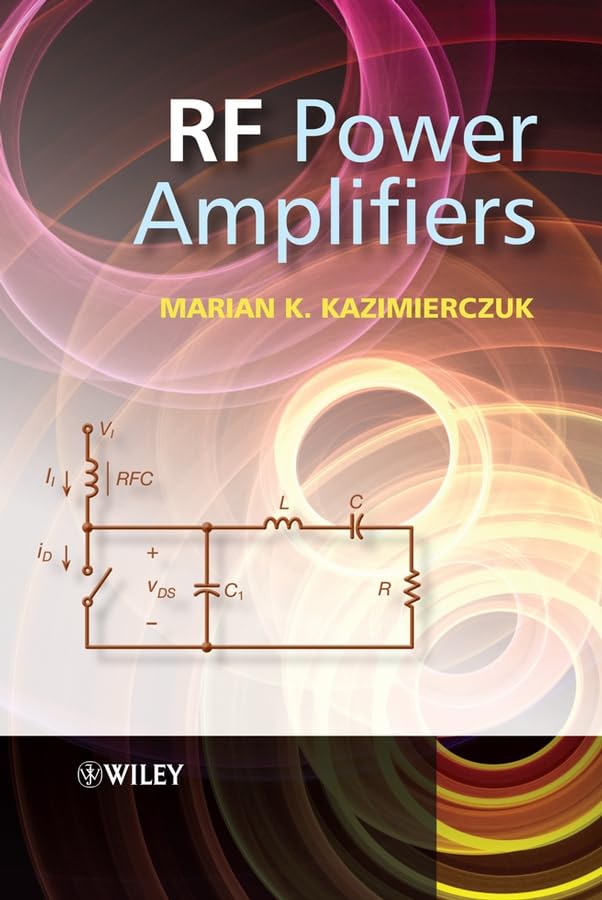



An advanced textbook covering the fundamental theory of RF power amplifiers and their uses, this book provides essential guidance for design procedures. The introduction explains the basic theory of RF power amplifiers besides providing the basic classification of the different types of RF power amplifier. It then systematically dedicates a chapter to each different of RF power amplifier covering A, B and C, D (full-bridge and half-bridge types), E (zero-voltage-switching and zero-current-switching), F and DE amplifiers. Throughout this comprehensive guide, the optimal operating conditions are explored and the possible causes for suboptimum operation explained. The book then considers integrated inductors and linearization techniques and LC Oscillators in the concluding chapters. A comprehensive text covering the fundamentals of RF power amplifiers and their range of applications in radio and TV broadcasting, wireless communications and radars. - Presents accessible coverage of the complex principles of operation of RF power amplifiers and radio power systems. - Introduces the fundamental design techniques and procedures for practitioners for RF power amplifiers. - All chapters contain examples and design procedures throughout, with review questions and problems at the end of each chapter. - A solutions manual is available for instructors upon enquiry This excellent introductory text covers the fundamental theory of radio frequency (RF) power amplifiers and their uses in a range of applications within radio and TV broadcasting, wireless communications and radars. With clear vision and structure, this book dedicates chapters to individual RF power amplifiers, analysing them and providing the practitioner with basic design techniques and essential design procedure guidance on: Class A amplifiers - Class B and C amplifiers - Class D amplifiers (both full-bridge and half-bridge types) - Class E amplifies (Zero-voltage-switching and zero-current switching types) - The state-of-the-art class DE amplifier - Class F amplifiers Read this book to learn about the circuit operation principles for each, including optimal operating conditions and the possible cause for suboptimum operation. You will fid detailed descriptions of parameters, impedance and circuits, along with coverage on switching losses and current and voltage stresses. Integrated inductors - an important area of the technology not often covered in detail in similar books - are explored here. This book also gives you an expert analysis of the techniques of the linearization of power amplifiers. For research and development staff and design engineers, this book is a valuable reference to the topic. With its practical examples and summaries, review questions an end-of-chapter problems for senior level undergraduate and graduate electrical engineering students, it is a must. There is even a solutions manual available for university instructors. Marian K. Kazimierczuk is Professor of Electrical engineering at Wright State University, Dayton, Ohio, USA. He is the author of five books, over 130 journal papers, over 150 conference papers, and seven patents. he is a fellow of the IEE and he received an Outstanding Teacher Award from the American Society for Engineering Education in 2008. His research interests are in the areas of RF power amplifiers, radio transmitters, power electronics, PWM dc-dc power converters, resonant dc-dc power converters, modeling and controls, semiconductor power devices, magnetic devices, and renewable energy sources.