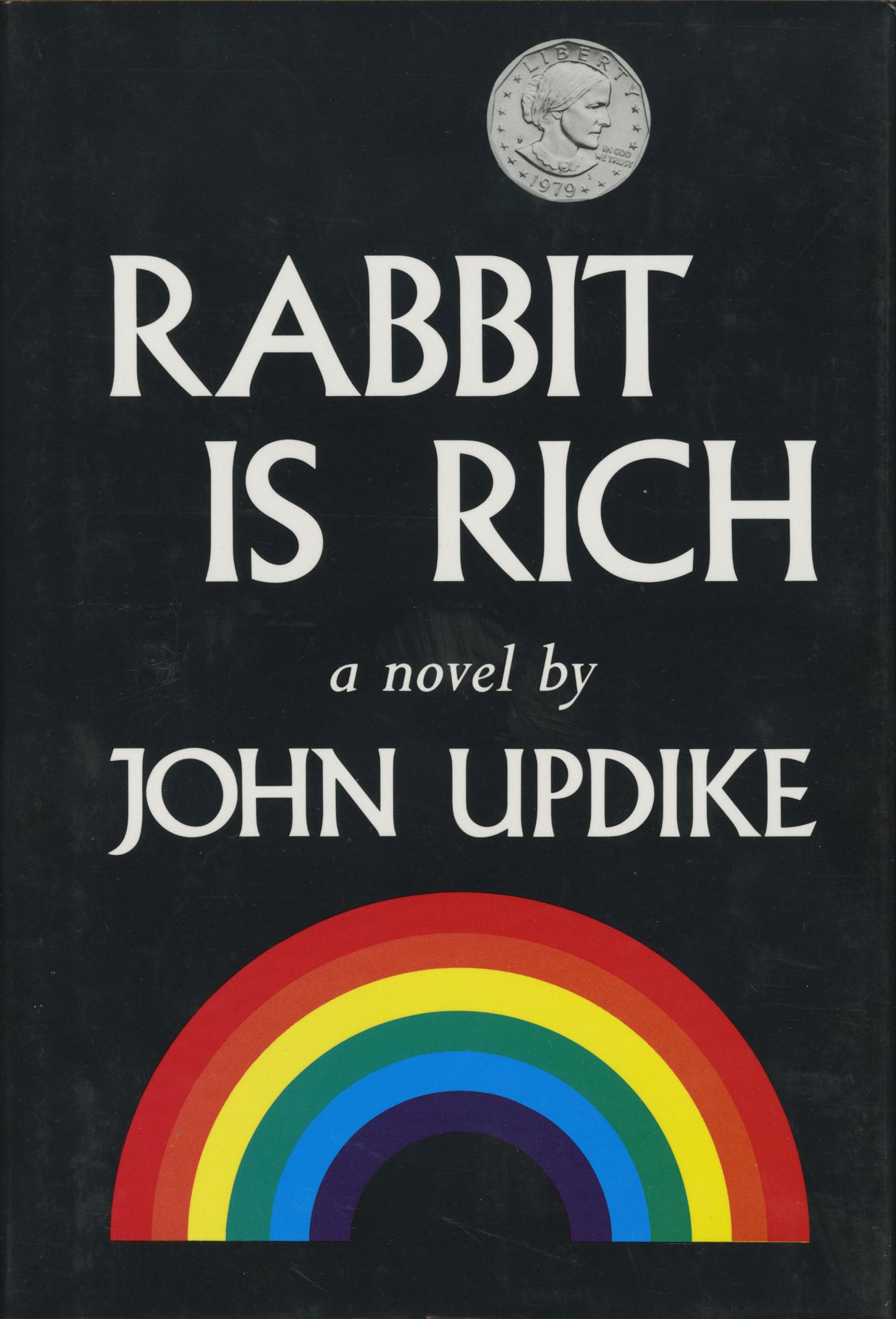



PULITZER PRIZE WINNER • The middle-aged hero of Rabbit, Run, returns—from one of the most gifted American writers of the twentieth century. The hero of John Updike's Rabbit, Run (1960), ten years after the hectic events described in Rabbit Redux (1971), has come to enjoy considerable prosperity as Chief Sales Representative of Springer Motors, a Toyota agency in Brewer, Pennsylvania. The time is 1979: Skylab is falling, gas lines are lengthening, the President collapses while running in a marathon, and double-digit inflation coincides with a deflation of national confidence. Nevertheless, Harry Angstrom feels in good shape, ready to enjoy life at last—until his son, Nelson, returns from the West, and the image of an old love pays a visit to his lot. New characters and old populate these scenes from Rabbit's middle age, as he continues to pursue, in his erratic fashion, the rainbow of happiness. "The reviewers seemed to be under the impression that the hero was a terrible character. It's incredible! No, I think it's the most interesting American novel I've read in quite a long time" —Mary McCarthy, interviewed in The Paris Review "The power of the novel comes from a sense, not absolutely unworthy of Thomas Hardy, that the universe hangs over our fates like a great sullen hopeless sky. There is real pain in the book, and a touch of awe" —Norman Mailer, Esquire "...An American protest against all the attempts to impress upon us the 'healthy, life-loving and comic' as our standard for novels. It is sexy, in bad taste, violent, and basically cynical. And good luck to it." —Angus Wilson, naming three Books of the Year in the Observer And Rabbit Redux "Against all odds, Rabbit Redux is a sequel that succeeds; it is in every respect uncannily superior to its distinguished predecessor and deserves to achieve even greater critical and popular acclaim." —Brendan Gill, The New Yorker "I can think of no stronger vindication of the claims of essentially realistic fiction than this extraordinary synthesis of the disparate elements of contemporary experience. Rabbit Redux is a great achievement, by far the most audacious and successful book Updike has written." — The New York Times Book Review The hero of John Updike's Rabbit, Run (1960), ten years after the hectic events described in Rabbit Redux (1971), has come to enjoy considerable prosperity as Chief Sales Representative of Springer Motors, a Toyota agency in Brewer, Pennsylvania. The time is 1979: Skylab is falling, gas lines are lengthening, the President collapses while running in a marathon, and double-digit inflation coincides with a deflation of national confidence. Nevertheless, Harry Angstrom feels in good shape, ready to enjoy life at last -- until his son, Nelson, returns from the West, and the image of an old love pays a visit to his lot. New characters and old populate these scenes from Rabbit's middle age, as he continues to pursue, in his erratic fashion, the rainbow of happiness. The hero of John Updike's Rabbit, Run (1960), ten years after the hectic events described in Rabbit Redux (1971), has come to enjoy considerable prosperity as Chief Sales Representative of Springer Motors, a Toyota agency in Brewer, Pennsylvania. The time is 1979: Skylab is falling, gas lines are lengthening, the President collapses while running in a marathon, and double-digit inflation coincides with a deflation of national confidence. Nevertheless, Harry Angstrom feels in good shape, ready to enjoy life at last -- until his son, Nelson, returns from the West, and the image of an old love pays a visit to his lot. New characters and old populate these scenes from Rabbit's middle age, as he continues to pursue, in his erratic fashion, the rainbow of happiness. JOHN UPDIKE was the author of more than sixty books, eight of them collections of poetry. His novels, including The Centaur, Rabbit Is Rich, and Rabbit at Rest, won the Pulitzer Prize, the National Book Award, the National Book Critics Circle Award, and the William Dean Howells Medal of the American Academy of Arts and Letters. He died in 2009. I Running out of gas, Rabbit Angstrom thinks as he stands behind the summer-dusty windows of the Springer Motors display room watching the traffic go by on Route 111, traffic somehow thin and scared compared to what it used to be. The fucking world is running out of gas. But they won’t catch him, not yet, because there isn’t a piece of junk on the road gets better mileage than his Toyotas, with lower service costs. Read Consumer Reports, April issue. That’s all he has to tell the people when they come in. And come in they do, the people out there are getting frantic, they know the great American ride is ending. Gas lines at ninety-nine point nine cents a gallon and ninety per cent of the stations to be closed for the weekend. The governor of the Commonwealth of Pennsylvania calling for five-dollar minimum sales to stop the panicky topping-up. An