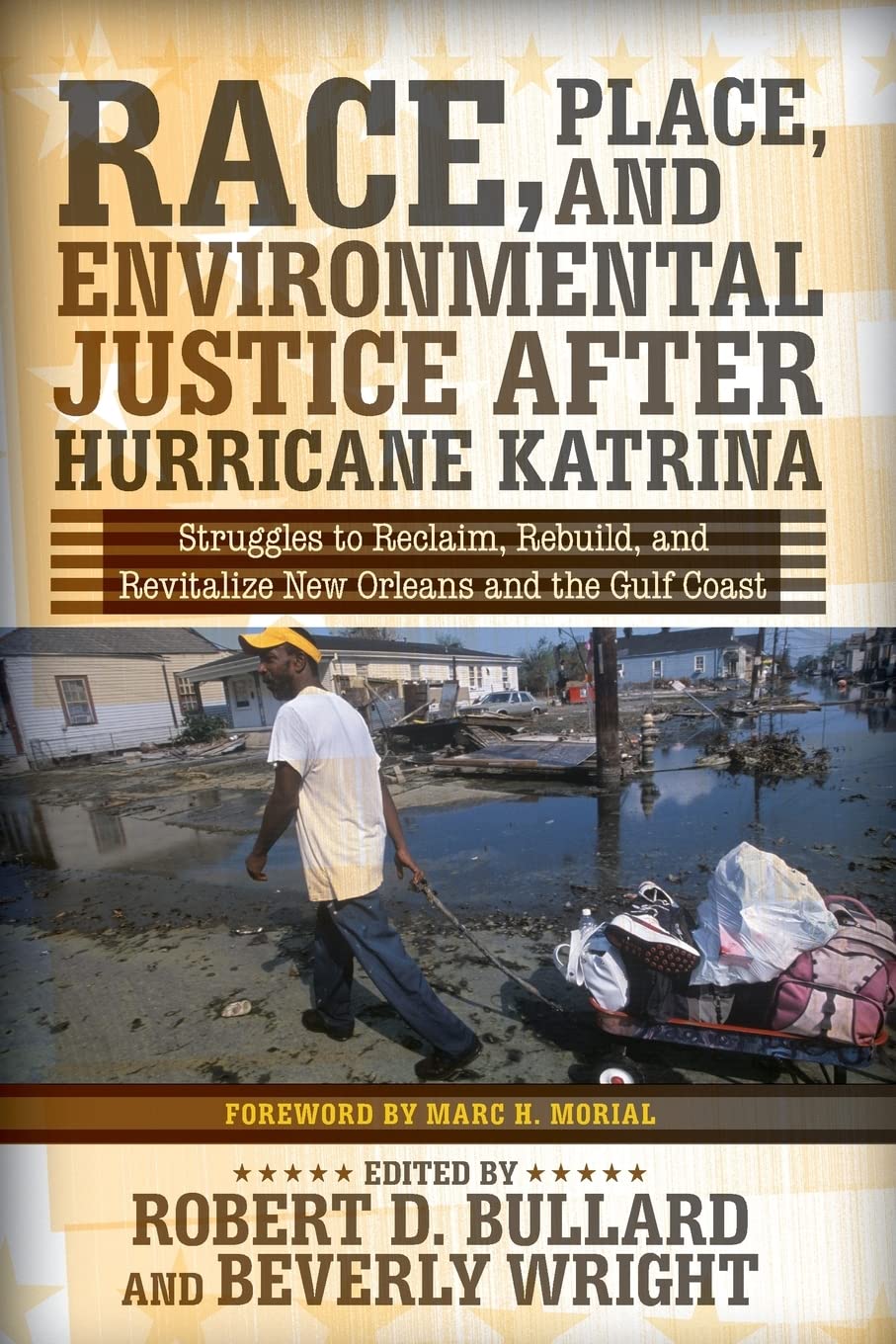
Race, Place, and Environmental Justice After Hurricane Katrina: Struggles to Reclaim, Rebuild, and Revitalize New Orleans and the Gulf Coast
$31.53
by Robert D. Bullard



On August 29, 2005, Hurricane Katrina made landfall near New Orleans leaving death and destruction across the Louisiana, Mississippi, and Alabama Gulf Coast counties. The lethargic and inept emergency response that followed exposed institutional flaws, poor planning, and false assumptions that are built into the emergency response and homeland security plans and programs. Questions linger: What went wrong? Can it happen again? Is our government equipped to plan for, mitigate, respond to, and recover from natural and manmade disasters? Can the public trust government response to be fair? Does race matter? Racial disparities exist in disaster response, cleanup, rebuilding, reconstruction, and recovery. Race plays out in natural disaster survivors' ability to rebuild, replace infrastructure, obtain loans, and locate temporary and permanent housing. Generally, low-income and people of color disaster victims spend more time in temporary housing, shelters, trailers, mobile homes, and hotels - and are more vulnerable to permanent displacement. Some 'temporary' homes have not proved to be that temporary. In exploring the geography of vulnerability, this book asks why some communities get left behind economically, spatially, and physically before and after disasters strike. This heavily researched and annotated collection of essays on the “geography of vulnerability” as found in the aftermath of Katrina is an overwhelming analysis of a microcosm of American society. Written by experts in environmental justice, land-use policy, and political science, it addresses everything from transportation infrastructure to social inequality and urban development. Although academic in style, it carries emotional weight. The numbers alone are powerful, as the years of societal neglect for lower-income residents of New Orleans and the Gulf Coast are laid bare. From quoting a misguided congressman who believes that all living in rural areas are farmers to the pathetically inadequate evacuation plan for one of the largest and most vulnerable cities in the country, the authors each have a distinct focus which together provide a cohesive look at how so many things went wrong after the catastrophe and how those errors were years in the making. With solid, fact-based conclusions, responsible recommendations, and chapters on rebuilding efforts, this title should serve as a textbook for today’s urban planners. “There have been many books written about Hurricane Katrina but none has the range and power of Race, Place, and Environmental Justice After Hurricane Katrina . Bullard, Wright, and the contributors cover all the issues: the pre-existing social and environmental injustices, the lack of preparation for disaster, and the skewed political and economic structure that made sure that Katrina’s wrath would be felt most sharply in low-income communities of color. But most significantly, they offer one of the most detailed, analytical, and rigorous looks at the aftermath: the toxic soup left behind, the economic, physical and social challenges of rebuilding, and the shifting demographics and politics of New Orleans. This is a must-read for anyone concerned with the devastating effects Katrina had on Louisiana and the nation, and a worthy anchor text for courses on environmental justice, social inequality, and the American future.” —Manuel Pastor, University of Southern California “Race, Place, and Environmental Justice reveals how the political disasters confronting New Orleans before Katrina and in the rebuilding process afterwards wreaked far more damage on the city than the storm itself, a context that unfortunately prevails in virtually every major US city.” —Gregory D. Squires, George Washington University Robert D Bullard Used Book in Good Condition