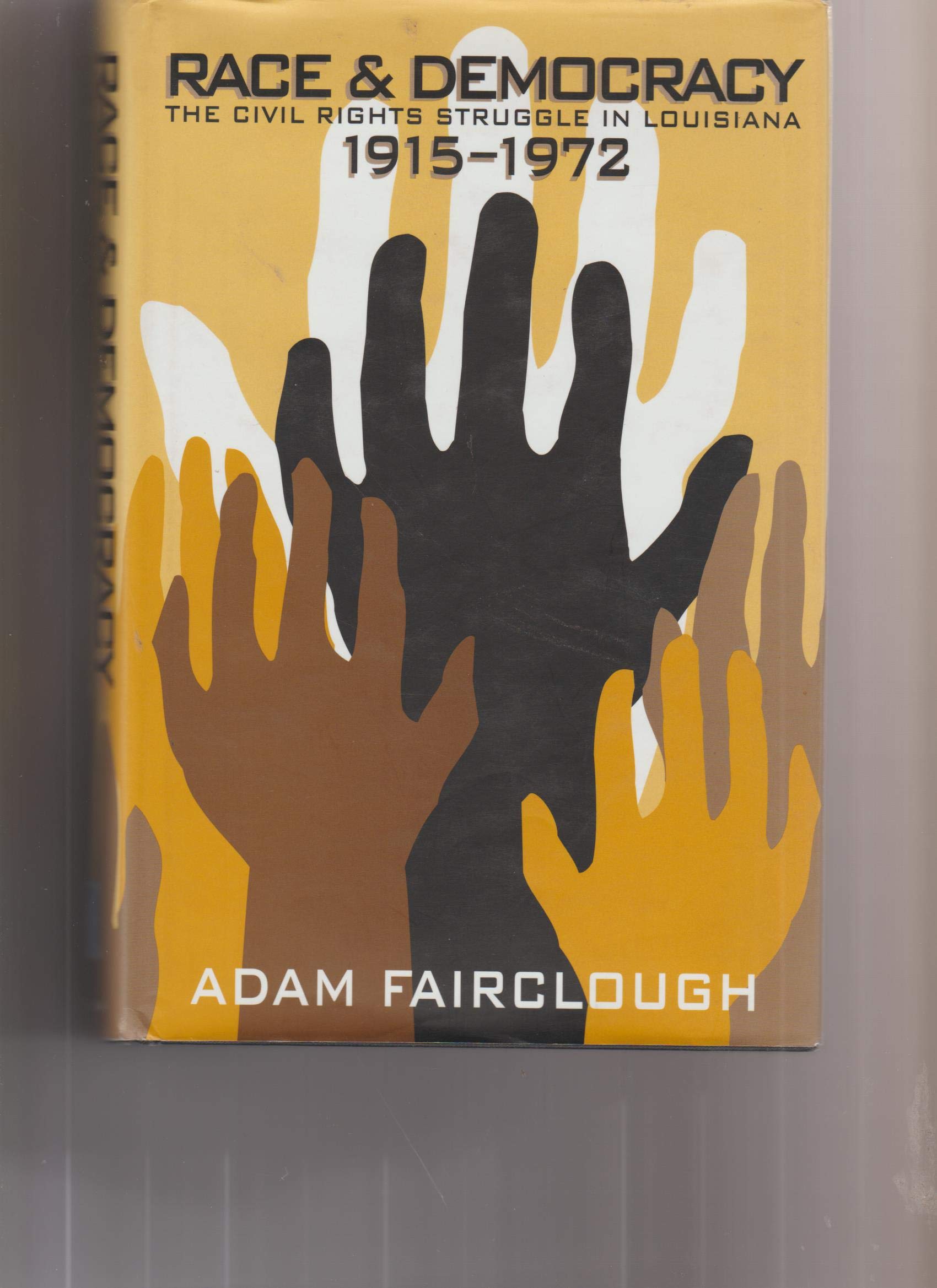
Race & Democracy: The Civil Rights Struggle in Louisiana, 1915-1972
$120.57
by Adam Fairclough



Hailed as one of the best treatments of the civil rights movement, Race and Democracy is also one of the most comprehensive and detailed studies of the movement at the state level. This far-reaching and dramatic narrative ranges in time from the founding of the New Orleans branch of the NAACP in 1915 to the beginning of Edwin Edwardss first term as governor in 1972. In his new preface Adam Fairclough brings the narrative up to date, demonstrating the persistence of racial inequalities and the continuing importance of race as a factor in politics. When Hurricane Katrina exposed the race issue in a new context, Fairclough argues, political leaders mishandled the disaster. A deep-seated culture of corruption, he concludes, compromises the ability of public officials to tackle intransigent problems of urban poverty and inadequate schools. Fairclough takes readers to the grass roots of the movement as it was defiantly advanced and resisted in scores of places like New Orleans shipyards, the voter registrars office in Opelousas, and the Little Union Baptist Church in Shreveport. He traces the social networks that sustained black activism, such as Masonic lodges and teachers associations, and he also analyzes white responses to the movement as expressed through political factions, trade unions, business lobbies, the Catholic Church, White Citizens Councils, and the Ku Klux Klan. British scholar Fairclough examines the history of the Civil Rights movement in Louisiana from 1915, when the New Orleans branch of the NAACP was founded, through the start of the first administration of Governor Edwin Edwards in 1972. He has written the most comprehensive account yet of the movement in Louisiana and perhaps in any Southern state. Especially valuable is the discussion of the movement during the decades before the Supreme Court's 1954 decision overturning racial segregation in public schools?a period that many scholars have neglected. Fairclough also explores the cultural diversity that differentiates Louisiana from other deep Southern states and provides a cogent analysis of the impact of that diversity on the Civil Rights struggle in the state. The work's value is reduced only slightly by a number of minor inaccuracies. Recommended for academic libraries.?Thomas H. Ferrell, Univ. of Southwestern Louisiana, Lafayette Copyright 1995 Reed Business Information, Inc. University of Leeds historian Fairclough has studied the U.S. civil rights movement from a national perspective with his work on the Southern Christian Leadership Conference, To Redeem the Soul of America (1987), and with Martin Luther King Jr. . His research on the struggle for racial equality in Louisiana convinces him that the Montgomery-to-Selma 1955^-65 story of the civil rights movement is incomplete. "Black protest between the late 1930s and the mid-50s constituted more," he argues, "than a mere prelude to the drama proper: it was the first act of a two-act play." And this longer time frame grants the NAACP a role as important as that of SCLC, CORE, or SNCC. Fairclough draws on archival collections, FBI files and other government documents, interviews, and secondary sources to trace the fight for political, economic, and social rights for African Americans in "the most diverse and unique southern state" from the final years of Huey Long to the 1972 election of Governor Edwin Edwards. A final chapter, "Struggle Without End," considers more recent Louisiana politics. Race & Democracy is a local history that raises issues of more than regional interest. Mary Carroll