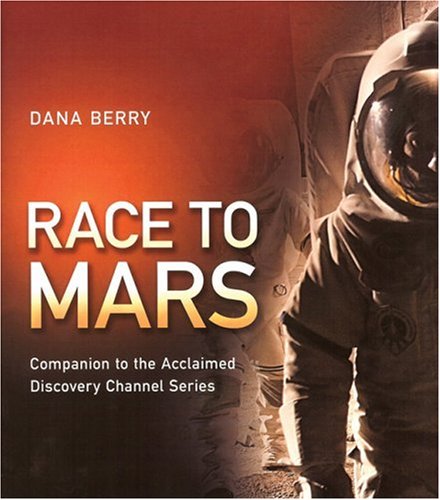



Scheduled for its television premier in September and October of this year, the exciting series Race to Mars will be presented on the Discovery Channel in the United States and Canada. This beautiful book—the program’s companion volume—describes the dramatic chain of events that will ultimately send human beings to Mars. The story begins in ancient times when the red planet was associated with war and violence, then leads us to the American astronomer Percival Lowell. He trained his telescope on our neighboring red planet and detected surface marks that he and other observers believed were canals. Both the book and the TV account proceed to the present day, describing NASA’s series of unmanned landings, then continuing into the future, dramatizing events in the course of the projected Martian mission. The TV series will be shown in two main sections: Race to Mars summarizes the science-based fictional docudrama, a four-hour miniseries to be pres/ented on two separate evenings Mars Rising summarizes the TV documentary, to be presented as six one-hour shows This book’s magnificent illustrations include many of the high-quality photos taken by satellites and recent surface probes of Mars. Its additional illustrations include state-of-the-art visuals created especially for the TV series by author Dana Berry. Lively, readable, and scientifically accurate, Race to Mars chronicles an ongoing challenge which, if successful, will climax with one of the twenty-first century’s greatest achievements. (sidebar material) Questions Facing the Planners of the Race to Mars Will Mars astronauts be the test pilots of legend or a new breed of multi-skilled engineers? - Can humans endure the extreme psychological demands of a more than two-years-long Mars mission? - What unexpected mental demands will be made on the first explorers of Mars? - In light of the importance of long-term team compatibility, is a mixed-gender crew the best way to go? (back cover) After decades of exploration, after years of planning, after multiple rocket launches, and a journey of almost a year s duration HUMANS LAND ON MARS! It s December 30, 2030: the hatch of the Gagarin Mars ascent/descent vehicle opens and six humans take a momentous step into history. In Race to Mars, Dana Berry chronicles their harrowing and exciting journey. The story begins with astronomers and dreamers, leads to the work of engineers and physicists, and ends with the astonishing achievement of the crew members who risk their lives to extend the reach of humankind to another world. (front flap) Is there life on Mars? People have long suspected that there might be. The nineteenth-century Milanese astronomer Giovanni Schiaparelli first drew attention to the canali on the planet s surface. An American, Percival Lowell, after studying Schiaparelli s maps, became convinced that there was an alien civilization slowly dying there. His books in turn inspired the classic novel by H.G. Wells and a profusion of movies based on the premise laid out in Wells The War of the Worlds. Martians have inhabited our collective imagination for more than a hundred years. There are good reasons for our fascination. Of all the planets in our solar system, Mars is most like Earth. It has seasons, as Earth does. Although colder than Earth, the temperatures on Mars are within a range that humans might endure. And latest findings by NASA indicate the presence of water on Mars. The presence of water raises the possibility that life also exists. A journey to Mars is no longer a dream. Dana Berry draws on his wide experience as a science writer  and on research developed for the television docudrama Race to Mars  to describe the work already underway to take humans to the Red Planet. He describes the complex operation that leads to the construction in low Earth orbit of the Terra Nova spacecraft that will carry the six-person crew to Mars. He examines the nature of the risks  from mechanical failure and fire to physical and psychological breakdown  that the crew will have to overcome. And he writes about the experiments that will be conducted when Earth s first human emissaries set foot on Martian soil. (back flap) Race to Mars features spectacular computer-generated images created especially for the Mars television series  along with latest breathtaking photographs of the planet captured by NASA. Dana Berry, a writer, artist, and pioneering computer animator, is the author of New Cosmos: An Intimate Guide to the Latest Discoveries in Space. His work is regularly featured in books and magazines, including Discover, Nature, Sky and Telescope, and Science News. According to National Geographic,  Dana Berry has single-handedly pushed the entire genre of science visualization into high art. He has also created animation for science documentaries, news broadcasts, NASA video press releases, and e