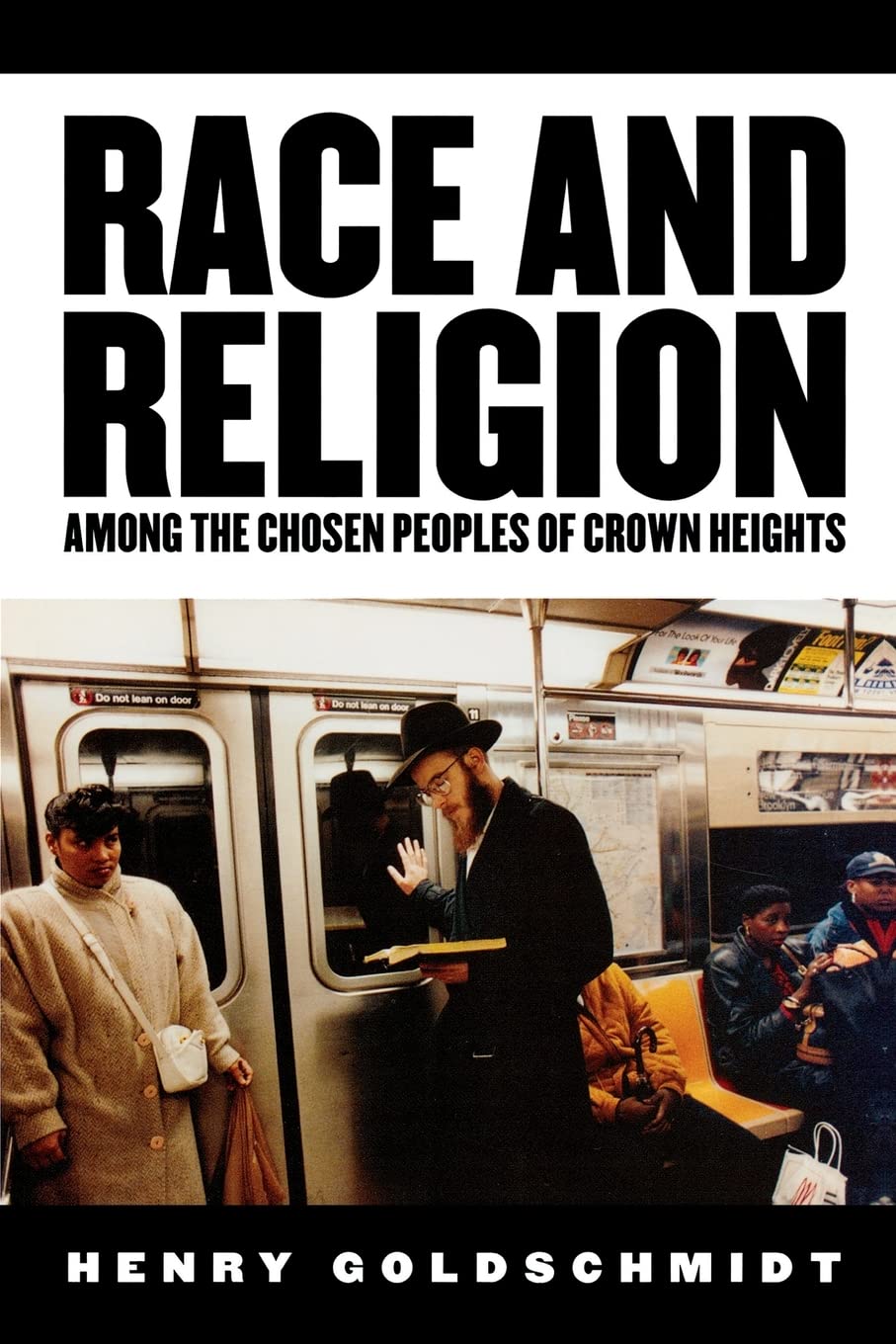



In the first major scholarly work to look beyond the sensationalized violence of August 1991, Henry Goldschmidt explores the everyday realities of Black-Jewish difference in the Brooklyn neighborhood of Crown Heights. Drawing on two years of ethnographic fieldwork, he argues that collective identities like Blackness and Jewishness are particularly complex in today's Crown Heights because the neighborhood's Afro-Caribbean, African American, and Lubavitch Hasidic communities understand their differences in dramatically different ways-as a racial divide between Blacks and Whites or a religious divide between Gentiles and Jews. Goldschmidt takes this collision of conceptual categories as an invitation to reimagine both "race" and "religion." By exploring the limits of categorical thought, he works to create space in American society for radical forms of cultural difference. Henry Goldschmidt is the Education Program Associate at the Interfaith Center of New York, and formerly an Assistant Professor of Religion and Society at Wesleyan University. Race and Religion among the Chosen Peoples of Crown Heights is a richly sustained and critically insightful ethnography of the Lubavitch community in Crown Heights. Henry Goldschmidt has done an excellent job of creating an account that reflects the Lubavitchers' worldview and simultaneously gives voice to their neighbors. -- Jonathan Boyarin ― Distinguished Profesor of Modern Jewish Studies, University of Kansas This volume is an excellently written and researched look at Crown Heights, Brooklyn, and the Jewish communities that live there: the orthodox Lubavitch and the African Americans who consider themselves to be descendents of ancient Hebrew Israelites. An incredibly important contribution to religious studies, critical race theory, anthropology, and urban studies, Goldschmidt has produced a powerful work that will be read and appreciated by academics and general readers alike. -- John L. Jackson, Jr. ― author of Real Black: Adventures in Racial Sincerity In August of 1991, the Brooklyn neighborhood of Crown Heights was engulfed in violence following the deaths of Gavin Cato and Yankel Rosenbaum a West Indian boy struck by a car in the motorcade of a Hasidic spiritual leader and an orthodox Jew stabbed by a Black teenager. The ensuing unrest thrust the tensions between the Lubavitch Hasidic community and their Afro-Caribbean and African American neighbors into the media spotlight, spurring local and national debates on diversity and multiculturalism. Crown Heights became a symbol of racial and religious division. Yet few have paused to examine the nature of Black-Jewish difference in Crown Heights, or to question the flawed assumptions about race and religion that shape the politics and perceptions of conflict in the community.In Race and Religion among the Chosen Peoples of Crown Heights, Henry Goldschmidt explores the everyday realities of difference in Crown Heights. Drawing on two years of fieldwork and interviews, he argues that identity formation is particularly complex in Crown Heights because the neighborhood's communities envision the conflict in remarkably diverse ways. Lubavitch Hasidic Jews tend to describe it as a religious difference between Jews and Gentiles, while their Afro-Caribbean and African American neighbors usually define it as a racial difference between Blacks and Whites. These tangled definitions are further complicated by government agencies who address the issue as a matter of culture, and by the Lubavitch Hasidic belief a belief shared with a surprising number of their neighbors that they are a "chosen people" whose identity transcends the constraints of the social world.The efforts of the Lubavitch Hasidic community to live as a divinely chosen people in a diverse Brooklyn neighborhood where collective identities are generally defined in terms of race illuminate the limits of American multiculturalism a concept that claims to celebrate diversity, yet only accommodates variations of certain kinds. Taking the history of conflict in Crown Heights as an invitation to reimagine our shared social world, Goldschmidt interrogates the boundaries of race and religion and works to create space in American society for radical forms of cultural difference.Henry Goldschmidt is an assistant professor of religion and society at Wesleyan University in Middletown, Connecticut. He is the coeditor (with Elizabeth McAlister) of Race, Nation, and Religion in the Americas. In August of 1991, the Brooklyn neighborhood of Crown Heights was engulfed in violence following the deaths of Gavin Cato and Yankel Rosenbaum—a West Indian boy struck by a car in the motorcade of a Hasidic spiritual leader and an orthodox Jew stabbed by a Black teenager. The ensuing unrest thrust the tensions between the Lubavitch Hasidic community and their Afro-Caribbean and African American neighbors into the media spotlight, spurring local and national debates on diversity and