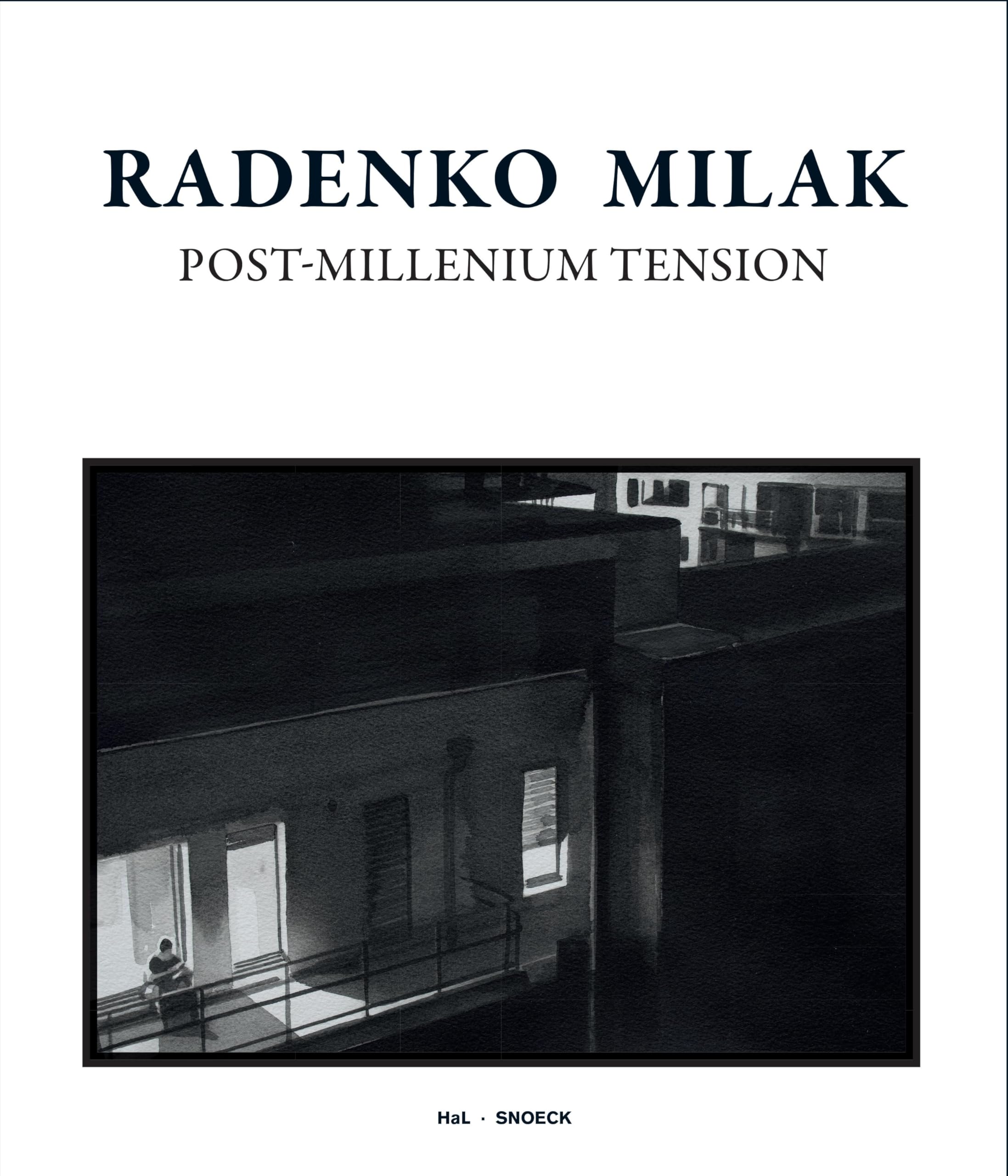



When we first see one of Radenko Milak’ s (*1980, Travnik near Banja Luka) watercolors, we feel we » recognize« it, as there is always a before and after, like in a film loop – a unique quality of his work, writes Udo Kittelmann in his essay. Standing before a Milak painting, we believe we are seeing a fragment of something larger, a glimpse of the world or the universe, much like a photograph is always a snapshot of a theoretically endless image. Moreover, almost every motif he chooses draws from images we already know, stored in our memory. His work explores multiple themes: the shift from photography to watercolor, the interplay between original and reproduction, the choice of subjects, and how his images resonate with our subconscious and collective unconscious – since memory is shaped not only by language but primarily by images. His mastery of the medium creates the illusion of viewing photographs, while simultaneously making us witnesses to a media transformation: the original photo becomes a watercolor, which the human eye first perceives as a photograph and then as a painting. This duality compels us to step closer, eager to participate in the artwork – to observe the brushstrokes, gestures, and craftsmanship. Over the years, Milak has developed diverse series: cityscapes and architecture, futuristic technologies, feminism, pivotal moments in music history, surveillance and big data, loneliness, isolation during the COVID-19 pandemic, and film stills – all rendered in asymmetrically evolving watercolor series over two decades. His consistent use of black ink on white paper lends his works a timeless quality. Udo Kittelmann (b. 1958) trained as an optician before transitioning to curatorial work in 1988. After directing the Kö lnischer Kunstverein (1994– 2001), he served as commissioner of the German Pavilion at the 2001 Venice Biennale, winning the Golden Lion for Gregor Schneider’ s » Totes Haus ur« . He later directed Frankfurt’ s Museum of Modern Art (2002– 2008) and Berlin’ s Nationalgalerie (2008– 2020), overseeing five major museums. A prolific author and editor, he continues to curate groundbreaking exhibitions, including projects at the Fondazione Prada during the Venice Biennale. Max Dax (b. 1969) was editor-in-chief of SPEX (2007– 2010), Germany’ s iconic music magazine rooted in punk and new wave. Known for his incisive interviews with musicians and artists, he contributes to major newspapers like WELT and TAZ. Radenko Milak (b. 1980 in Travnik) studied at the Academy of Arts in Banja Luka (1999– 2003) and the University of Arts in Belgrade (2003– 2007). He represented Bosnia and Herzegovina at the 2017 Venice Biennale. His large-scale watercolors have been exhibited worldwide, from Western and Southern Europe to South America. Represented by multiple galleries, he gained acclaim for his 2017 series » University of Disaster« . Marc Wellmann (b. 1968 in Hamburg) grew up in Berlin under the influence of sculptor Bernhard Heiliger, his stepfather. After studying art history and American studies at FU Berlin, he earned his PhD in 2004. He managed the Bernhard Heiliger Foundation (1996– 2015) and curated Heiliger’ s 2005 retrospective at Berlin’ s Martin-Gropius-Bau. Since 2013, he has been artistic director of Haus am Lü tzowplatz, Berlin’ s oldest art association.