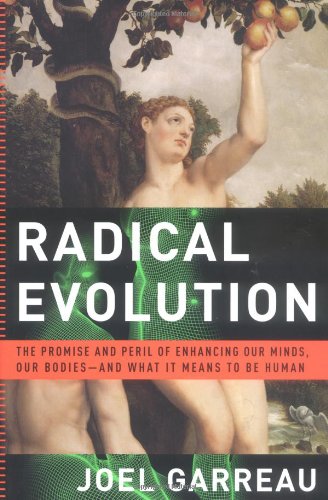
Radical Evolution: The Promise and Peril of Enhancing Our Minds, Our Bodies -- and What It Means to Be Human
$6.44
by Joel Garreau



In Radical Evolution, bestselling author Joel Garreau, a reporter and editor for the Washington Post, shows us that we are at an inflection point in history. As you read this, we are engineering the next stage of human evolution. Through advances in genetic, robotic, information and nanotechnologies, we are altering our minds, our memories, our metabolisms, our personalities, our progeny–and perhaps our very souls. Taking us behind the scenes with today's foremost researchers and pioneers, Garreau reveals that the super powers of our comic-book heroes already exist, or are in development in hospitals, labs, and research facilities around the country -- from the revved up reflexes and speed of Spider-Man and Superman, to the enhanced mental acuity and memory capabilities of an advanced species. Over the next fifteen years, Garreau makes clear, these enhancements will become part of our everyday lives. Where will they lead us? To heaven–where technology’s promise to make us smarter, vanquish illness and extend our lives is the answer to our prayers? Or will they lead us, as some argue, to hell — where unrestrained technology brings about the ultimate destruction of our entire species? With the help and insights of the gifted thinkers and scientists who are making what has previously been thought of as science fiction a reality, Garreau explores how these developments, in our lifetime, will affect everything from the way we date to the way we work, from how we think and act to how we fall in love. It is a book about what our world is becoming today, not fifty years out. As Garreau cautions, it is only by anticipating the future that we can hope to shape it. What's in store for humanity? It is becoming clear that we will use our growing technological powers to transform not only the world around us but ourselves, too. Many forms of human enhancement are already routine--sports medicine, psychotropic mood drugs, wakefulness and alertness enhancers, cosmetic surgery, drugs for sexual performance. Much more will become possible in coming decades. Joel Garreau's Radical Evolution joins several recent titles that attempt to make sense of the radical future possibilities for our species. The potential prospects include superintelligent machines, nonaging bodies, direct connections between human brains or between brain and computer, fully realistic virtual reality, and the reanimation of patients in cryonic suspension. As enablers of such miracles, Garreau mentions especially "GRIN technologies"--genetics, robotics, information technology and nanotechnology. The focus of Garreau's book, however, is not on the nuts and bolts of the technology itself but rather on what it will all mean for us humans. His reporting skills well honed by his work as a journalist and editor at the Washington Post, Garreau is constantly on the lookout for the human story behind the ideas. Biographical sketches of the people he has interviewed for the book get approximately equal airtime with their opinions about human extinction and transcendence. The bulk of one interviewee's beard, the size of another's collection of musical instruments, the length of a third's pants: as Garreau knows all too well, these are the indispensable rivets to hold the attention of the current version of Homo sapiens while we try to ponder whether we will have indefinite life spans or whether the world will end before our children have a chance to grow up. Garreau organizes his material around several scenarios. Unfortunately, these are not very carefully delineated. It is not clear whether all of them are meant to represent separate possibilities. In the Curve Scenario, information technology continues to improve exponentially, and this progress bleeds over into adjacent fields such as genetics, robotics and nanotechnology. In the Singularity Scenario, "the Curve of exponentially increasing technological change is unstoppable" and leads, "before 2030, to the creation of greater-than-human intelligence," which proceeds to improve itself "at such a rate as to exceed comprehension." There is a Heaven Scenario, which serves as a rubric for a future in which "almost unimaginably good things ... including the conquering of disease and poverty, but also an increase in beauty, wisdom, love, truth and peace" are happening pretty much on their own accord, without deliberate steering. Garreau associates this view with the distinguished inventor Ray Kurzweil. We are told that one of the early "warning signs" that we are entering the Heaven Scenario is that the phrase "The Singularity" enters common usage. There is also a Hell Scenario. The chief talking head assigned to this scenario is Bill Joy, who was a co-founder of Sun Microsystems. In April 2000 Joy published a bombshell article in Wired entitled "Why the Future Doesn't Need Us," which described how the author had come to the realization that advances in genetics, nanotechnology and robotics will eventually