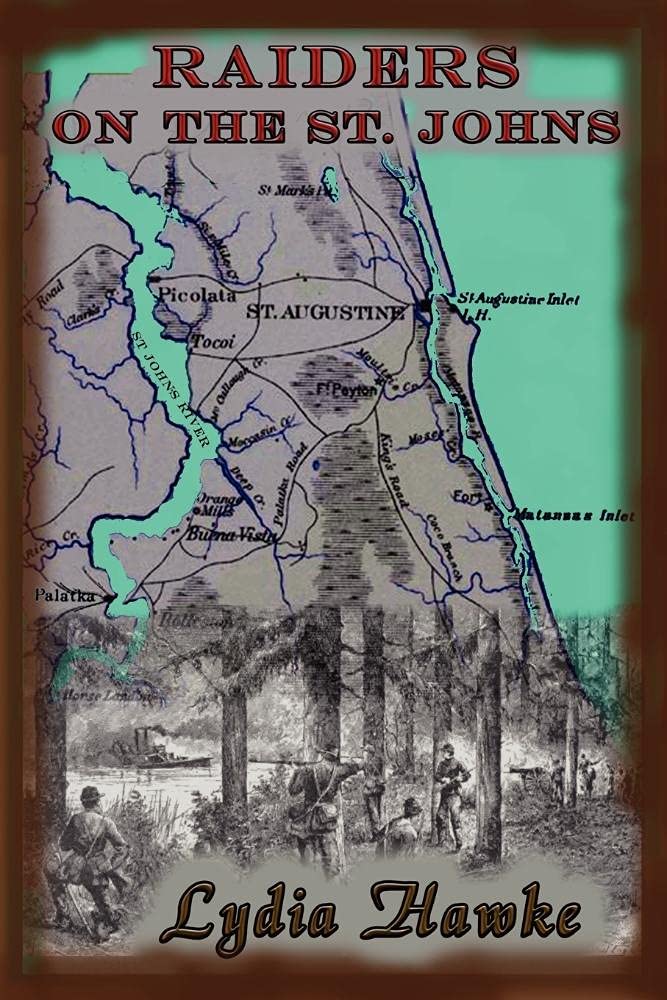



His assignment to Florida to recruit a Union cavalry company meant Captain Dan Farrell was returning home to a state split by conflicting loyalties. Among them his brother Jack, a member of Confederate Captain J. J. Dickison's partisan rangers. As an officer, Dan would like nothing better than to put Jack out of action. As a brother he feared the day they would meet in battle. Complicating Dan's life is his neighbor, Sarah Cates Phillips. His return to Florida renews his acquaintance with the alluring widow. To Sarah, Dan is more than the appealing Yankee captain that once stole her heart. His worst flaw is the color of his uniform. How can she love a man who is out to destroy those she holds most dear? When I wrote "Raiders on the St. Johns," I endeavored to dramatize the tensions between warring factions in northeast Florida during the War Between the States. Confederate Captain John J. Dickison commanded Company H, 2nd Florida Cavalry, which operated mostly in the interior of the state. Other companies were added to his force from time to time. Most historians credit him and his men for making it too hazardous for the Union troops to gain a foothold in the area west of the St. Johns River and east of Cedar Key. In fact, after the Battle of Olustee, nearly every time they tried to invade, the Union troops were soundly defeated. The Union forces did organize two regiments of cavalry from Florida men who had their reasons for wanting to fight against the Confederacy. Most of those recruited were from the west coast. The recruitment efforts were not as successful on the east coast. I suspect, as have other historians, that the Union Army's heavy-handed tactics in this area alienated many folks. On the west coast, the Union blockade squadron achieved more success, as they protected the Florida Unionists, armed them, and traded with them. Records show that in early 1864 a few Union recruits were signed up in St. Augustine, but as to whether someone like Dan Farrell experienced further success is not clear. I tried to replicate the engagements depicted as faithfully as possible. It may seem curious that the Confederates won all of the significant fights, but that is what the record states.The Union suffered a huge setback at Olustee, which also torpedoed hopes for readmission of the state until after the surrender. The Maple Leaf, which Confederate mines sunk off Mandarin Point just south of Jacksonville, has provided intrepid divers with wonderfully preserved artifacts that were saved from deterioration by the same mud that hid the wreck. Confederate scouts captured Colonel Noble and his companions soon after the colonel boasted he could travel between Jacksonvnille and St. Augustine in perfect safety. That Christmas Eve, he discovered he could not. The capture of the dance party acutally occurred in much the manner protrayed. Although the young soldier who infiltrated behind the lines to gather intelligence from his father is not identified in Dickison's writings, I assert it is very likely he was my uncle Charles Colee, who brought out his father, George, to talk with his commander. Dickison and his men achieved two amazing exploits that almost defy belief. The capture of the gunboat "Columbine," achieved with a few artillery pieces and a dozen sharpshooters, was a unique feat. Cavalry is not supposed to be able to take on a heavily fortified gunship and win! But it happened just south of Palatka. The inconclusive first Battle of Gainesville did not involve Dickison's troop, though the Union reports made those claims. The second Battle of Gainesville was so one-sided that I spent a lot of time scratching my head and analyzing how it was possible. The opposing forces were about equal in strength, and in fact, some of Dickison's men were untrained recruits. The Union troops had just taken the town and should have been in position to resist the attack. Instead, the Confederates crushed them with very few casualties. Of the 300 Union troops involved, only about 40 made it out with the main column, though a number of others managed to straggle to safety. Dickison admitted to only six casualties, two dead and four wounded. This compares to an inconclusive but much larger number of Union dead, many wounded, and over a hundred prisoners. The only explanation I found was that the Union troops were busy looting, were caught off guard, and suffered the consequences. Since the publications of "Exiles on the St. Johns," I have found two more Confederate ancestors previously unknown to me. John J. Irwin, the father-in-law of my great, great grandfather James L. Colee, served as a lieutenant in the same company, Baya's Artillery, 8th Florida. Alexander J. Wells served in Company D, 54th Georga regiment. He was the father-in-law of John Hardy Bolton, my great, great grandfather. I turned up a single, lonely Union soldier in my background, William Boor, who served in an Ohio regiment. I hope I fhave illustrated northeast Flo