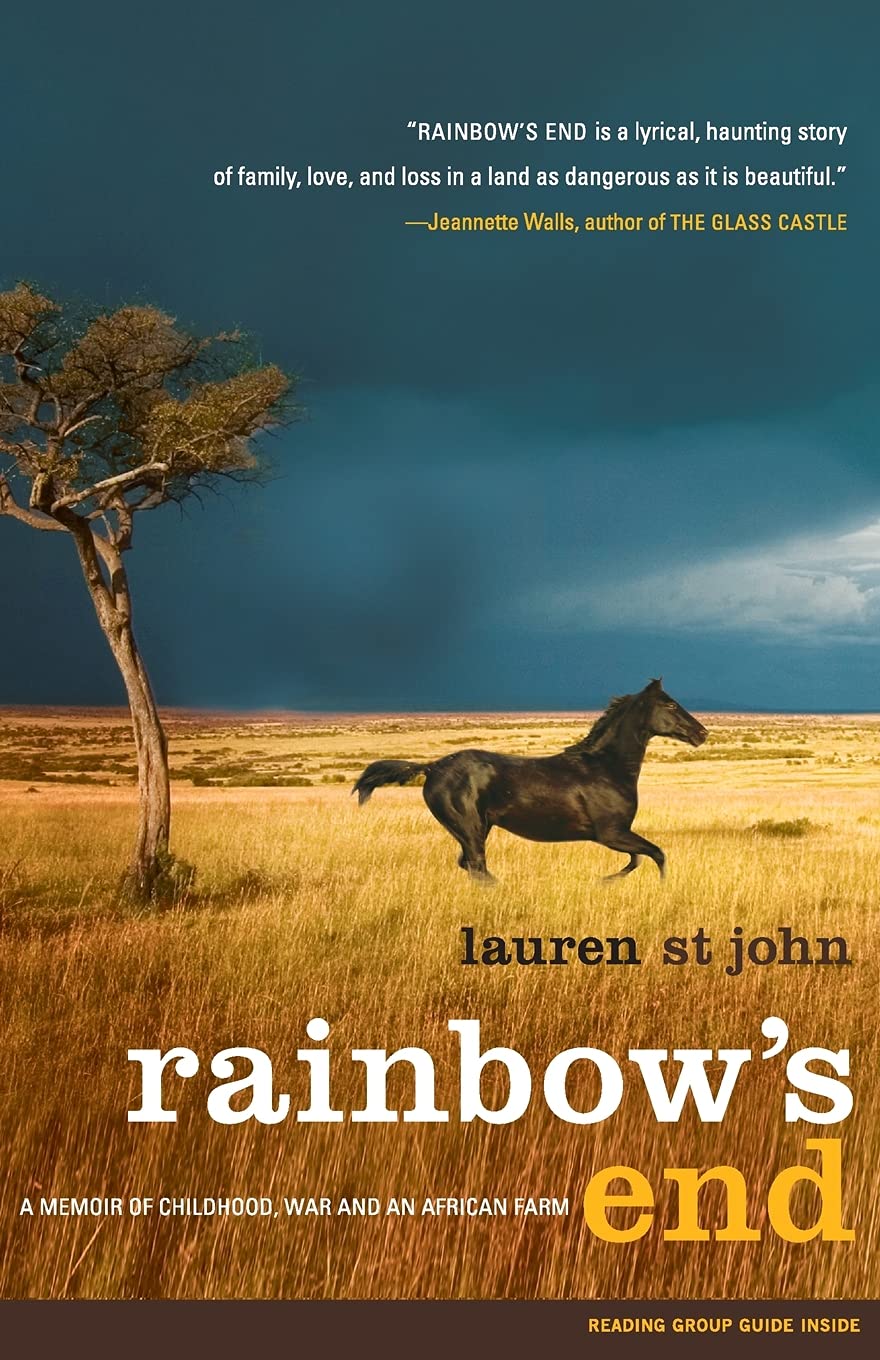



This is a story about a paradise lost. . . . About an African dream that began with a murder . . . In 1978, in the final, bloodiest phase of the Rhodesian civil war, eleven-year-old Lauren St John moves with her family to Rainbow's End, a wild, beautiful farm and game reserve set on the banks of a slowflowing river. The house has been the scene of a horrific attack by guerrillas, and when Lauren's family settles there, a chain of events is set in motion that will change her life irrevocably. Rainbow's End captures the overwhelming beauty and extraordinary danger of life in the African bush. Lauren's childhood reads like a girl's own adventure story. At the height of the war, Lauren rides through the wilderness on her horse, Morning Star, encountering lions, crocodiles, snakes, vicious ostriches, and mad cows. Many of the animals are pets, including Miss Piggy and Bacon and an elegant giraffe named Jenny. The constant threat of ruthless guerrillas prowling the land underscores everything, making each day more dangerous, vivid, and prized than the last. After Independence, Lauren comes to the bitter realization that she'd been on the wrong side of the civil war. While she and her family believed that they were fighting for democracy over Communism, others saw the war as black against white. And when Robert Mugabe comes into power, he oversees the torture and persecution of thousands of members of an opposing tribe and goes on to become one of Africa's legendary dictators. The ending of this beautiful memoir is a fist to the stomach as Lauren realizes that she can be British or American, but she cannot be African. She can love it -- be willing to die for it -- but she cannot claim Africa because she is white. " Rainbow's End is a lyrical, haunting story of family, love, and loss in a land as dangerous as it is beautiful." -- Jeannette Walls, author of The Glass Castle "Striding tall through Lauren St John's gorgeously written memoir is her father, and chapter after chapter their relationship is untangled and celebrated. Joy and a hunger for life infuse this book -- whether St John is writing about the harrowing years of Rhodesia's civil war, her childhood adventures in the bush, or the breaking apart of her family. Rainbow's End is a most generous and wise book." -- Lisa Fugard, author of Skinner's Drift Lauren St John was born in Gatooma, Rhodesia, now Kadoma, Zimbabwe, in December 1966. After studying journalism in Africa, she moved to London, where she was for many years golf correspondent to The Sunday Times . She is the author of several books on sports, the biography Hardcore Troubadour: The Life and Near Death of Steve Earle , and one children's novel, The White Giraffe . 1 Most people left Rhodesia to get away from the War. We came back for it. It was April 1975. One year after moving to South Africa to start a new life, we were in a car crammed with possessions and we were barreling once more into the indigo haze, into the thorny, blond bush, somewhere beyond which our next new life was waiting. Dad had a Peter Stuyvesant out in the air, twisting smoke, the twin gray lines of the strip road were tapering crazily into the horizon, and he was saying, categorically: "Two things got me down about Cape Town. One was the weather and the other was people telling me I'd run away from the War. I couldn't stand people saying I'd run away from the War." Which was ironic because it wasn't even his war. It had become his war only because in 1960 he happened to see a recruitment ad for the Rhodesian Army the same week he received his National Service papers in his home town of Uitenhage, South Africa, and he'd thought to himself: A chance to see another country! What a pleasure! Even though he was only eighteen and it would mean fighting for someone else's cause. And even though his family had been putting down roots in the Eastern Cape ever since their ship, buffeted by ice storms on the Thames in England and ocean winds in the Bay of Biscay, had docked at Algoa Bay with the 1820 Settlers. By the seventies the Rhodesian War had become Dad's war because he'd spilled blood for it and also because he'd married Mom, whose great-grandfather had been an associate of Cecil John Rhodes, who "discovered" Rhodesia. Her ancestry was full of stories about pioneering uncles walking barefoot from Durban to Bulawayo, more than a thousand miles, to save their shoes. Mom always said that Dad was Rhodesian from the moment he set foot in the country and saw how beautiful it was. Not that South Africa wasn't. In almost every way it was more blessed with visual splendor, more rich in natural resources, and unlike its landlocked northern neighbor, it had the ocean, steaming up to the coast in a smoking white rush. But something about the landscape of Rhodesia spoke to him. He liked its unshowy loveliness. He liked the way of life, and he liked the people, who for the most part didn't think there w