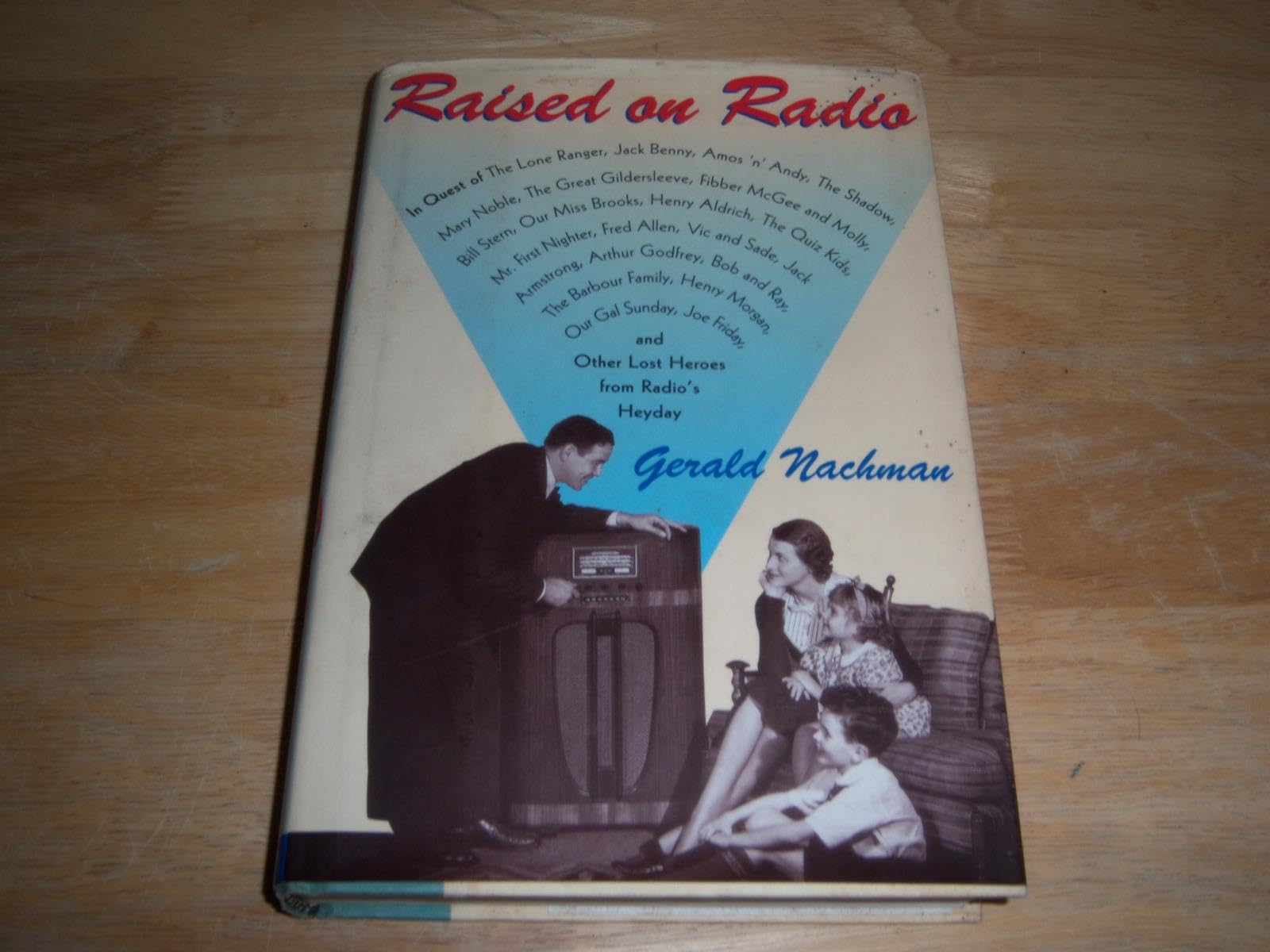



For everybody "raised on radio" -- and that's everybody brought up in the thirties, forties, and early fifties -- this is the ultimate book, combining nostalgia, history, judgment, and fun, as it reminds us of just how wonderful (and sometimes just how silly) this vanished medium was. Of course, radio still exists -- but not the radio of The Lone Ranger and One Man's Family , of Our Gal Sunday and Life Can Be Beautiful , of The Goldbergs and Amos 'n' Andy , of Easy Aces , Vic and Sade , and Bob and Ray , of The Shadow and The Green Hornet , of Bing Crosby, Kate Smith, and Baby Snooks, of the great comics, announcers, sound-effects men, sponsors, and tycoons. In the late 1920s radio exploded almost overnight into being America's dominant entertainment, just as television would do twenty-five years later. Gerald Nachman, himself a product of the radio years -- as a boy he did his homework to the sound of Jack Benny and Our Miss Brooks -- takes us back to the heyday of radio, bringing to life the great performers and shows, as well as the not-so-great and not-great-at-all. Nachman analyzes the many genres that radio deployed or invented, from the soap opera to the sitcom to the quiz show, zooming in to study closely key performers like Benny, Bob Hope, and Fred Allen, while pulling back to an overview that manages to be both comprehensive and seductively specific. Here is a book that is generous, instructive, and sinfully readable -- and that brings an era alive as it salutes an extraordinary American phenomenon. A sharp, nostalgic homage to the golden era of radio, told as both a memoir and a social history. Nachman, a columnist for the New York Times syndicate, attempts to explain just how radio came to define American pop culture from the 1920s to the '40s by examining the personalities, genres, and behind-the-scenes politics of network radio productions. As the earliest tycoons (like George Washington Hill of the American Tobacco Company and barn broadcaster Dr. Frank Conrad) contributed to radios availability and mass-market appeal, a boom began that drew talent of varying degrees and generated a patriotic hype not unlike that which surrounds todays information superhighway: radio was to be the American medium that would bring culture and democracy around the globe. Instead, it introduced advertising to the country and created the formatssoap operas, news, sports, variety, sitcom, and dramathat remain in popular entertainment to this day. Nachman recalls the 30 remarkable years of radios reign by remembering the programsinspired first by vaudeville, then by Broadwaythat he enjoyed as a child: from the sassy satirist Fred Allen (the David Letterman of radio) to the fluffy but arousing teen-girl dramas like Junior Miss. Mirroring the countrys domestic politics, radio programs of that era attempted to sweeten immigrant stereotypes and launch antiracist images of blacks (in what Nachman calls a rather thin rainbow coalition): the Italian immigrant comedy Life with Luigi, the blue-collar characters in The Life of Riley, and the Jewish family in The Goldbergs all told the immigrant story with bursts of ethnic humor and staunch American patriotism. Beulah, a show about a black maid, tried to honor black culture (while using white actorsa practice that happily died out early on). Still lovable despite its flaws, network radio through Nachmans eyes is a treat. A humorous account of a radiophiles memory and longing for the return of the lost era. -- Copyright ©1998, Kirkus Associates, LP. All rights reserved. ...[a] captivating, highly personal book.... With the amplitude of a Ken Burns television documentary and with the added asset of a keen sense of comic proportion, the author takes the reader step by step through the story of radio, which he calls "the ultimate populist medium." -- The New York Times , Mel Gussow ...an adoring, nostalgic, and anecdote-stuffed history of radio's golden age.... Nachman has a superb knack for ... vivid shorthand description, which keeps the book briskly moving along. -- The Boston Globe , Scott Alarik Clearly Nachman ... did extensive research and conducted many interviews, and he has spared the reader few of his findings. -- The New York Times Book Review , Ruth Bayard Smith y "raised on radio" -- and that's everybody brought up in the thirties, forties, and early fifties -- this is the ultimate book, combining nostalgia, history, judgment, and fun, as it reminds us of just how wonderful (and sometimes just how silly) this vanished medium was. Of course, radio still exists -- but not the radio of The Lone Ranger and One Man's Family , of Our Gal Sunday and Life Can Be Beautiful , of The Goldbergs and Amos 'n' Andy , of Easy Aces , Vic and Sade , and Bob and Ray , of The Shadow and The Green Hornet , of Bing Crosby, Kate Smith, and Baby Snooks, of the great comics, announcers, sound-effects men, sponsors, and tycoons. In the late 1920s r