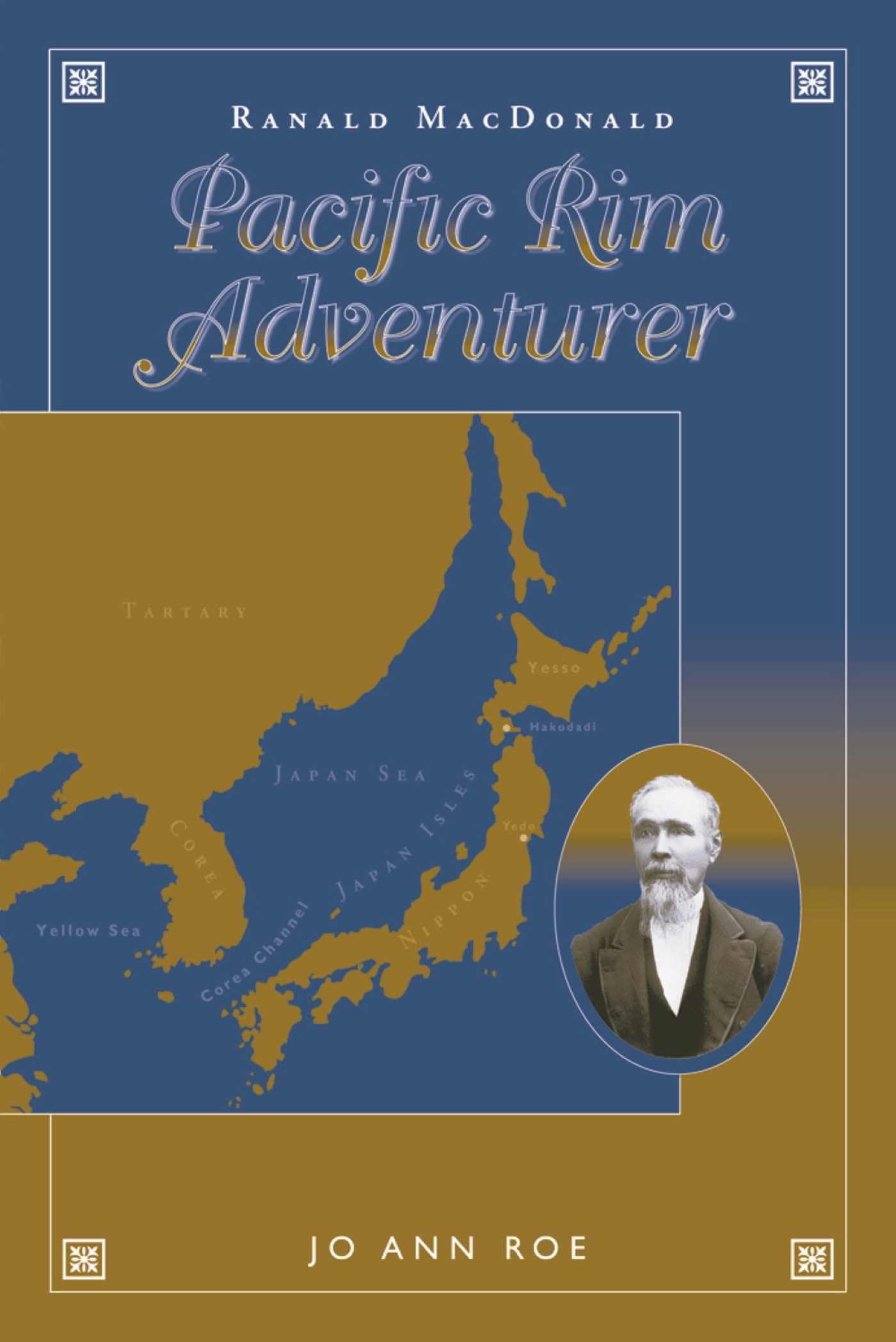



Noted regional author Jo Ann Roe has written the definitive biography of Ranald MacDonald (1824-94), an Old Oregon Country resident who entered forbidden Japan in 1848 at great risk of death and certain imprisonment. MacDonald was the son of a Hudson’s Bay Company (HBC) official and his Indian wife from the Chinook tribe. In the 1830s, as a youngster at the HBC’s Ft. Vancouver and Red River schools, MacDonald became fascinated with stories about the little-known Japanese. This interest, no doubt, was stimulated by reports in 1833-34 of storm-swept Japanese sailors shipwrecked on the Olympic Peninsula and captured by Indians, but later released to HBC officials. Consequently, in 1848, 24-year-old MacDonald arranged with the captain of an American whaling ship to be cast off in a rowboat on the northern Japanese coast. Interned but escaping execution, MacDonald was ordered to teach English to Japanese students. After nearly a year in captivity, he received permission to leave Japan in 1849 with other American sailors stranded on the forbidden coast. Later, several of MacDonald’s Japanese students interpreted for Commodore Perry when the U.S. Navy forced a not entirely unwilling Japan to open its doors to outsiders in the 1850s. MacDonald next traveled over much of Asia, Europe, and Canada, before returning to the Pacific Northwest in 1858, where he resided for the rest of his life, but not without adventure. MacDonald joined a daring exploration of Vancouver Island, and became involved in other developments in the Pacific Northwest region. Today, his grave in northeast Washington is recognized as a state park heritage site. In Japan on Rishiri Island, Japanese historical enthusiasts have erected a monument and interpretive marker to commemorate the site where the brave Oregonian landed. “Another outstanding contribution to the record of Northwest history by Washington State University Press.” -- Associated Press “As Jo Ann Roe ably demonstrates, Ranald MacDonald should have been knighted. Few individuals have greater accomplishments and fewer accolades to their credit. An incurable traveler in the mold of Sir Richard Burton, MacDonald fit the profile of the classic nineteenth-century explorer of distant lands and people. The author vividly depicts the scenes of a bygone world―whaling ships on the high seas; regal, isolated Japan; the teeming docks of Hong Kong; Hawaiian royalty and far-off Guam; gold rushes in Australia and the Cariboo, British Columbia; South American Ports; Rome, Paris, and London; unexplored Vancouver Island; and the bustling trading post at Fort Colville, Washington Territory.” --Craig Holstine, author, Forgotten Corner: A History of the Colville National Forest, Washington Ranald MacDonald, a solitary venturer, entered secretive Japan in 1848, risking certain imprisonment, if not death, in the closed kingdom. Born at Astoria on the banks of the Columbia River, MacDonald (1824-94) was the son of a high-ranking Chinook woman and a Hudson's Bay Company official. He became fascinated with stories about the little-known Japanese while a youngster at the HBC's Ft. Vancouver and Red River schools. In 1848, 24-year-old MacDonald arranged with the captain of an American whaling ship to be cast off in a rowboat on the cold, northern Japanese coast. Interned but escaping execution, MacDonald was sent by high-ranking Japanese officials to more populous parts of the country and ordered to teach English to Japanese translators. After nearly a year in captivity, he was released along with a small group of other American sailors stranded on the forbidden coast. In the 1850s, several of MacDonald's Japanese interpreters served in key roles when Commodore Perry of the U.S. Navy forced a not entirely unwilling Japan to open its doors to the outside world. MacDonald's wandering spirit led him throughout Asia, Australia, Europe, and eastern Canada, before returning to the Pacific Northwest in 1858, where he lived for the rest of his life, but not without further adventures. He joined a difficult exploration of Vancouver Island, and, for many years, participated in the gold excitement of Canada's Fraser and Cariboo districts. Jo Ann Roe published eight books and more than 400 articles on regional travel and history in scores of magazines and newspapers, winning awards from the Washington Press Association, the National Federation of Press Women, the National Writer’s Club, as well as the Washington Governor’s Writers Award for her biography of Frank Matsura. Used Book in Good Condition