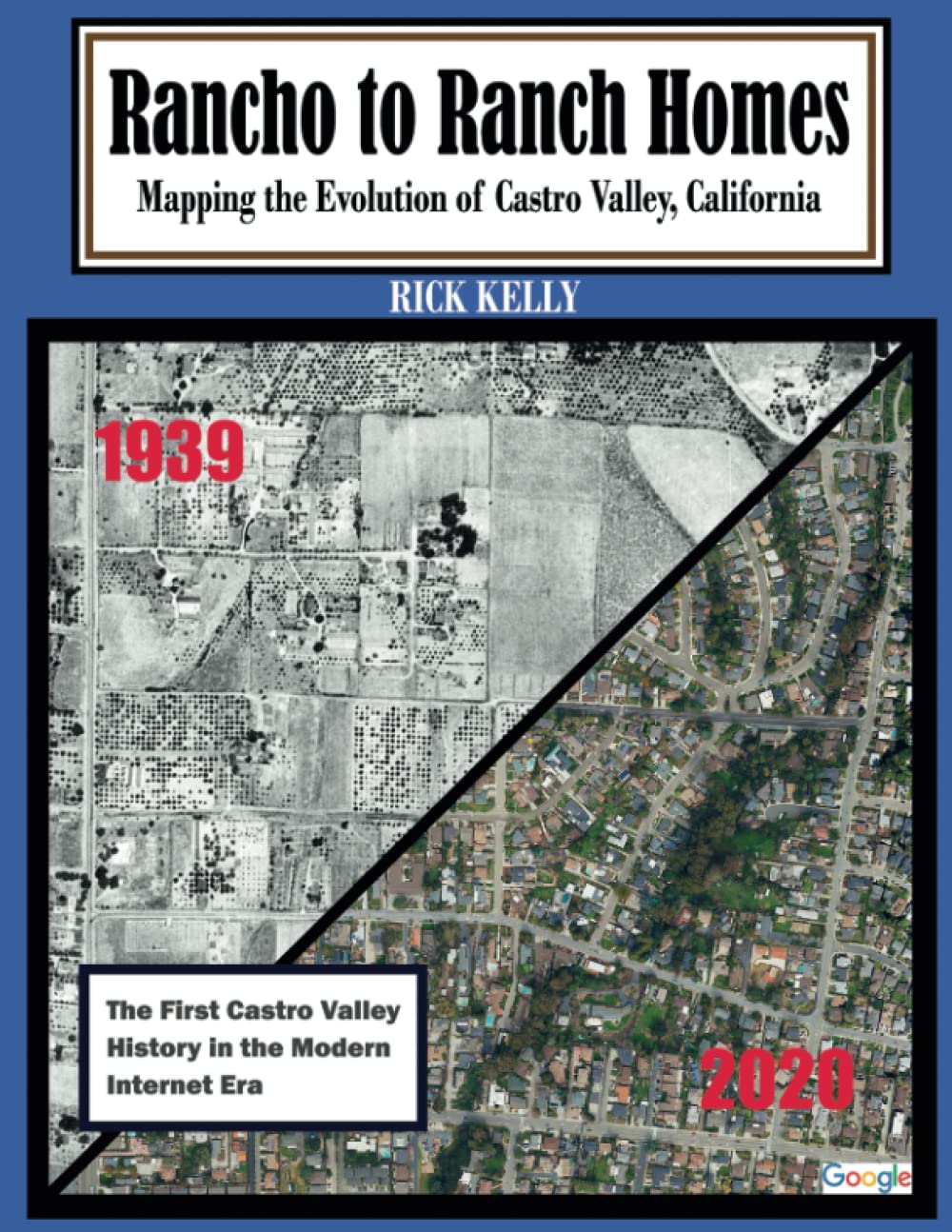
Rancho to Ranch Homes: Mapping the Evolution of Castro Valley, California
$44.00
by Richard J Kelly



A New History of Castro Valley, California: This new book details the evolution of Castro Valley from a Native American territory to a modern commuter suburb. The author took advantage of the vast wealth of information available on the modern internet--e.g., ancestry.com, newspapers.com, archive.org, Hathitrust.org, Google Books, historicaerials.com, the Huntington Library Early California Population database and the University of California at Santa Barbara historic aerial photography database. He also extracted information and many images from the archives at the Bancroft Library at the University of California at Berkeley, the Hayward Area Historical Society, the California Historical Society, the Alameda County Public Works Agency and Recorder's Office, the Library of Congress and the Alameda County and Contra Costa County library systems. Using old obituaries and the recently released 1950 census, he was able to track down living descendants of many of the Valley pioneers, gaining access to their family histories and old family photos. The book recounts the failure of the California Mission system to achieve its primary assigned goal and the subsequent usurpation of its property by the government of the Mexican Territory of Alta California. It presents the complex history of namesake Guillermo Castro's acquisition of Castro Valley and surrounding areas as the Rancho San Lorenzo in 1843. After the Gold Rush, squatters started to fill Castro's rancho, their names and locations are revealed for the first time. The work includes hundreds of photographs and maps showing how Castro's ranch was subdivided over and over as agricultural practices evolved--first for grain farms, then successively for fruit/vegetable farms and chickens. The transition to smaller fruit raising farms in the 1880's attracted many well-to-do businessmen from Oakland and San Francisco who built summer or retirement homes in town. As intensive chicken ranching took hold after 1905, families of more modest means moved to Castro Valley to pursue that relatively low-overhead branch of agriculture. Unlike surrounding towns long served by mass transit, Castro Valley avoided extensive conversion to suburban homes until the outbreak of World War II. The transition to suburbia is covered in detail, including the frantic building of defense homes for critical war industry workers, the following "GI Home" era, and the remarkably piecemeal conversion of chicken ranches to ranch homes. Topics include the history of the library, water supply, sewers, mass transit, highways, bridges, schools, newspapers and Eden Hospital. Castro Valley's participation in "White Flight" and the concurrent discrimination against African American residents is described. Twenty eight pages are dedicated to the many efforts to incorporate Castro Valley as a city or to annex it to Hayward or San Leandro--the history is much more involved than most residents imagine. Many of the photographs have never been published, including the recently discovered photograph of namesake Guillermo Castro from 1852. Most of the maps dating back to 1855 were only made readily accessible by the County in 2016 and have never before been published. Biographies are included for many of the towns important residents, often with photographs provided by descendants identified by the author. The book includes eight appendices providing detailed information on the provenance of road names, tract subdivisions and agricultural practices. Over 1000 references and endnotes are presented to facilitate further research. The final chapter includes examples of the towns history that have been preserved, lost or are at risk. The book closes with a brief discussion of the uncertain future of Castro Valley in view of the ongoing California housing shortage.