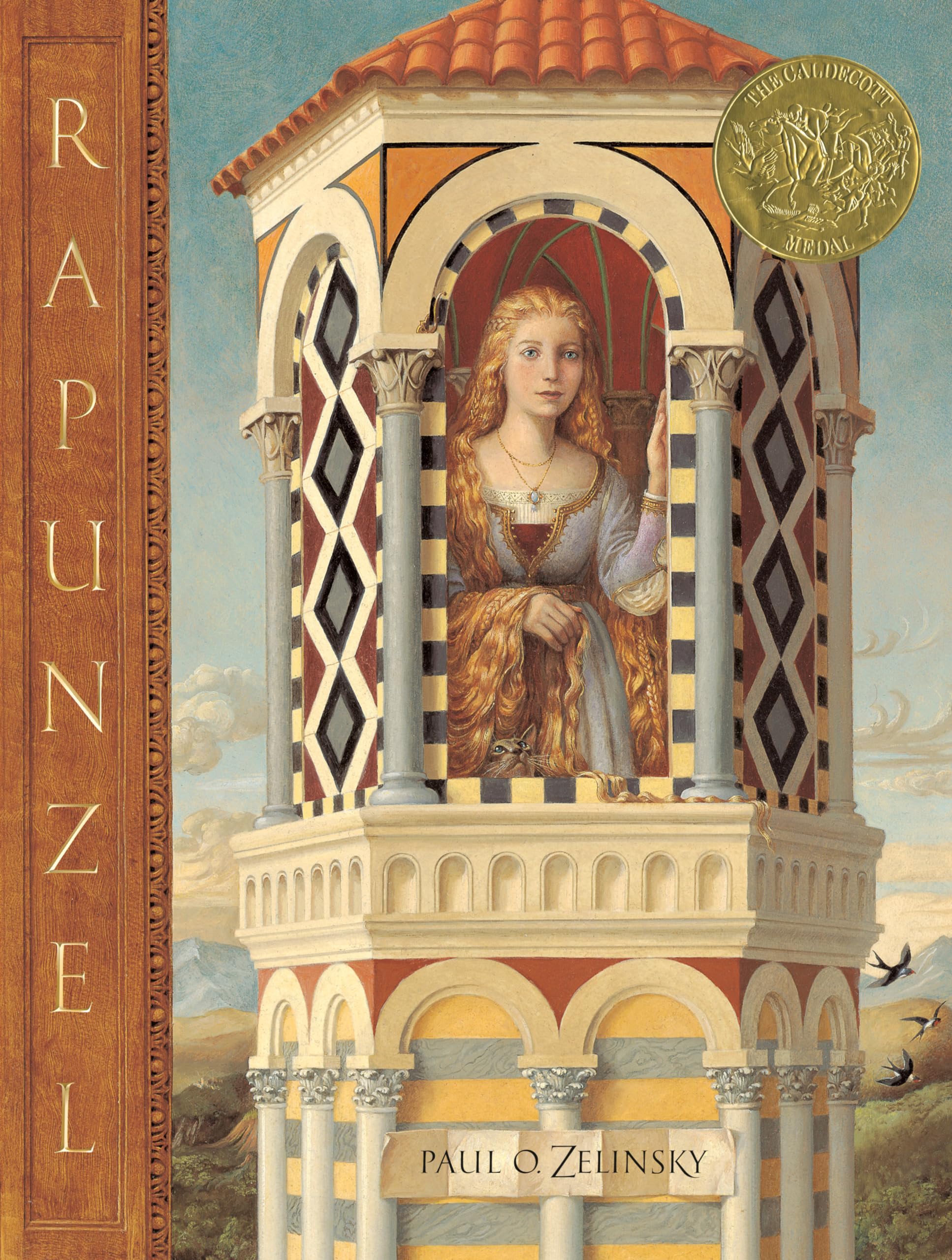



Surely among the most original and gifted of children's book illustrators, Paul O. Zelinsky has once again with unmatched emotional authority, control of space, and narrativecapability brought forth a unique vision for an age-old tale. Few artists at work today can touch the level at which his paintings tell a story and exert their hold. Zelinsky's retelling of Rapunzel reaches back beyond the Grimms to a late-seventeenth-century French tale by Mlle. la Force, who based hers on the Neapolitan tale Petrosinella in a collection popular at the time. The artist understands the story's fundamentals to be about possessiveness, confinement, and separation, rather than about punishment and deprivation. Thus the tower the sorceress gives Rapunzel here is not a desolate, barren structure of denial but one of esoteric beauty on the outside and physical luxury within. And the world the artist creates through the elements in his paintings the palette, control of light, landscape, characters, architecture,interiors, costumes speaks to us not of an ugly witch who cruelly imprisons a beautiful young girl, but of a mother figure who powerfully resists her child's inevitable growth, and of a young woman and man who must struggle in the wilderness for the self-reliance that is the true beginningof their adulthood. As ever, and yet always somehow in newly arresting fashion, Paul O. Zelinsky's work thrillingly shows us the events of the story while guiding us beyond them to the truths that have made it endure. In older versions of the classic tale Rapunzel , it always seemed improbable that a grown man could scale a tower using only his beloved's hair. Not so in Paul O. Zelinsky's Caldecott Medal-winning version of Rapunzel . Here, Rapunzel's reddish-blonde mane is thick with waves and braids, and cascades like a waterfall down the walls of her isolation tower. In Zelinsky's able hands it's easy to believe that a prince would harbor no hesitations about scrambling up our fair heroine's hair. Of course, this is not the work of an amateur--Zelinsky's lush versions of Hansel and Gretel , Rumpelstiltskin , and Swamp Angel all earned him Caldecott Honors. His gorgeous, Italian Renaissance-styled illustrations are characterized by warm golden tones and the mesmerizing sensation of trompe l'oeuil . Not only does he have the touch of a world-class illustrator, Zelinsky has also proven himself a master storyteller. We are frightened when the sorceress demands to take the baby Rapunzel, we are alarmed when the flowing locks are cruelly shorn, and we rejoice when the prince and his now modest-haired love are reunited. The notes at the back of Rapunzel reveal his careful scholarship regarding the long history of the story (tracing its origins and transformations from Italy to France and finally to Germany and the Grimm brothers)--work that no doubt contributed to his clean, compelling version of the age-old tale. Children will be captivated by the magical story and evocative pictures and adults will delight in the fresh feel of a well-loved legend. (Click to see a sample spread. Illustration © 1997 by Paul O. Zelinsky, published by Dutton Children's Books, a division of Penguin Putnam Books for Young Readers.) (Ages 4 and older) Kindergarten-Grade 3. An elegant and sophisticated retelling that draws on early French and Italian versions of the tale. Masterful oil paintings capture the Renaissance setting and flesh out the tragic figures. Copyright 1997 Reed Business Information, Inc. Exquisite paintings in late Italian Renaissance style illumine this hybrid version of a classic tale. As Zelinsky (The Wheels on the Bus, 1990, etc.) explains in a long source note, the story's Italian oral progenitor went through a series of literary revisions and translations before the Brothers Grimm published their own take; he draws on many of these to create a formal, spare text that is more about the undercurrents between characters than crime and punishment. Feeling ``her dress growing tight around her waist'' a woman conceives the desire for an herb from the neighboring garden--rendered in fine detail with low clipped hedges, elaborate statuary and even a wandering pangolin--that causes her to lose her child to a witch. Ensconced for years in a tower, young Rapunzel meets the prince, ``marries'' him immediately, is cast into the wilderness when her own dress begins to tighten, gives birth to twins, and cures her husband's blindness with her tears at their long-awaited reunion. Suffused with golden light, Zelinsky's landscapes and indoor scenes are grandly evocative, composed and executed with superb technical and emotional command. (Picture book/folklore. 8-10) -- Copyright ©1997, Kirkus Associates, LP. All rights reserved. By filling his illustrations with visual fine points and making them historically specific, Zelinsky also reminds readers of the idea that this story, or something like this story, actually could have happened. ( Ag