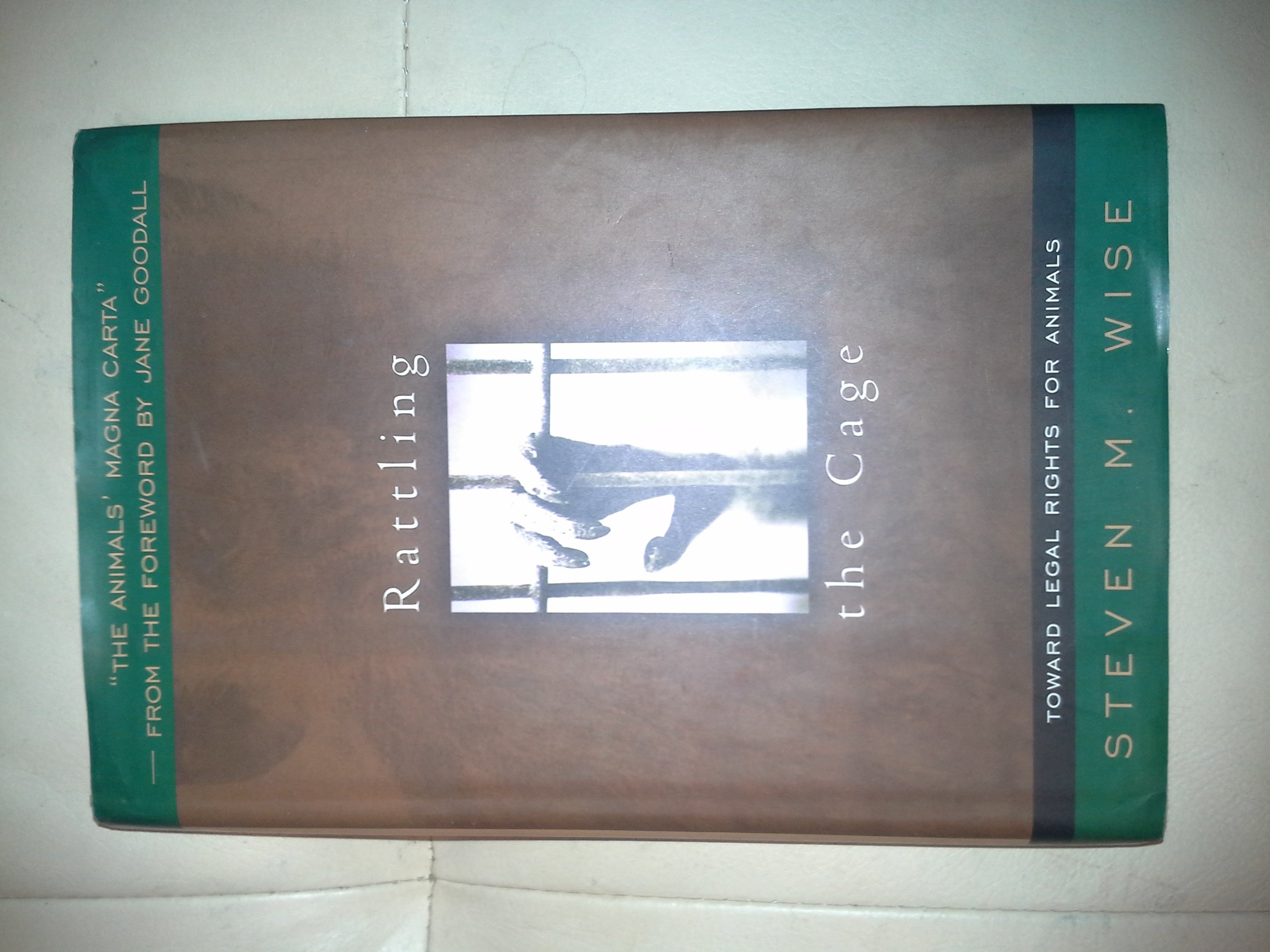



While the popular animal rights movement gains ever-increasing momentum, in the courts the dark ages prevail. The evolution of law that has brought fundamental rights to the most defenseless humans has yet to begin for other species. A human lost in a permanent vegetative state enjoys a large array of legal rights. But a chimpanzeea creature who can communicate with language, count, understand the minds of others, feel a variety of emotions, live in a complex culture, and make and use toolshas no rights at all.Steven Wise, who has worked and communicated with the world's most prominent primatologists, demonstrates that, based on the latest scientific findings, the cognitive, emotional, and social capacities of at least chimps and bonobos entitle them to freedom from imprisonment and abuse. His path-breaking, witty, and impeccably researched book has everything needed to convince judges, scientists, lawyers, and the millions of others who simply care about animals of the injustice of denying them basic legal rights. Steven Wise has spent his legal career in courts across the United States, championing the interests of dogs, cats, dolphins, deer, goats, sheep, African gray parrots, and American bald eagles. In Rattling the Cage , Wise--who teaches "animal rights law" at several academic institutions, including Harvard Law School--presents a thorough survey of the legal, philosophical, and religious origins of humankind's inhumanity toward citizens of the animal kingdom. Wise's devotion for animals is evident as he explains how the bigoted notion that nonhuman creatures possess mere instrumental value rather than intrinsic value has led to their worldwide enslavement for human benefit. Rattling the Cage offers Wise's argument to secure the blessings of liberty for chimpanzees and bonobos. Despite the cognitive, emotional, social, and sexual sophistication exhibited by both species, Wise acknowledges that advocating the legal personhood of what others might consider hairy little beasts leaves him vulnerable to ridicule and marginalization as a fringe academic. He compares his struggle to that of Galileo, recognizing that anachronistic cultural and religious beliefs may disable modern judges from ruling according to correct principles just as the irrational convictions of Galileo's contemporaries forced them to cling to an Earth-centered universe that no longer existed. "Think of a Fundamentalist Protestant faced with a decision about teaching evolution in the public schools or a Roman Catholic deciding a question of abortion rights," Wise suggests, then turns the rhetoric up a notch: "Is it surprising that Nazi judges dispensed Nazi justice and that racist judges dispensed racist justice?" Wise seems certain, though, that our concept of justice eventually will evolve to the point where no chimp or bonobo will be deprived of life, liberty, or property without due process of law--perhaps the best for which any primate can hope, at least until apes preside over courts to administer a justice of their own making. --Tim Hogan Animal rights law is an emerging field that has received some press recently since Harvard Law School announced its first course in animal law. A dozen law schools already have courses, and one, Lewis and Clark College's Northwestern School of Law, has published the periodical Animal Law since 1995. Wise, who teaches the Harvard course, is a prominent animal rights lawyer and activist. He begins his book with a survey of the legal treatment of animals from ancient times to the present, examines the nature of consciousness, and concludes with a discussion of human rights. Wise offers both a reasoned treatise and a compelling argument for according rights, specifically "legal personhood," to chimpanzees and bonobos, with whom we share over 98 percent of our DNA structure. This important and provocative book should be on all library shelves. -Peggie Partello, Keene State Coll. Lib., NH Copyright 2000 Reed Business Information, Inc. Nonhuman animals are not "persons" in the legal sense and therefore have no legal rights. Wise, an animal rights activist and lawyer, argues for the entitlement of animals to legal rights in this scholarly new book. The author defines exactly what is meant by legal personhood through an overview of cases involving humans and demonstrates how this definition can be applied to animals, specifically chimpanzees and bonobos. The book's title is somewhat misleading, as the vast majority of the author's arguments refer to these two great apes, our closest relatives. The parallels drawn between legal arguments for human rights and research showing that apes demonstrate the same mental capacities as the human persons make for a compelling argument against the injustice of denying basic legal rights to apes. The text is extensively footnoted with quotes from a vast body of literature, legal and otherwise. Whether or not readers are convinced by Wise's arguments, they w